
In This Article
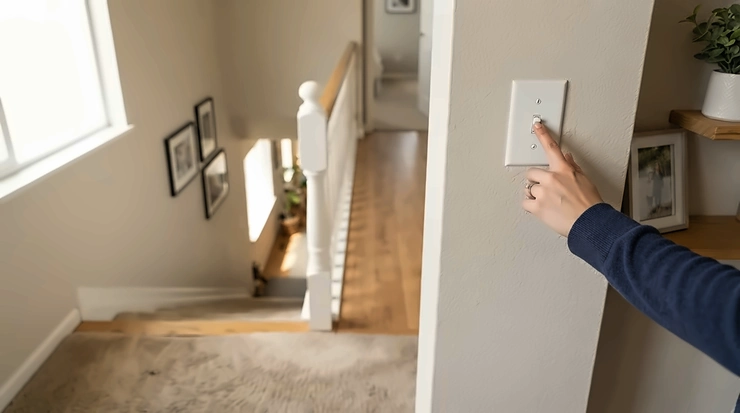
Picture the 2am dash to the loo. One eye open, one hand on the banister, and a single pendant at the top of the stairs throwing your own shadow over every tread. That’s the moment staircase wall lights earn their keep. They sit low, they wash light across each step, and they let you see the nosing (the front edge of the tread) rather than guess at it.
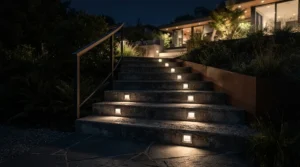
The stakes are higher than most people assume. RoSPA estimates that over 700 people die and more than 43,000 are hospitalised each year in England after falls on stairs, according to research published by the Health and Safety Executive. Lighting isn’t the only factor, but it’s one of the cheapest to fix. A well-chosen set of staircase wall lights costs less than a decent pair of trainers.
This guide covers seven real fittings, from budget to premium. It also explains how recessed stair step lights differ from surface-mounted options, and what to weigh for proper stairwell lighting. Further on you’ll find the building-regulations picture, a plain-English take on two-way switching, and a fix for glare on stairs, the problem that quietly ruins many otherwise good installations.
One honest note first. Stock, sellers and pack sizes on amazon.co.uk change constantly. Always confirm the exact model code on the listing before you order.
Quick Comparison: Staircase Wall Lights at a Glance
| Product | Standout spec | Price range | Best For |
|---|---|---|---|
| Knightsbridge NH020 | IP54, 80mm round, 50mm recess depth | Under £25 | Tight budgets, hallways and landings |
| Ultrabeam LSL002 | 1W mini round, brushed aluminium | Check current price (varies by pack) | Lots of small fittings, one per step |
| Hera Wall F | 0.9W, direct 230V, through-wiring | Mid-£40s | Neat, even light with no visible light point |
| ORION Stairs 7255352 | 185 lumens, 3000K, die-cast aluminium | Around £50-£60 | Dependable all-rounder |
| Collingwood STEPBEAM30 | CRI 90, 5-year guarantee | £40-£55 range | Better colour rendering at a fair price |
| Collingwood WL340 | Asymmetric, straight to mains, IP65-IP67 | High-£200s to mid-£300s | Bathrooms, outdoor steps, long warranty |
| Brilliant Lighting LD47 | Extremely low glare, 20° tilt, 126 lumens | From around £150 | Glare-sensitive eyes, showpiece stairs |
The Knightsbridge NH020 and the ORION Stairs 7255352 are the sensible starting points for most homes. They’re cheap enough to fit one per step or every other step without wincing. If your priority is cutting glare on stairs for older eyes, the Brilliant Lighting LD47 justifies its premium. The Collingwood WL340 is the odd one out: it’s priced as a long-term, damp-proof fitting, so only buy it if you need that.
💬 Just one click — help others make better buying decisions too!😊
Top 7 Staircase Wall Lights: Expert Analysis
These seven span budget, mid-range and premium. Each analysis below rests on published specifications and is framed as reasoning, not hands-on testing. Prices are ranges only, so check the current price on the listing.
1. Knightsbridge NH020 — best budget guide light
This is a miniature round recessed fitting that does one job cheaply: it marks the way. The listing shows an 80mm diameter, a 50mm recess depth and a die-cast aluminium body. It’s Class II (double-insulated, so no earth needed) and rated IP54, which gives it splash protection.
In practice, 50mm of depth means it should fit most standard plasterboard walls and typical 45mm-style recessed boxes, though you should confirm the box requirement on the listing. At roughly 3mm of projection, it’s flush enough that you won’t catch a sleeve on it.
On paper this suits anyone fitting a whole flight on a budget. You’d trade finesse for coverage. Light quality and beam control at this price are basic, so expect a soft pool of light rather than a crisp wash.
I couldn’t verify a meaningful pool of amazon.co.uk reviews for this exact model at the time of research. Read the three-star reviews on the live listing first, because they tend to be the most candid about glare and brightness.
Pros:
- ✅ Very low cost per step
- ✅ Shallow 50mm recess depth
- ✅ IP54 gives some splash protection
Cons:
- ❌ Basic light quality and beam control
- ❌ Dimming support is not clearly stated
Under £25 per fitting is strong value for guide lighting, but not for proper task lighting.
2. Ultrabeam LSL002 — best for one-light-per-step layouts
The LSL002 is a 1W round mini recessed LED in brushed aluminium. It’s sold for step and stair riser use, and the maker positions it for installation in multiples along a staircase. That detail shapes how you should think about it.
A 1W LED is a gentle source. One fitting won’t flood a landing, but one per riser builds a rhythm of small pools of light that outline every tread. That’s the logic behind recessed stair step lights generally: many modest sources beat a few bright ones, because you avoid hot spots and deep shadows.
If your staircase is straight and boxed in by walls on both sides, this approach suits you well. If you have a floating or open-sided staircase, you’ll have nowhere to recess into, so look elsewhere.
I couldn’t verify review data for this specific model. If you buy it, note whether the listing is for a single fitting or a pack, because cost per step is the real comparison.
Pros:
- ✅ Compact 1W unit suits per-step layouts
- ✅ Brushed aluminium finish looks tidy
- ✅ Low power draw across a full flight
Cons:
- ❌ Too gentle for wide landings alone
- ❌ Pack sizes make price comparison fiddly
Check current price against the number of fittings per pack before judging value.
3. Hera Wall F — best for even, dot-free light
The Wall F is a 0.9W warm-white fitting with a stainless-steel-look frame. It connects directly to 230V with no transformer, which cuts the hardware you need behind the wall. The listing describes it as fitting flush-mounted or cavity wall boxes, and it includes a plug-in terminal for through-wiring.
Through-wiring matters on a staircase. You can daisy-chain fittings from one to the next, so you aren’t running a separate cable back to a junction for every step. That saves real time for an electrician, which is worth weighing against the fitting price.
The product copy says no light points are visible and the output is very homogeneous. I’d read that as a deliberate effort to reduce hot-spotting. It’s a good match for people who find bare LED dots harsh.
Where it falls down is brightness. 0.9W is low, so you’ll probably want a fitting on every step, or every other step with a second light source elsewhere. Review sentiment couldn’t be verified for this model.
Pros:
- ✅ Direct 230V connection, no transformer
- ✅ Through-wiring terminal simplifies runs
- ✅ Even, low-glare light output
Cons:
- ❌ Low wattage needs close spacing
- ❌ Mid-range price per fitting adds up
Around the mid-£40s: fair value if wiring convenience matters to you.
4. ORION Stairs 7255352 — best dependable all-rounder
This grey die-cast aluminium fitting is made specifically for stairways and corridors. The listing gives 185 lumens, a 3000K warm white, IP20 (indoor only), Class II and a 230V supply. It isn’t dimmable.
185 lumens from one fitting is meaningful. That’s bright enough that fitting it every second or third step can still give continuous coverage, which makes it economical on a longer flight. The 3000K colour temperature is warm without being yellow, so it sits comfortably against most hallway paint.
The IP20 rating is the catch. It isn’t suitable for damp spaces, so keep it to dry interior stairs. And because it isn’t dimmable, you’ll want to think about brightness at night. A fitting that’s perfect at 7pm may feel punchy at 3am.
Reviews for this exact model weren’t verifiable at the time of research, so lean on the specification and check recent buyer comments on the listing.
Pros:
- ✅ 185 lumens covers more than one step
- ✅ Purpose-made for stairways and corridors
- ✅ Warm 3000K colour temperature
Cons:
- ❌ Not dimmable
- ❌ IP20 means indoor, dry areas only
Around £50-£60 is fair for a purpose-built stair fitting.
5. Collingwood STEPBEAM30 — best colour rendering for the money
The standout number here is CRI 90. Colour rendering index measures how faithfully a light shows colours, so a high figure means skin tones, wood treads and carpet look natural instead of washed out. The listing also gives 2.7W, 3000K, a 30° to 45° beam, an L70 lifetime of 50,000 hours, and a five-year guarantee.
That lifetime figure is worth translating. At six hours of use a day, 50,000 hours is more than 20 years of service, though real-world driver failures can come sooner. A five-year guarantee backs the claim up better than a marketing line does.
The 30° to 45° beam is a narrow-to-medium throw, which suits fitting every second step. It’s the choice I’d steer towards if your staircase is carpeted in a mid-tone and you want the light to look rich rather than clinical. Energy class D is typical for small LED wall fittings.
I couldn’t verify review sentiment for this model on amazon.co.uk.
Pros:
- ✅ CRI 90 renders colours naturally
- ✅ Five-year guarantee
- ✅ Long 50,000-hour lifetime rating
Cons:
- ❌ Narrow beam needs sensible spacing
- ❌ Dimming isn’t confirmed on the listing
The £40-£55 range makes it good value for the guarantee and light quality alone.
6. Collingwood WL340 — best for damp areas and long warranties
The WL340 is a marker-style step light that connects straight to mains. It draws 2.6W, with an asymmetric distribution and a brushed stainless finish. Listings show IP67 on one variant and IP65 on others. The WL340WW listing quotes a seven-year guarantee and no dimming.
Asymmetric means the optic throws light forward and down, instead of in a circle. On a stair wall, that’s what you want: light onto the tread, not back into your eyes. That directly reduces glare on stairs.
The IP rating is the main reason to pay more. An IP65 to IP67 fitting survives damp, so it works for external steps, a cellar stair, or a bathroom-adjacent landing. For a dry hallway it’s overkill, and the price reflects that.
Review sentiment wasn’t verifiable. Match your finish to the exact variant code, since IP ratings differ between them.
Pros:
- ✅ High IP rating for damp areas
- ✅ Asymmetric optic limits glare
- ✅ Long guarantee on the quoted variant
Cons:
- ❌ Much pricier than indoor alternatives
- ❌ Not dimmable
A high-£200s to mid-£300s range is hard to justify unless you need the weather protection.
7. Brilliant Lighting LD47 — best for low glare
The LD47 is described as a discreet, extremely low glare fitting with a recessed optic and a 20° tilt. It delivers 126 lumens and works indoors or outdoors.
Two details matter. The recessed optic means the LED sits back inside the housing, so you can’t see the bright source from a normal angle. The 20° tilt aims light downward onto the tread, away from your eyeline. Together they’re a textbook answer to glare on stairs.
Lower lumens than the ORION Stairs 7255352 (126 versus 185) is a fair trade here. You’re paying for how the light is delivered, not how much of it there is. For older users with sensitive eyes, or anyone who dislikes seeing bright pinpoints on the wall, that matters more than raw output.
I couldn’t verify amazon.co.uk review data. The manufacturer’s range includes several siblings (the LD42W, LD42A, LD47 and LD48), so double-check the model code.
Pros:
- ✅ Recessed optic hides the light source
- ✅ 20° tilt directs light onto treads
- ✅ Suits indoor and outdoor use
Cons:
- ❌ Premium price per fitting
- ❌ Modest 126 lumens needs close spacing
From around £150 each, it’s an investment, best on a statement staircase where glare control is a priority.
Detailed Spec Comparison
| Product | Wattage | Brightness / beam | Rating | Dimmable |
|---|---|---|---|---|
| Knightsbridge NH020 | Not quoted here | Soft guide light | IP54 | Not stated |
| Ultrabeam LSL002 | 1W | Gentle, per-step | Not stated | Not stated |
| Hera Wall F | 0.9W | Even, homogeneous | Not stated | Not stated |
| ORION Stairs 7255352 | Not quoted | 185 lm | IP20 | No |
| Collingwood STEPBEAM30 | 2.7W | 30°-45° beam | Not quoted | Not stated |
| Collingwood WL340 | 2.6W | Asymmetric | IP65-IP67 | No |
| Brilliant Lighting LD47 | Not quoted | 126 lm, 20° tilt | Not quoted | Not stated |
The gaps in this table are deliberate: where a spec wasn’t confirmed in the sources I found, I’ve said so instead of guessing. If dimming is a must-have, confirm it on the live listing before ordering. Among the options here, the Collingwood STEPBEAM30 and the Brilliant Lighting LD47 look strongest on light quality, while the ORION Stairs 7255352 wins on brightness per pound.
What Are Staircase Wall Lights?
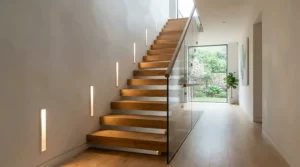
Staircase wall lights are low-level or wall-mounted fittings, either recessed into the wall or surface-fixed beside the stairs, that light the treads and nosings from the side. They improve step visibility after dark, reduce the shadows cast by overhead lighting and, when chosen well, add atmosphere without glare.
There are three broad families. Recessed fittings sit inside the wall and are almost invisible by day. Surface-mounted wall lights project slightly and are often decorative. Strip and under-stair lighting is a third option, covered below. In practice, recessed stair step lights suit narrow, enclosed flights, because there’s nothing to bump into on the way up.
The mental model I find useful is this: ceiling lights tell you a staircase exists, while wall-level lights tell you where each step is. For safe stairwell lighting you usually want both, with the wall lights doing the precise work.
How to Choose Staircase Wall Lights
- Decide recessed or surface-mounted. Recessed needs wall depth (the Knightsbridge NH020 wants around 50mm) and works best in plasterboard. Surface-mounted suits solid or awkward walls.
- Check the brightness, not just the wattage. Lumens tell you what you’ll see. A 185-lumen unit like the ORION Stairs 7255352 covers more than a 0.9W unit like the Hera Wall F.
- Pick warm white. Around 2700K-3000K is easier on the eyes at night and flatters most hallways.
- Look at the beam. A downward or asymmetric beam keeps light on the tread and out of your eyes.
- Match the IP rating to the location. IP20 is fine for dry hallways; use IP65 or higher for damp or exterior steps.
- Confirm dimming and driver details. Not every fitting is dimmable, and the wrong dimmer can cause flicker.
- Check the guarantee. A five-year (Collingwood STEPBEAM30) or seven-year (Collingwood WL340, quoted variant) guarantee tells you what the maker expects.
Work through these in order. Most buyers get steps three and four wrong, picking by looks first and discovering glare second.
Stair Lighting Building Regulations: What UK Homeowners Should Know
This is an area where you should read carefully, because the rules differ across the UK and I can’t promise a single rule applies to your house.
In England, Approved Document K covers protection from falling, collision and impact, including stair design. The government has also published research evidence on potential changes to Approved Document K guidance on domestic stairs, so it’s sensible to check you’re working from the current version of the guidance.
Lighting expectations sit partly elsewhere. NHBC’s technical standards, which apply to warranted new homes, say artificial lighting should be provided to all staircases and landings and controlled by two-way switching, or alternatively by automatic light-sensitive controls. Northern Ireland’s regulations go further and expressly call for two-way switches at the top and bottom of a staircase.
Treat all of this as practical guidance, not a legal opinion. For anything beyond a like-for-like swap, talk to your local building control team. Fixed wiring changes may also fall under Part P of the Building Regulations (electrical safety in dwellings), so use a registered electrician for new circuits. The takeaway for stair lighting building regulations: plan for lighting at the top and bottom, controlled from both ends, and keep the paperwork if you ever sell.
Stairwell Lighting: Wall Lights vs Other Options
Good stairwell lighting is rarely one fitting. Here’s how the main approaches compare.
| Approach | Strength | Weakness | Best For |
|---|---|---|---|
| Staircase wall lights (recessed) | Precise tread lighting, minimal clutter | Needs wall depth and wiring | Enclosed, straight flights |
| Under-stair or LED strip | Dramatic “floating” effect | Weak at lighting the tread itself | Open-riser or feature stairs |
| Ceiling downlights or pendants | Lights the whole space | Casts shadows onto steps | Overall brightness |
Looking at the table, wall lights do the safety work, strips do the styling, and ceiling lights fill the space. Most well-lit staircases combine at least two of these.
If you must choose one, choose wall-level light. Ceiling-only lighting is the setup most likely to throw your own shadow onto the very step you’re about to take. Layering it with a softly dimmed ceiling light gives you the comfortable brightness for daytime and a safe low glow for nights.
Features That Actually Matter (And Those That Don’t)
What matters. Beam direction, glare control, colour temperature and a sensible IP rating decide whether you’ll like your lights in a year. A fitting that hides its LED, like the Brilliant Lighting LD47, delivers comfort you notice every single night.
Also worth having. Through-wiring (as on the Hera Wall F) saves installer time. A solid guarantee matters because chasing out a dead fitting means opening up plaster.
What doesn’t matter as much. Ultra-high lumen counts are rarely needed, because you want a gentle guide, not a floodlight. “Smart” features can be nice, but a reliable fitting on a good two-way switch beats a clever one on flaky Wi-Fi. Finish is a taste call, yet it should be the last thing you choose, not the first.
✨ Don’t Miss These Exclusive Deals!
🔍 Ready to upgrade your stairs? Click on any highlighted product above to check current pricing and availability. A few well-placed fittings can make every trip upstairs feel calmer and safer for the whole family!
Long-Term Cost and Maintenance
Running costs are tiny. Take eight fittings at 2.7W each, like the Collingwood STEPBEAM30: that’s about 21.6W in total. Run six hours a night and you use roughly 47kWh a year. At an illustrative 25p per kWh, that’s around £12 a year. Check your own tariff, but the point stands.
The real cost is replacement. Many recessed fittings have integrated LEDs, so when one fails you swap the whole unit, not a bulb. That’s why guarantees matter, and why I’d weigh a five-year promise (as on the Collingwood STEPBEAM30) above a few pounds saved per fitting.
For maintenance, wipe fittings with a dry or barely damp cloth, since abrasive cleaners damage metal finishes. Check the face plate every year for dust build-up that can dim the output. Finally, note the model codes of everything you fit. Matching a fitting to a plastered-in cutout years later is far easier with the code in hand.
Two-Way Switching for Stair Lights: A Practical Guide
Two-way switching lets you control the same light from two places, typically a switch at the bottom of the stairs and another at the top. It’s the arrangement NHBC guidance points to, and it’s the one that stops you climbing in the dark to reach a switch.
How it works, simply. Two switches share the light, linked by travellers (extra conductors between them). Flick either switch and the circuit changes state, so the light follows whichever you used last. Fixed wiring changes like this should be done by a registered electrician, particularly where new cabling is involved.
Practical tips before you start:
- Decide where the switches go before plastering, not after.
- Choose switches that suit your lamp type. LED loads can be fussy about dimmers, so check compatibility.
- For fittings that aren’t dimmable (such as the ORION Stairs 7255352), use a standard two-way switch, not a dimmer.
- Consider a low-level “night” circuit on its own switch, so you can leave a few Hera Wall F or Knightsbridge NH020 fittings glowing overnight.
Common first-30-days mistakes: ordering the lights before checking the wall depth, forgetting a switch at one end, and mixing colour temperatures between fittings. A small test with one fitting before you commit saves a lot of plaster repair. Done well, two-way switching is invisible, which is exactly the point.
Glare on Stairs: Problem-Solution Guide
Glare is the hidden flaw in stair lighting. A fitting can be bright enough and still be uncomfortable. Research summarised by Designing Buildings notes that inadequate lighting, uneven treads or missing handrails all increase the risk of serious injury on stairs, and glare belongs in that same family, because it makes you squint at precisely the wrong moment.
Problem 1: Visible bright dots. Glare on stairs is worst when the LED is exposed at eye level. Solution: choose recessed optics like the Brilliant Lighting LD47, or diffused fittings like the Hera Wall F.
Problem 2: Light bouncing off glossy treads. Polished or varnished steps reflect fittings back at you. Solution: choose a warm, low-lumen light, and consider a matt finish on the treads.
Problem 3: Mounting too high. Fittings at chest height shine into your eyes on the way down. Solution: keep them low, around ankle to knee height, with a downward tilt.
Problem 4: Harsh colour temperature. Cool white feels clinical and glaring at night. Solution: stay around 2700K-3000K, as the ORION Stairs 7255352 and Collingwood STEPBEAM30 do.
Problem 5: Too much light. More isn’t safer. Solution: use more fittings at lower output, and add a dimmable ceiling light if you want brightness for daytime tasks.
Real-World Scenarios: Matching Lights to Your Home
A 1930s semi with a boxed-in staircase. Plasterboard walls, a narrow flight, and a modest budget around £100-£150 for the lot. Eight Knightsbridge NH020 fittings, one per step or every other, give guidance without wrecking the budget. Fit them on a two-way switch.
A new-build with an open hallway. Warranty rules apply, so lighting on both flights and landings with two-way control is expected under NHBC guidance. The ORION Stairs 7255352 at every second or third step gives continuous coverage. Choose warm white so the open space feels cohesive.
A family home with an older relative visiting regularly. Eyes are more sensitive to glare. Here the Brilliant Lighting LD47 is the right call for the key flight, even if it costs more, with a Collingwood STEPBEAM30 on the landing for good colour rendering. Leave a low-level circuit on overnight.
A cellar stair or external steps. Damp changes everything. The Collingwood WL340 and its IP65-IP67 rating are what you pay for.
In each case, the decision tree is short: wall construction, then dampness, then glare sensitivity, then budget.
Staircase Wall Lights FAQs
❓ How far apart should staircase wall lights be?
❓ Can recessed stair step lights go in a stud wall?
❓ Are staircase wall lights dimmable?
❓ Do I need an electrician to fit staircase wall lights?
❓ What colour temperature is best for stairs?
Conclusion: Light the Steps, Not Your Eyes
The best staircase wall lights do three things quietly: show you each step, avoid dazzling you, and fade into the wall when you’re not thinking about them. That’s really the whole brief.
If you’re on a budget, the Knightsbridge NH020 is the sensible start. For a dependable all-rounder, the ORION Stairs 7255352 is hard to fault. The Collingwood STEPBEAM30 is the smart pick for colour quality and warranty, while the Brilliant Lighting LD47 is the one to choose if glare is your main worry. Pair whichever you pick with proper two-way switching, check your local stair lighting building regulations, and remember that good stairwell lighting is layered, not single-source.
Finally, don’t skip the boring prep: measure wall depth, check the model code on the listing, and test one fitting before you commit to the lot.
Recommended for You
- Wall Lights For Hallways: 7 Best Picks For UK Homes (2026)
- LED Strip Lights For Stairs: 7 Best Picks For UK Homes (2026)
- Hallway Ceiling Lights: 7 Brilliant Picks For UK Homes (2026)
Disclaimer: This article contains affiliate links. As an Amazon Associate, I earn from qualifying purchases. If you purchase products through these links, we may earn a small commission at no additional cost to you.
✨ Found this helpful? Share it with your friends! 💬🤗
