
In This Article
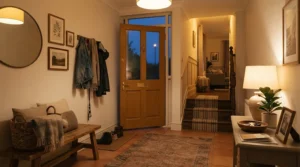
The hallway is the hardest-working, least-loved room in a British home. Nobody lingers there. Yet it is where you shed wet coats, trip over trainers and make a first impression on every guest.
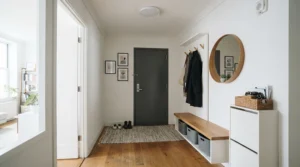
Good hallway ceiling lights do three jobs at once. They show you where you’re going and make a narrow tunnel feel like a welcome. They also shouldn’t cost a small fortune to run.
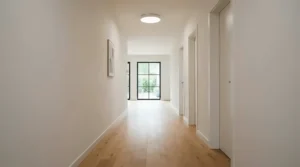
Most UK hallways are awkward. They are long, narrow, often windowless and low-ceilinged, and many hang off an older ceiling rose. In modern British wiring a loop-in rose doubles as a junction box, which affects what you can bolt up there.
So this guide compares seven real, current fittings on their specifications, from budget to premium. We interpret each spec in plain English, because “2,400 lumens” means nothing until you know your hallway is only four square metres.
Along the way we cover lumens for hallways, why 2700K warm white flatters a magnolia wall, and what to do about your ceiling rose and wiring. We also explain how to pick an LED hallway ceiling light that won’t make your home feel like a dental surgery.
One note on money: every price below is a range, because prices change daily. Check the current price before you buy.
Hallway Ceiling Lights at a Glance: Quick Comparison
| Product | Light output | Colour temperature | Standout | Price range | Best for |
|---|---|---|---|---|---|
| Lepro 24W Square LED Ceiling Light | 2,400lm | 5000K | Brightest budget option | £15-£25 | Lepro 24W: utility hallways and garage entrances |
| Lepro 15W 8.7-Inch Flush Mount (3000K) | 1,250lm | 3000K | Warm budget all-rounder | £15-£30 | Lepro 15W: small and medium hallways |
| Sylvania START Surface IP44 DualTone | 1,550lm | 3000K/4000K switchable | Two tones in one fitting | £25-£45 | Sylvania START Surface: undecided buyers |
| Eglo Fueva 5 | 1,350-2,400lm by size | 3000K | Ultra-slim 28mm depth | £30-£50 | Eglo Fueva 5: low ceilings |
| WiZ SuperSlim 16W | 1,500lm | 2700K-6500K | Hub-free smart control | £35-£65 | WiZ SuperSlim: mood and routine lighting |
| ENER-J 24W Microwave Sensor Light | about 2,200lm | 4000K | Automatic on/off | £25-£40 | ENER-J 24W: full-hands arrivals |
| Philips Hue White Ambiance Still | 2,350lm at 2700K | 2700K-6500K tunable | Premium ecosystem fitting | £150-£200 | Philips Hue Still: large entrance halls |
Looking at the table, the Lepro 24W Square LED Ceiling Light gives the most lumens per pound by a distance, but at 5000K it is the coldest option on the list. If you want warmth without paying smart-light money, the Lepro 15W and Eglo Fueva 5 both sit at 3000K, much closer to a cosy glow. Only the WiZ SuperSlim and the Philips Hue Still reach a true 2700K warm white.
💬 Just one click — help others make better buying decisions too!😊
Top 7 Hallway Ceiling Lights: Expert Analysis
1. Lepro 24W Square LED Ceiling Light — brightest budget fitting going
At around 2,400 lumens for pocket-money pricing, this is a floodlight in a polite white box. The headline specs are 24W, 2,400lm, 5000K daylight white and an IP44 rating, in a slim square body.
In practice, 2,400 lumens is what you’d want for a 20-square-metre room. In a one-metre-wide corridor it is overkill, and at 5000K it is rather clinical. It suits hallways that behave like workspaces: a garage entrance, a boot room, a pantry passage. I’d pair it with white walls, not warm-painted ones.
Buyer sentiment looks solid. At the time of research the listing showed roughly 4.6 stars across several hundred ratings, though that is only a snapshot.
Pros:
- ✅ Enormous output for the money
- ✅ IP44 shrugs off splashes and dust
- ✅ Slim square profile suits low ceilings
Cons:
- ❌ Cold 5000K light feels stark in living spaces
- ❌ Not dimmable on the listings I found
Expect to pay around £15-£25. It is superb value if you want task lighting, and the wrong choice if you want a welcome.
2. Lepro 15W 8.7-Inch Flush Mount LED Ceiling Light — warm budget all-rounder
This is the sensible sibling. A 3000K tone and a compact footprint make it the budget flush hallway ceiling light that doesn’t shout.
The specs are 15W, 1,250 lumens, 3000K and an IP54 rating, in a roughly 22cm round body. That output matches a 10-12 square-metre hallway, which covers a typical terrace or semi. The 3000K tone is warm enough to flatter timber and paint, though a shade cooler than a candlelit 2700K.
IP54 is more protection than a hallway strictly needs. It does make the fitting a safe choice for a draughty porch or a hall that doubles as a utility corridor.
I couldn’t verify a large, consistent set of buyer reviews for this exact variant, so judge it on the spec sheet and the retailer’s return policy.
Pros:
- ✅ Warm 3000K tone suits most decor
- ✅ Compact 22cm footprint for narrow halls
- ✅ IP54 rating copes with damp porches
Cons:
- ❌ Not the cosiest 2700K warm white
- ❌ Plain, utilitarian styling
Pricing sits around £15-£30. For small and medium hallways, that is a lot of sense for very little money.
3. Sylvania START Surface IP44 DualTone (18W, 1,550lm) — switchable 3000K or 4000K
Can’t decide between warm and neutral? This fitting lets you decide on the day you install it.
It offers 18W, 1,550 lumens and a DualTone switch between 3000K and 4000K. The housing is about 33cm across with IP44 and IK03 ratings. Sylvania’s literature describes a halo effect that spills light onto the surrounding wall surface. The datasheet is also non-dimmable and quotes lifespans up to 90,000 hours.
That wall halo matters in a narrow hallway. Light that grazes the walls makes a corridor feel wider, a trick plain downlights can’t manage. The retailer listings classify it as Class I, which means it needs an earth connection. Older homes sometimes lack earths at the lighting circuit, so ask an electrician to check.
Review data I could verify for this model was thin, so treat the build claims as manufacturer claims.
Pros:
- ✅ Switchable 3000K and 4000K tones
- ✅ Wall halo makes corridors feel wider
- ✅ IP44 suits porches and utility hallways
Cons:
- ❌ Non-dimmable
- ❌ Commercial look, a little corridor-of-a-school
Expect around £25-£45. It is good value if you want flexibility without smart-home fuss.
4. Eglo Fueva 5 — slim 28mm profile in warm 3000K
This is the one for low ceilings and tall humans. At about 28mm deep, it clears door headers and hair alike.
Eglo’s Fueva 5 comes in several diameters. The 285mm version is quoted at about 2,400 lumens and the 160mm version at 1,350 lumens (11W), both warm white 3000K with IP44. The smaller version I found listed as Class II, meaning double-insulated and no earth needed. Check the exact variant you order.
The real trick is picking the right diameter. For a narrow hallway, a 160-210mm size gives plenty of light without dominating the ceiling. The 285mm model is better in a wide entrance hall.
I couldn’t verify enough consistent buyer reviews to characterise them here, so lean on the spec sheet.
Pros:
- ✅ Ultra-slim body for low ceilings
- ✅ Warm 3000K light at multiple sizes
- ✅ IP44 rating for porches
Cons:
- ❌ Not dimmable
- ❌ Integrated LED can’t be replaced
Pricing is around £30-£50 by size. It is a mid-range winner for traditional British hallways with tight headroom.
5. WiZ SuperSlim 16W — tunable white without a hub
Smart lighting for people who hate hubs. This round fitting talks to your Wi-Fi and little else.
The specs are 16W, 1,500 lumens, 2700K-6500K tunable white, a diameter of about 29cm and a body only 2.3cm thick, rated IP20. It is app- and voice-controllable with no extra hub required, and listings mention Matter compatibility. Check the variant, because larger versions go up to roughly 2,450 lumens.
Tunable white is genuinely useful in a hallway. You can run 2700K warm white in the evening and cooler light in the morning rush. You can also dim it to a gentle glow for midnight bathroom trips. One catch is that the wall switch has to stay on for smart control to work.
I couldn’t verify enough Amazon reviews for this exact model to summarise, so check recent ratings before ordering.
Pros:
- ✅ True 2700K warm white up to cool daylight
- ✅ Dims through the app, no dimmer needed
- ✅ No separate hub required
Cons:
- ❌ Wall switch off means no smart control
- ❌ Relies on home Wi-Fi
Expect around £35-£65. It is strong value for households that want routines and mood without an ecosystem commitment.
6. ENER-J 24W LED Ceiling Light with Microwave Sensor — hands-free, handy with full arms
If you’ve ever fumbled for a switch with shopping in both hands, you know the appeal. This one switches itself on.
It is a 24W fitting with roughly 2,200 lumens at 4000K and a microwave sensor. Listings describe a night mode, which triggers only in the dark, and a daylight mode that detects movement all the time. A microwave sensor can pick up movement through thin partitions, so adjust the sensitivity or you may get phantom switch-ons from the next room.
It is ideal where the switch sits at the far end of a long hallway. At 4000K it is bright and neutral rather than cosy, which suits a functional passage.
I couldn’t verify a robust set of buyer reviews for this exact listing.
Pros:
- ✅ Automatic on/off with full arms
- ✅ Night mode triggers only in darkness
- ✅ Bright neutral 4000K output
Cons:
- ❌ May false-trigger through thin walls
- ❌ Bulkhead styling, not decorative
It sits at around £25-£40. It is excellent value for convenience, less so for ambience.
7. Philips Hue White Ambiance Still — premium ecosystem fitting
The luxury pick. It is expensive for a hallway fitting, but it makes sense in the right house.
The specs are about 2,350 lumens at 2700K (about 2,500 at 4000K), roughly 21-22W, IP20 and Class I (earthed). It uses Bluetooth control, with an optional Hue Bridge to unlock more features. A dimmer switch is included, the quoted light-source life is 25,000 hours, and Philips lists a two-year warranty.
That is a lot of light and a big fitting for a narrow hallway. It earns its keep in a wide entrance hall or an open stair landing, where it also acts as living-space lighting. If you already run Hue bulbs elsewhere, scenes and schedules tie everything together.
I couldn’t verify enough consistent buyer feedback on this specific model to summarise it.
Pros:
- ✅ True 2700K warm white and tunable range
- ✅ Dimmer switch included
- ✅ Slots into the wider Hue ecosystem
Cons:
- ❌ Premium pricing
- ❌ Oversized for narrow hallways
Pricing sits around £150-£200. It is worth it for large halls and Hue households, and extravagant otherwise.
| Product | Size | Dimming/control | IP | Notes | Best for |
|---|---|---|---|---|---|
| Lepro 24W | Square, slim | Non-dimmable | IP44 | 5000K cold | Lepro 24W: workspaces |
| Lepro 15W | About 22cm | Not stated | IP54 | 3000K | Lepro 15W: small halls |
| Sylvania START Surface | About 33cm | Non-dimmable | IP44 | 3000K/4000K | Sylvania START Surface: wall halo |
| Eglo Fueva 5 | 160-285mm | Non-dimmable | IP44 | 28mm deep | Eglo Fueva 5: low ceilings |
| WiZ SuperSlim | About 29cm | App/voice | IP20 | Hub-free | WiZ SuperSlim: smart routines |
| ENER-J 24W | Round bulkhead | Sensor | Check listing | Night/daylight mode | ENER-J 24W: hands-full arrivals |
| Philips Hue Still | Larger round | Dimmer included | IP20 | Class I | Philips Hue Still: wide halls |
Reading across, only the WiZ SuperSlim and Philips Hue Still combine dimming with true 2700K. Every non-dimmable option on the list pushes you to choose output carefully at purchase. Anyone with a very narrow hall should favour the smaller Eglo Fueva 5 or Lepro 15W over the monsters.
✨ Don’t Miss These Hallway Upgrades!
🔍 Ready to rescue your entrance from gloom? Click any highlighted product above to check current pricing and availability. These carefully selected fittings will help you create a welcoming hallway your family will love!
What Is a Flush Hallway Ceiling Light?
A flush hallway ceiling light is a low-profile fitting that mounts directly against the ceiling with no drop or stem, adding only a few centimetres of depth. Hallway ceiling lights come as flush, semi-flush or pendant styles. Flush suits low UK ceilings, where headroom matters more than drama.
Many British hallways have ceilings around 2.2-2.4 metres. A pendant that hangs 30cm lower will be fine for a basketball player’s grandmother but not for most adults. This is why a flush hallway ceiling light is the default choice.
Semi-flush designs hang a little lower, and they can work in hallways with taller ceilings or stairwells. Pendants need genuine height to avoid knocks.
The slim fittings in our list (the Eglo Fueva 5 and WiZ SuperSlim) are quoted at 2.3-2.8cm deep, so even a tight hall stays clear. Rule of thumb: if you can touch the ceiling with a flat hand, choose flush.
How to Choose Hallway Ceiling Lights
- Measure your floor area. Length times width in metres gives you the square metres you need to light.
- Convert area to lumens. Use the lumens for hallways rule below, then compare against each fitting’s total lumens.
- Choose colour temperature first. Decide between 2700K warm white, 3000K and 4000K before looking at styles.
- Check ceiling height. Under 2.4 metres, stay with flush; taller allows semi-flush.
- Check your wiring and ceiling rose. Confirm earth availability, because Class I fittings need one and Class II don’t.
- Choose your control. Standard switch, dimmer, smart app, or motion sensor?
- Check the IP rating. IP20 is fine inside; IP44 helps with porches and damp-prone halls.
Notice how the choice of fitting comes last. Work out the numbers first and the shortlist builds itself.
Lumens for Hallways: How Bright Is Bright Enough?
Lumens measure total light output, and a common rule of thumb is roughly 100 lumens per square metre for a hallway. Sources vary, with some quoting 100-150 lux, so treat this as a starting point.
Here is how that works in real homes:
- A 1m × 4m terrace hallway is 4 square metres, so about 400 lumens.
- A 1.2m × 5m hallway is 6 square metres, so about 600 lumens.
- A 2m × 6m entrance is 12 square metres, so about 1,200 lumens.
A windowless hall or dark walls may justify 30-50% more. That reasoning is my own guidance, not a standard.
Apply this to our list and most fittings are generous. The Lepro 24W and Eglo Fueva 5 (285mm) deliver around 2,400 lumens, which suits a roughly 20-square-metre space. In a narrow hall they only make sense if you can dim them, and the Lepro 24W and Eglo Fueva 5 can’t. A narrow hallway will do better with the Lepro 15W or the smaller Eglo Fueva 5.
Dimmable fittings like the WiZ SuperSlim and Philips Hue Still solve the mismatch. They give you the lumens when you need them and mood lighting when you don’t.
2700K Warm White: Why Hallways Love It
Kelvin (K) describes how warm or cool a light looks. Lower numbers glow golden, higher numbers look bluer. 2700K warm white resembles the old incandescent bulb, 3000K is a touch crisper, and 4000K reads as neutral daylight.
Hallways usually sit between richly coloured rooms, so warm light helps. 2700K warm white flatters skin tones, wooden floors and warm paint colours. In a windowless hallway, colder light can feel institutional.
Consider the adjoining rooms too. If your lounge is lit at 2700K and your hallway at 5000K, an open door produces an abrupt colour clash that looks accidental. Matching temperatures across open-plan areas keeps the home coherent.
From our seven picks, the WiZ SuperSlim and Philips Hue Still reach true 2700K warm white. The Lepro 15W and Eglo Fueva 5 sit at 3000K, which is close enough for most eyes. The Lepro 24W (5000K) and ENER-J 24W (4000K) belong in utility-style spaces.
Ceiling Rose, Wiring and Hallway Ceiling Light Fittings
Most British hallway ceiling light fittings hang from or replace an existing ceiling rose. In loop-in wiring, the rose passes power on to the next light as well as feeding yours. That means a new flush fitting must keep every connection intact.
When the old rose has several cables, they can’t all simply go into the new fitting’s terminal block. Electricians typically use a proper connector or junction box to preserve the loop, then wire the new light on top. If you’re unsure which type you have, stop and ask a professional.
Check the electrical class too. Class I fittings (Sylvania START Surface and Philips Hue Still) require an earth connection, whereas Class II fittings don’t. Older homes may lack an earth at the lighting circuit.
Finally, consider weight and fixings. Flush fittings should be fixed into joists or with suitable fixings rather than relying on a thin plasterboard screw.
LED Hallway Ceiling Light vs Traditional Alternatives
| Feature | LED hallway ceiling light | Halogen/incandescent fitting | Best for |
|---|---|---|---|
| Energy use | Very low | High | LED, almost always |
| Lifespan | Roughly 20,000-90,000 hours quoted | A fraction of that | LED for hard-to-reach ceilings |
| Heat output | Low | High | LED in low-ceilinged halls |
| Bulb replacement | Often not possible (integrated) | Easy | Traditional if you like swapping bulbs |
| Dimming/smart | Wide choice | Limited | LED with WiZ SuperSlim or Philips Hue Still |
According to the Energy Saving Trust, lighting accounts for around 11% of average UK household electricity consumption, so efficient fittings are worth considering. Halogen bulbs have also been phased out in the UK, so a modern LED hallway ceiling light is effectively the default.
Based on the table, an LED hallway ceiling light wins almost everywhere except bulb replacement. If a diffuser fails on a sealed fitting such as the Eglo Fueva 5, you replace the whole thing. Buyers who dislike that trade-off should look for fittings with replaceable lamps.
Common Mistakes When Buying Hallway Ceiling Lights
- Buying by watts instead of lumens. Watts show energy use, not brightness. Always compare lumens.
- Choosing a cold colour by accident. 5000K daylight looks dazzling online but harsh at home.
- Oversizing. A 40cm fitting in a one-metre-wide corridor dominates the ceiling.
- Ignoring headroom. Semi-flush and pendant fittings need genuine height.
- Forgetting the earth. Class I fittings can’t just be hooked up without an earth.
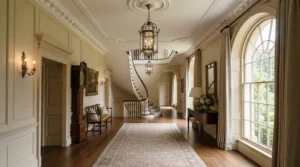
- Relying on one light in a long hallway. Past about four metres, a single fitting leaves dim ends.
The pattern is clear. Most regrets come from skipping measurement, not from choosing a bad brand.
Long-Term Cost and Maintenance
Running costs for LED fittings are tiny. An 18W fitting used four hours a day consumes roughly 26 kWh a year, and a 24W fitting about 35 kWh. Even at current tariffs, that is a modest annual cost, typically a few pounds, though your tariff will vary.
Lifespans quoted in the listings run from 20,000 hours for some Lepro models to 25,000 for the Philips Hue Still. At four hours a day (about 1,460 hours a year), 20,000 hours is more than a decade. You’ll likely redecorate before the LED fades.
Maintenance is mostly dusting. Wipe the diffuser with a damp microfibre cloth every few months, with the power off. Sealed IP44 fittings are easier to keep clean.
The real long-term question is replacement. Integrated LEDs, such as the Eglo Fueva 5, mean replacing the entire unit when it fails. Cheap fittings such as the Lepro 15W make that less painful, while a £150-£200 Philips Hue Still makes a failure sting. Check warranty terms before you pay premium prices.
Practical Guide: Fitting Your New Hallway Ceiling Light
- Switch off at the consumer unit. Don’t rely on the wall switch alone.
- Test the wiring is dead with a voltage tester.
- Photograph the old connections before touching anything.
- Identify your wiring type. Loop-in roses with several cables need extra care.
- Remove the old fitting and check for a good, sound fixing point.
- Mount the new baseplate into a joist or with suitable fixings.
- Connect brown to live, blue to neutral and the earth to the earth terminal where required.
- Test before you close up.
Replacing a light fitting is generally treated as non-notifiable work under Part P, according to the IET’s Part P FAQs. All the same, the work still has to meet safety standards. If anything looks unfamiliar, hire a qualified electrician.
Common mistakes in the first 30 days are switching smart fittings off at the wall and setting motion sensors too sensitive. Leave smart switches on, and tune the sensitivity dial gradually.
Real-World Scenarios: Matching Hallway Ceiling Lights to Your Home
Scenario 1: Victorian terrace, 1m × 5m hallway. The budget is about £30, the ceiling is low, and the lights are used constantly. The Eglo Fueva 5 in a smaller diameter gives about 1,350 lumens at 3000K, only 28mm deep. If you need extra brightness, add a second fitting rather than a bigger one.
Scenario 2: Windowless inner hall in a family home. There are two children, lots of full-hands arrivals and a switch far from the front door. The ENER-J 24W switches itself on, while the Sylvania START Surface offers a wall halo for a wider feel. I’d go sensor if hands-free matters most, and Sylvania if atmosphere matters.
Scenario 3: Wide open entrance hall with a stairwell. The budget is flexible, and you want warm light in the evening and brighter light for morning routines. The WiZ SuperSlim delivers tunable white without a hub, while the Philips Hue Still makes sense if you already run Hue bulbs. Dimming handles late-night trips.
The thread running through all three is that room shape and routine decide the fitting, not brand prestige.
Problem and Solution Guide for Gloomy Hallways
Problem: The hallway feels like a tunnel. Choose a fitting with a wall halo, such as the Sylvania START Surface, or paint the walls a lighter shade. Light that reaches the walls widens the space.
Problem: Dark spots at each end. One central light rarely covers a long hallway. Use two smaller fittings, such as two Eglo Fueva 5 units, for even coverage.
Problem: Glare when you come in from the dark. Dimmable options such as the WiZ SuperSlim and Philips Hue Still let you choose a softer setting for night.
Problem: The switch is at the wrong end. A sensor fitting like the ENER-J 24W removes the need to walk through the dark.
Problem: Cold, clinical colour. Swap a 5000K fitting for a 2700K or 3000K one. Even a Lepro 15W is a big improvement on a Lepro 24W for atmosphere.
Frequently Asked Questions
❓ How many hallway ceiling lights does a long corridor need?
❓ Can I put an LED hallway ceiling light on a dimmer switch?
❓ Do I need an electrician to swap hallway ceiling light fittings?
❓ What diameter flush hallway ceiling light suits a narrow hall?
❓ Are motion sensor hallway ceiling lights worth it?
Conclusion: Choosing the Right Hallway Ceiling Lights
The best hallway ceiling lights are the ones that suit your actual hallway, not the biggest or the cleverest. Measure the floor area, convert it to lumens for hallways, then choose a colour temperature that suits your decor.
For tight budgets, the Lepro 15W is the warmest sensible choice, and the Lepro 24W wins on brightness if you don’t mind cold light. The Sylvania START Surface adds flexibility with its switchable tones, and the Eglo Fueva 5 helps wherever headroom is tight. The WiZ SuperSlim offers affordable smart control, while the ENER-J 24W takes the fumbling out of arrivals. The Philips Hue Still is the premium choice for big entrance halls.
Before you buy, check your wiring, earth and ceiling rose. A £25 fitting costs more if it needs rewiring you didn’t expect.
✨ Ready to Light the Way Home?
🔍 Click any highlighted product above to check current pricing and availability. Pick your hallway ceiling lights with confidence and give every arrival the welcome it deserves!
Recommended for You
- Motion Sensor Hallway Lights: 7 Brilliant Picks For UK Homes (2026)
- Bathroom Night Light With Motion Sensor: 7 Best UK Picks (2026)
- Bathroom Shaver Light With Socket: 7 Safe, Smart UK Picks (2026)
Disclaimer: This article contains affiliate links. As an Amazon Associate, I earn from qualifying purchases. If you purchase products through these links, we may earn a small commission at no additional cost to you.
✨ Found this helpful? Share it with your friends! 💬🤗
