
In This Article
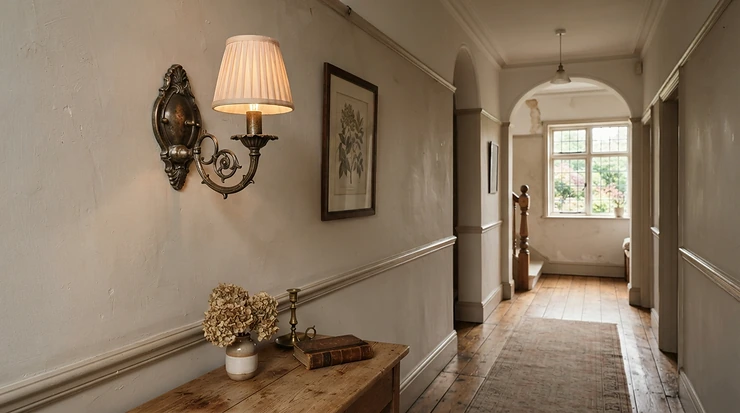
Most British hallways get a single ceiling light and a great deal of optimism. The result is a flat, bright tunnel with shadows pooling at the edges, coats lurking in the gloom and a front door that never quite feels welcoming. Wall lights for hallways fix that by putting soft light where you actually walk. They also wash the walls, so a tight space feels less like a corridor and more like a room. Choosing the right wall lights for hallways comes down to three things: depth, height and power source. 🔌
The good news for 2026 is that you no longer need a rewiring budget. Plug-in wall lights for hallway use take minutes to set up, battery models need nothing but a magnet, and slim hallway wall lights barely 3 cm deep will tuck beside a coat rack without catching anyone’s shoulder.
Here’s how this guide works. I’ve compared seven real amazon.co.uk listings by reading their specifications and the aggregated themes in their reviews. Then I’ve explained what each spec means in a real hall. I haven’t tested these fittings personally, so you won’t find invented anecdotes here, and where review data is thin I say so. Prices are ranges only, because they move daily.
Every light below is LED or built around LED bulbs, and that matters. The Energy Saving Trust estimates that swapping remaining halogen spotlights for LEDs could save around £45 a year in Great Britain. Efficient hallway lighting pays you back while it flatters your walls.
Quick Comparison: Wall Lights for Hallways at a Glance
| Product | Power source | Listed size | Price range | Best For |
|---|---|---|---|---|
| Auraglow Plugin GU10 Spotlight Uplighter | Plug-in (GU10 bulb not included) | approx. 2 × 4 × 6 cm | Around £15-£25 | Renters and dark corners |
| Dehobo Plug-In Wall Light (D0606) | Plug-in, switched flex | 10 × 8 × 13.5 cm | Budget; check current price | Accent light above a console |
| Lightsjoy Rechargeable Up-Down LED Wall Light | USB battery | Not verified | Around £10-£25 | Hallways with no socket |
| Lampop 8W LED Up-Down Wall Light | Hardwired | 19 × 6 × 3 cm | Budget; check current price | Small, tight hallways |
| OOWOLF 12W LED Up-Down Wall Light | Hardwired | Not verified | Budget-to-mid; check current price | Warm ambience on smooth walls |
| wowatt 20W 60cm LED Wall Light | Hardwired | 61 × 8.5 × 3 cm | Mid range; check current price | Long corridors and stairs |
| Dehobo Industrial Wall Lights (2-Pack, D0321) | Hardwired (E14 bulbs) | 13 × 12 × 10 cm each | Around £20-£30 per pair | Wider halls, industrial style |
Looking at the table, the real dividing line isn’t price but power source and depth. Lampop and wowatt are the slimmest options at about 3 cm, while Dehobo Industrial Wall Lights (2-Pack, D0321) project roughly four times further. If you rent, the plug-in and battery rows are your shortlist; if you’re redecorating, the hardwired rows give a cleaner finish.
💬 Just one click — help others make better buying decisions too!😊
Top 7 Wall Lights for Hallways: Expert Analysis
Below are seven real products, from plug-in quick fixes to slim hardwired bars. One honest caveat: the Amazon pool for this category skews towards value and mid-range pricing. Genuinely premium designer fittings tend to live with specialist lighting retailers, so treat this list as the smart-money end of the market.
1. Auraglow Plugin GU10 Spotlight Uplighter — turns a spare socket into an uplighter
Auraglow Plugin GU10 Spotlight Uplighter is the no-drilling, no-electrician, no-drama option, and that explains its popularity. It plugs into a standard UK socket and rotates 360°, so one fitting can wash light up the wall or flip downwards for a low glow.
The model (AG286) weighs just 105 g and takes an LED GU10 bulb that isn’t included. That matters more than it sounds. The bulb sets the colour temperature and beam spread, so a warm 2700-3000K lamp gives a welcoming glow while a cool white turns your hall into a car park. Two units in a double socket create a V-shaped effect, effectively doubling the output without extra wiring.
On the spec sheet, this is an ambient and accent light rather than a task light. If your hallway socket sits near the skirting, the beam starts low, which suits a landing or night route but won’t replace a reading lamp.
Reviewers on the listing, rated around 4.5/5 across well over a thousand ratings at the time of research, consistently praise the plug-and-play setup. The recurring snags are the missing bulb and, as one landing user noted, the low position when the socket is near the floor.
Pros:
- ✅ Genuinely no tools, wiring or electrician needed
- ✅ Rotates to light upwards or downwards
- ✅ Bulb choice controls colour and beam
Cons:
- ❌ GU10 LED bulb must be bought separately
- ❌ Light height is dictated by socket height
Expect around £15-£25 depending on colour and seller. Verdict: the best impact-per-pound in this list for a rented hallway.
2. Dehobo Plug-In Wall Light (D0606) — switched cable with an adjustable head
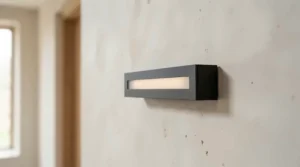
Dehobo Plug-In Wall Light (D0606) is the tidy way to add a directional spot to a hallway without touching the mains wiring. It screws to the wall, plugs in via a roughly 1.15-1.2 m cable, and the head angles to where you need it.
It takes GU10 LED bulbs only, capped at 7W, and comes in matte black with a listed footprint of 10 × 8 × 13.5 cm. Check which dimension is the projection before ordering. Reviewers flag that the ring around the bulb isn’t a true diffuser, so pick a bulb with built-in diffusion or the beam can feel harsh in a narrow space.
The honest take: that roughly one-metre flex is the defining constraint. One reviewer worked out that, after the plug loop, the light can only sit about a metre above the socket at best. In practice that suggests a console table or radiator shelf with a socket beneath, lighting a mirror or artwork at low level.
Review sentiment is mixed-positive. Buyers like the neat look and easy fixing, but note the fiddly bulb change, the short cable and, for one buyer, the wrong instruction sheet.
Pros:
- ✅ Mounting hardware included
- ✅ Inline switch on the cable
- ✅ Head aims light precisely
Cons:
- ❌ Short cable limits mounting height
- ❌ Fiddly bulb change and 7W LED-only cap
Priced firmly at the budget end, so check current price. Verdict: a sensible single accent, weaker as main hallway lighting.
3. Lightsjoy Rechargeable Up-Down LED Wall Light — wireless, magnetic, no socket required
Lightsjoy Rechargeable Up-Down LED Wall Light is the cheat code for hallways with no nearby socket, or a landlord with strong opinions about drilling. It fixes with 3M adhesive or a magnetic back and charges by USB.
The listing quotes up to 24 hours of continuous runtime on the lowest setting and 16 hours on the highest. If you only run it a couple of hours each evening, that implies a recharge roughly every week or two on paper. Because it throws light both up and down, it also doubles as gentle wayfinding at night.
Honestly, this is a night-time and accent light. Battery fittings won’t match a mains-powered bar for brightness, and recharging is a chore you have to remember. For a hall where you just need to avoid stubbing a toe at 3 a.m., it’s a clever fit.
On review data, I could only verify an aggregated headline rating of about 4.6/5 from roughly 590 reviews on a deal-tracking page. I couldn’t verify a detailed breakdown of complaints, so treat that headline as the only hard signal.
Pros:
- ✅ No wiring, drilling or socket needed
- ✅ Magnetic or adhesive mounting
- ✅ Up-and-down glow with brightness settings
Cons:
- ❌ Needs periodic USB recharging
- ❌ Won’t replace a mains fitting for brightness
Deal prices have ranged roughly £10-£25. Verdict: strong value as a supplementary night light.
4. Lampop 8W LED Up-Down Wall Light — compact and just 3 cm deep
Lampop 8W LED Up-Down Wall Light is about as discreet as a hardwired fitting gets. It measures 19 × 6 × 3 cm, weighs 440 g and is made of aluminium.
That 3 cm depth is the headline for a narrow hallway projection problem. The listing also gives an IP44 rating, meaning splash protection that’s handy in a porch (one reviewer used it there) even if a dry hallway doesn’t need it. Note that the listing shows 6000K cool white. In a hall that reads brisk and clinical, so look for a warmer variant if one is offered.
Based on the review spread, I’d treat it as polarised. One buyer replaced halogen wall lights in a small hallway with four of these and reported them still working six months later. Others called it too small, and a couple reported disappointing brightness or a unit that wouldn’t work at all.
My take: it suits a short hall where several small fittings share the load, not a long dark corridor where one unit has to carry everything.
Pros:
- ✅ Only 3 cm deep, ideal for tight halls
- ✅ Mounting hardware included
- ✅ IP44 splash protection
Cons:
- ❌ Cool white variant can feel cold
- ❌ Polarised reviews on brightness and quality control
Budget-priced, so check current price. Verdict: good value if you buy a couple and keep expectations modest.
5. OOWOLF 12W LED Up-Down Wall Light — warm wash with an easy install
OOWOLF 12W LED Up-Down Wall Light pairs a minimalist aluminium body with a warm-white up-and-down glow. The listing quotes a 24-month warranty, which is generous for this price tier.
The detail that matters is the light’s direction. Grazing the wall at close range flatters smooth plaster but exposes every ripple. Two separate reviewers noted exactly that, one wryly crediting the lights for revealing what the plasterer had “finished”. If your hallway walls are old, textured or patchy, expect them to be highlighted rather than hidden.
Reviewers also report no on/off switch on the fitting, so control is via your wall switch. A competent DIYer reported about 15 minutes per light, though other buyers recommend an electrician. Reviewers describe the look as hotel-like, with plenty of light for the size.
My analysis: this is a strong pick for a freshly skimmed hallway with an existing switched supply. It’s a poor pick for a bumpy Victorian wall.
Pros:
- ✅ Warm-white up-and-down wash
- ✅ 24-month warranty per the listing
- ✅ Reported quick installation
Cons:
- ❌ No built-in switch
- ❌ Exposes uneven plaster
Sits in the budget-to-mid bracket, so check current price. Verdict: great value on a smooth wall.
6. wowatt 20W 60cm LED Wall Light — long linear glow for corridors
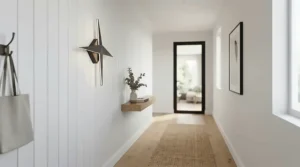
wowatt 20W 60cm LED Wall Light is the heavy hitter here. It’s a 61 × 8.5 × 3 cm aluminium bar listed at 1600 lumens, 2800K warm white, with a three-year warranty.
Reviewers equate the output to a traditional 60-80W lamp, which is a lot of hallway light from a 3 cm-deep fitting. The 2800K warmth keeps it cosy rather than clinical. It’s rated IP20, so keep it to dry areas, and reviewers confirm it can’t be dimmed.
The catch is installation. One reviewer who tried a plug lead found there was no cable entry at the mid-point and no switch. In effect it must be wired into a switched supply, and the cable looks untidy unless it’s concealed in the wall. Another had a bracket screw that wouldn’t bite. That points to an electrician and some plastering: ideal during a refurb, awkward afterwards.
Pros:
- ✅ High output of around 1600 lumens
- ✅ Only 3 cm deep
- ✅ Three-year warranty per the listing
Cons:
- ❌ Needs hard-wiring and concealed cable
- ❌ No dimming
A mid-range price for a long linear fitting, so check current price. Verdict: the best choice for a long, narrow, dark corridor, if wiring is on the table.
7. Dehobo Industrial Wall Lights (2-Pack, D0321) — pair of adjustable cage sconces
Dehobo Industrial Wall Lights (2-Pack, D0321) gives you two black metal cage sconces for the price many brands charge for one. Each rod rotates 350° and pivots 90°, so you can graze a gallery wall or bounce light off the plaster.
They take E14 bulbs up to 40W, which is useful: any small-screw LED, including filament styles, will fit. Each unit measures roughly 13 × 12 × 10 cm, and bulbs are bought separately. The cage leaves the lamp visible, so a frosted or opal bulb is wise in a hallway to avoid glare at eye level.
Here’s what the spec sheet won’t tell you: that depth, around 12 cm, is too much for the narrowest halls. In a hallway under about a metre wide, a swinging bag could catch it. In a wider entrance hall, though, the industrial look is a good style anchor.
Reviewers consistently describe good value and an easy install, with one buyer reporting a missing connector on a unit.
Pros:
- ✅ Two fittings in one pack
- ✅ Fully adjustable heads
- ✅ Works with many E14 LED bulbs
Cons:
- ❌ Exposed bulb needs a frosted lamp
- ❌ Around 12 cm deep strains narrow halls
Expect roughly £20-£30 for the pair. Verdict: stylish and cost-effective for wider hallways.
✨ Don’t Miss These Exclusive Deals!
🔍 Take your hallway to the next level with these carefully selected lights. Click on any highlighted product name to check current pricing and availability. These fittings will help you create a warm, welcoming entrance your family and guests will love! 💡
What Are Wall Lights for Hallways?
Wall lights for hallways are fixtures mounted on a hall wall, whether hardwired, plug-in or battery-powered, that provide ambient, accent or low-level light along a route. They free ceiling and floor space, soften shadows and are usually slim or low-projection so they don’t catch shoulders, coats or pushchairs.
Think of them as three families. Hardwired fittings are tidiest and most flexible. Plug-in wall lights for hallway use trade a visible flex for zero electrical work. Battery lights trade brightness for total freedom. Within each family you’ll meet two shapes that this guide returns to repeatedly: slim hallway wall lights, which win on depth, and uplighter wall lights, which win on atmosphere.
The honest limit is that wall lights are best as a layer. A hallway still benefits from a ceiling fitting you can switch on when you need to find a dropped key, with wall lights doing the mood work the rest of the time.
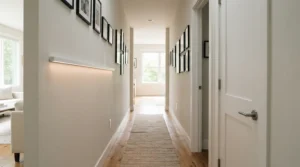
Plug-In vs Hardwired: Which Is Right for Your Hall?
The plug-in vs hardwired decision is the first fork in the road. Plug-in suits renters and quick upgrades; hardwired suits refurbishments and clean finishes.
| Factor | Plug-in | Hardwired |
|---|---|---|
| Installation | Screw to wall and plug in | Wired to a lighting circuit, usually by an electrician |
| Look | Visible flex unless covered | Clean wall, hidden cable |
| Switching | Inline switch, socket or smart plug | Wall switch, dimmer possible |
| Renter-friendly | High | Low |
| Hallway fit | Needs a nearby socket; height limited by flex | Can go wherever cable can run |
| Best For | Renters and fast upgrades | Refurbs and long runs |
Looking at the comparison, Auraglow Plugin GU10 Spotlight Uplighter and Dehobo Plug-In Wall Light (D0606) win on speed, while wowatt 20W 60cm LED Wall Light wins on finish. The big hidden cost of plug-in vs hardwired isn’t money but cable: if the flex crosses a doorway or hangs down a pale wall, it will bother you daily.
On safety, a plug-in light is generally an appliance rather than installation work, but new fixed wiring is different. In England, electrical safety in homes falls under Part P of the Building Regulations, and the government’s Approved Document P explains what counts as notifiable work. If you’re not sure, use a registered electrician. Whichever route you choose, look for UKCA or CE marking and a properly fused UK plug on plug-in fittings.
Wall Light Height: Where Should They Go?
Wall light height is the detail that separates a hallway that feels designed from one that feels accidental. Most guidance puts the centre of a decorative wall light at roughly 1.5-1.7 metres from the floor, around eye level, to avoid glare. Philips Hue’s UK guide suggests about 1.6 metres as a pleasant eye level for most people, with exceptions.
Hallways bend that rule in three ways. First, a hidden-source fitting, like the best uplighter wall lights, can sit higher or lower because there’s no bulb to stare at. Second, door swings and coat hooks claim the wall, so you may need to shift fittings sideways. Third, low-level lights around 300-500 mm from the floor make good night guides.
Plug-in lights add a complication. Their wall light height is tied to the socket and the flex. Approved Document M recommends sockets and switches between 450 mm and 1,200 mm in new dwellings only, so older homes often have sockets near the skirting. That’s why Auraglow Plugin GU10 Spotlight Uplighter can sit low, and why the roughly one-metre cable on Dehobo Plug-In Wall Light (D0606) limits how high it can go.
A practical trick: tape paper templates to the wall and live with them for a few days before drilling.
Narrow Hallway Projection: How Far Is Too Far?
Narrow hallway projection is the spec shoppers overlook until a coat sleeve snags. Projection is how far the fitting sticks out from the wall, and in a tight corridor every centimetre is claimed by bags, buggies and elbows. Design guides commonly suggest keeping projection under about 10 cm in corridors narrower than around 1.2 metres, so treat that as a sensible rule of thumb rather than a law.
Measure your hall at the point where you’d actually mount the light, then subtract coat hooks, radiators and skirting. Compare that with the depth in the listing. wowatt 20W 60cm LED Wall Light and Lampop 8W LED Up-Down Wall Light are each listed at about 3 cm, which is ideal. Dehobo Industrial Wall Lights (2-Pack, D0321) are roughly 12 cm deep, which is risky in the narrowest halls.
Beware of two traps. Listings sometimes give dimensions in an order that makes it unclear which one is projection, as with Dehobo Plug-In Wall Light (D0606), so check the diagram. And a plug-in fitting’s plug and flex add depth below it. If a design looks slim from the front but you can’t verify the side view, assume it’s deeper than it seems.
Slim Hallway Wall Lights: What to Look For
Slim hallway wall lights usually mean a body under about 5 cm deep, either a compact up-down block or a long linear bar. The best slim hallway wall lights pair shallow depth with enough output to matter.
Check four things. First, depth including the mounting plate. Second, whether the LEDs are integrated: if they are, the fitting’s lifespan equals the LED’s lifespan, so warranties of two to three years are reassuring. Third, colour temperature, since 2700-3000K flatters a hall. Fourth, dimming. Many slim fittings are non-dimmable, as reviewers note for wowatt 20W 60cm LED Wall Light.
There’s a trade-off to understand. Slim hallway wall lights save space, but compact bodies like the Lampop 8W LED Up-Down Wall Light have little room for heat management and large optics, so brightness is modest. A longer bar spreads the same light over a wider surface, which reads as softer and less spotty.
For tiny halls, use two or three small fittings rather than one big one. For long, dark corridors, one long linear light per wall section tends to look calmer.
Uplighter Wall Lights: Making a Narrow Hall Feel Taller
Uplighter wall lights throw light at the wall and ceiling, so the surfaces become the light source. Done well, that gives a soft, glare-free glow and makes a low ceiling feel higher. Done badly, it throws a hard scallop of light and highlights every blemish.
Three factors decide the result. The first is the ceiling: pale, matte ceilings bounce light beautifully, while dark or glossy ones swallow it. The second is the beam: with a GU10 plug-in like Auraglow Plugin GU10 Spotlight Uplighter, a narrow bulb gives a defined streak and a wider bulb gives a gentler wash. The third is wall texture, because grazing light exaggerates imperfections, as OOWOLF 12W LED Up-Down Wall Light reviewers noticed.
My practical advice is to choose uplighter wall lights with a warm colour temperature and place them at or above shoulder height, so the hidden source stays out of your eyeline. In a narrow hall, running a pair on opposite walls, slightly offset, avoids a symmetrical tunnel effect.
If you want only one uplighter, pick the end wall: light pulling the eye down the corridor makes the space feel longer.
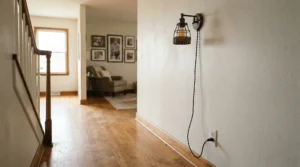
How to Choose Wall Lights for Hallways
Choosing wall lights for hallways takes six steps:
- Measure your hallway width and length. Width decides how much projection you can afford; length decides how many fittings you need.
- Decide on power source. Use the plug-in vs hardwired comparison above: renters lean plug-in or battery, refurbishers lean hardwired.
- Set the wall light height and spacing. Aim for roughly 1.5-1.7 metres to the centre for decorative fittings, and a common rule of thumb is one fitting every 2-2.5 metres, tighter in dark halls.
- Pick a warm colour temperature. 2700-3000K flatters skin, paint and wood.
- Check projection and finish. Aim for slim hallway wall lights in narrow spaces, and match metal finishes to your door furniture.
- Plan bulbs and control. Check bulb type and whether it’s included, whether the fitting has a switch, and whether a smart plug or smart bulb suits your setup.
Treat marking and warranty as the final filter. UKCA or CE marking and a stated warranty period are small signs of a trustworthy product.
How to Set Up Plug-In Wall Lights for a Hallway: First 30 Days
Plug-in fittings reward a little planning.
Day one: pick the socket, then tape a paper template at your intended wall light height. Check the flex length first, because a roughly one-metre cable like the one on Dehobo Plug-In Wall Light (D0606) limits you. Fit an LED bulb only, because several listings, including Auraglow Plugin GU10 Spotlight Uplighter, specify LED GU10 lamps and warn against halogen.
Week one: live with it. If the beam is harsh, switch to a diffused or wider-beam bulb. If the flex is visible, add a paintable cable cover in your wall colour rather than burying the flex in plaster. Keep cables out of doorways and walking lines.
Week two: sort out switching. An inline switch is fiddly on a high wall, so consider a smart plug or smart GU10 bulb. One reviewer did exactly that to avoid reaching for the inline switch.
Day 30: review. Do you see glare when you walk in? Is anything warm to touch? If so, lower the wattage. Then decide whether the hallway needs a second fitting, which usually beats raising the brightness of one.
Real-World Scenarios: Three Hallways, Three Setups
Here are three hypothetical profiles, matched to the products above with reasoning.
The renter on a budget. Imagine a narrow rented terrace hall, one socket at the far end, around £40 to spend, used daily. The pairing would be Auraglow Plugin GU10 Spotlight Uplighter by that socket for ambient light, plus Lightsjoy Rechargeable Up-Down LED Wall Light mid-hall for wayfinding. Nothing needs drilling, and everything leaves with you.
The homeowner mid-refurb. Picture a 0.9-metre-wide new-build hall being redecorated, with an electrician already booked. The slim option makes sense: wowatt 20W 60cm LED Wall Light on one long wall, 3 cm deep and warm, with the cable chased into the plaster. Budget for fittings plus an hour or two of the electrician’s time.
The night-time route. Consider a landing where someone needs better light after dark but rarely lingers. A low-level plug-in like Auraglow Plugin GU10 Spotlight Uplighter works precisely because skirting-level sockets give a low glow; one reviewer used it that way for a relative with poor eyesight. Add Lightsjoy Rechargeable Up-Down LED Wall Light where no socket exists.
Long-Term Cost & Maintenance
Running costs are tiny, but they’re not zero. The table below is illustrative and assumes four hours of use a day at 28p per kWh, so check your own tariff.
| Type | Typical power | Approx. yearly cost | Upkeep | Best For |
|---|---|---|---|---|
| Plug-in GU10 with LED bulb | 4-5W | Around £2 | Replace bulb when it fails | Renters |
| Battery USB light | Rechargeable | Pennies | Recharge every week or two on paper | No-socket halls |
| Hardwired 8W (Lampop) | 8W | Around £3 | Rare | Small halls |
| Hardwired 12W (OOWOLF) | 12W | Around £5 | Rare | Smooth-wall halls |
| Hardwired 20W (wowatt) | 20W | Around £8 | Rare | Long corridors |
The takeaway is that wattage barely matters; quality and lifespan do. A fitting with a longer warranty, such as the three-year cover on wowatt 20W 60cm LED Wall Light, will often beat a cheaper model that dies at month 14. Integrated LEDs mean the whole fitting is the consumable, while bulb-based fittings like Dehobo Industrial Wall Lights (2-Pack, D0321) let you replace a £3 lamp instead.
Budget for installation separately. Hardwiring means electrician time, and the Planning Portal explains how Part P guidance applies to electrical work in homes.
Common Mistakes When Buying Wall Lights for Hallways
Most regrets come from five avoidable errors.
- Buying on looks alone. A gorgeous cage sconce is a poor choice if its depth catches shoulders in a narrow hallway.
- Ignoring what’s not in the box. Several fittings here need bulbs bought separately, and Auraglow Plugin GU10 Spotlight Uplighter is LED GU10-only.
- Choosing cold white by accident. A 6000K variant, as listed for Lampop 8W LED Up-Down Wall Light, can feel clinical beside warm paint.
- Forgetting the wall. Uplighter wall lights highlight lumps and bumps, so fix or skim problem plaster first.
- Letting flex wander. A trailing cable across a doorway is a trip hazard and an eyesore.
One more: mixing colour temperatures along one hall. Pick one warmth and stay with it for a calmer result.
FAQ
❓ Can you use plug-in wall lights in a hallway with only one socket?
❓ How many wall lights do I need for a long hallway?
❓ Are battery wall lights for hallways bright enough?
❓ Do I need an electrician to replace a hardwired hallway wall light?
❓ What colour temperature is best for hallway wall lights?
Conclusion
The best wall lights for hallways are the ones that fit your walls, your wiring and your life. If you rent, Auraglow Plugin GU10 Spotlight Uplighter is the easiest win, and Lightsjoy Rechargeable Up-Down LED Wall Light covers hallways with no socket. If you’re redecorating a long corridor, wowatt 20W 60cm LED Wall Light delivers the most light for the least depth, provided you budget for wiring. Lampop 8W LED Up-Down Wall Light and OOWOLF 12W LED Up-Down Wall Light suit smaller hardwired jobs on smooth walls. Wider entrance halls can carry the character of Dehobo Industrial Wall Lights (2-Pack, D0321), and Dehobo Plug-In Wall Light (D0606) is a neat single accent above a console.
Remember the big four: measure projection, plan wall light height, decide on plug-in vs hardwired, and choose warm bulbs. Get those right and even an ordinary hallway starts to feel intentional. 🌟
Recommended for You
- LED Strip Lights For Stairs: 7 Best Picks For UK Homes (2026)
- Hallway Ceiling Lights: 7 Brilliant Picks For UK Homes (2026)
- Motion Sensor Hallway Lights: 7 Brilliant Picks For UK Homes (2026)
Disclaimer: This article contains affiliate links. As an Amazon Associate, I earn from qualifying purchases. If you purchase products through these links, we may earn a small commission at no additional cost to you.
✨ Found this helpful? Share it with your friends! 💬🤗
