
In This Article
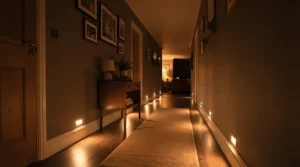
Motion sensor hallway lights are lighting fittings or add-on sensors that switch on automatically when they detect movement, usually through a passive infrared (PIR) sensor, then switch off after a set delay. They give you hands-free light in narrow, high-traffic spaces such as hallways, stairs and landings, without hunting for a switch.
Hallways are the most-walked, least-loved rooms in the house. You cross them at 2am half-asleep, at 7am with a laundry basket wedged under one arm, and at 6pm with shopping bags slowly cutting off your circulation. Fumbling for a switch in any of those moments is a small daily indignity. Good motion sensor hallway lights quietly end it. UK lighting retailers note that the category has drifted from burglar-deterrent gadgetry towards everyday convenience, and it’s easy to see why.
This guide covers 7 real products: stick-on pucks, plug-in night lights, rechargeable bars, hardwired ceiling fittings and smart sensors. I haven’t tested any of them personally. Everything below is analysis built from published specifications and aggregated review sentiment, and it’s labelled that way. Along the way we’ll decode PIR detection angle, explain what a lux sensor really does, and set a sensible auto-off timer. We’ll also weigh a battery motion sensor light against a PIR ceiling light hallway install, and sort out the right sensor light for landing duty at the top of the stairs.
Motion Sensor Hallway Lights at a Glance: Quick Comparison
Before the deep dive, here’s the whole field on one screen. The seven products fall into three camps: battery or rechargeable lights that go anywhere, hardwired ceiling fittings that replace what you have, and smart sensors that trigger bulbs you already own. Detection figures are taken from manufacturer and retailer specifications, and some listings disagree with each other, so treat the ranges as indicative.
| Product | Power | Detection | Best For |
|---|---|---|---|
| Guankai 8 Pack Motion Sensor Stair Light | 3 AAA per puck | 120°, roughly 1.5-5 m | Renters and stair edges |
| LOHAS-LED Motion Sensor Night Light | Mains plug-in | 120°, roughly 3-5 m | Hallways with a spare socket |
| MCGOR 14.7-inch Under Cabinet Lighting | USB-C rechargeable | 120°, about 3 m | Long corridors without sockets |
| Philips Shan LED Ceiling Light with PIR Sensor | Hardwired | 360°, 12 m | Hall junctions and wide landings |
| Philips Mauve LED Ceiling Light with PIR Sensor | Hardwired | 100°, 8 m | Straight hallways needing daylight control |
| Aqara Motion Sensor P1 | Coin-cell battery | 170° near, 150° at 7 m | Smart-home tinkerers |
| Philips Hue Indoor Motion Sensor | 2 x AAA | 100°, 5 m | Homes already running Hue bulbs |
Looking at the table, the Guankai 8 Pack Motion Sensor Stair Light and the LOHAS-LED Motion Sensor Night Light are the cheapest ways in, but neither replaces a proper ceiling light. The Philips Shan LED Ceiling Light with PIR Sensor offers the widest coverage, while the Philips Mauve LED Ceiling Light with PIR Sensor is the one to pick if daylight control matters. The two smart sensors, Aqara Motion Sensor P1 and Philips Hue Indoor Motion Sensor, are only worth it if you already own compatible bulbs and a hub or bridge.
💬 Just one click — help others make better buying decisions too!😊
Top 7 Motion Sensor Hallway Lights: Expert Analysis
1. Guankai 8 Pack Motion Sensor Stair Light — cheapest way to light a whole staircase
Eight small stick-on pucks for the price of one mid-range sensor fitting. That makes this the obvious route when you want a trail of light rather than one big pool.
Each puck runs on three AAA batteries (not included), with a 120° sensing angle and a range that listings put between roughly 1.5 and 5 metres. In practice 120° is a generous fan for a straight hallway. The “up to 5 m” figure is a best case, so expect reliable triggering as you walk towards a unit rather than from the far end of the corridor. Sources quote up to four months of battery life, but do the maths: eight pucks times three AAAs is 24 batteries per refill.
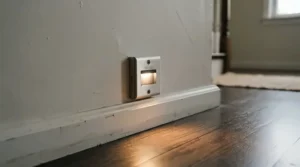
On the analysis, this suits renters, short hallways and stair edges, and it works best as a guide light rather than a main light. The sensor is always armed, with no off switch on the version I checked.
Aggregated review sentiment is consistent. Reviewers and roundups praise the peel-and-stick fitting and the soft warm glow, and the most repeated complaint is the missing switch. I couldn’t verify rating counts, so I’m quoting none.
Pros:
- ✅ Stick-on fitting, no drilling or tools
- ✅ Soft warm light that won’t dazzle at night
- ✅ Eight units cover several spots at once
Cons:
- ❌ No off switch, so the sensor is always armed
- ❌ Roughly 24 AAA batteries per full refill
Expect a price under £20 for the set. Strong value for stairs, though battery costs add up, so check the current price.
2. LOHAS-LED Motion Sensor Night Light — plug-in simplicity with a dusk-to-dawn mode
If your hallway has a socket, this is the least fussy option in the round-up: plug it in and you’re done.
Listings describe a warm 3000K LED of around 1W, with brightness steps that vary by variant (commonly 30/60 lumens, some with a lower or higher step). It has two modes: “ON” runs dusk to dawn, while “AUTO” lights only on motion. One listing quotes a 120° angle and a 3-5 m range. Because the sensor sits at socket height, it sees ankles and legs rather than shoulders, which is fine for walking past but less useful for spotting someone at the far end.
My honest take is that this is a night-path light, not a hall light. It’s ideal for the bedroom-to-bathroom dash, for children, and for older relatives. Variants differ, so check that the listing you pick is the UK-plug version. One UK-sourced listing showed CE and UKCA marking.
Published roundups describe a sensitive trigger and gentle warm light that suits hallways and bathrooms. A few commentators note the output is modest, which is the point of a night light.
Pros:
- ✅ Plugs into a standard UK socket
- ✅ Warm 3000K glow that’s easy on tired eyes
- ✅ Motion-only or dusk-to-dawn modes
Cons:
- ❌ Uses up a socket you may want
- ❌ Low output and low mounting height
Expect roughly £8-£15 for a twin pack. Cheap, cheerful and effective; check current price and the exact variant.
3. MCGOR 14.7-inch Under Cabinet Lighting — rechargeable bars with a proper night-light mode
Despite the name, these bars (model GLS-C010) make smart corridor lights, because a bar spreads light along a wall instead of dotting it in puddles.
Each bar carries 63 LEDs delivering around 180 lumens, with five dimming levels. The 120° sensor reaches roughly 3 m, and listings state an auto-off after about 20 seconds. The built-in battery is around 2,200mAh and charges over USB-C. In real terms 180 lumens is a path-finder rather than a reading lamp. It shows you the floor and door frames, and the dimmer levels stop you being blinded at 3am. Three modes (on, auto, off) mean you can finally disable the sensor when you need to.
This is the strongest battery motion sensor light here for a long, socket-free corridor. Magnets or adhesive plates (plates and screws are included) let you reposition it freely.
Reviewers praise the three-mode switch, the spare magnets and the auto-on as you approach. Battery life on auto looks fine in quiet spots, but a roundup of the smaller 10-inch version warns that busy kitchens may need charging every few days. Hallway traffic sits somewhere between the two.
Pros:
- ✅ Three modes, including a true “off”
- ✅ Five brightness levels with a soft night setting
- ✅ Magnet or adhesive mounting, easy to move
Cons:
- ❌ Fixed timer of about 20 seconds per listings
- ❌ Needs periodic USB-C charging
Expect around £20-£35 for a two-pack. Good value if you’d rather charge than swap batteries; check current price.
4. Philips Shan LED Functional Ceiling Light with PIR Sensor — widest 360° coverage for hall junctions
When a hallway has doors and stairs leading off in all directions, a sensor that sees everywhere beats one that stares down a corridor.
The listing shows 12W and 1150 lumens, with a 360° PIR sensor and a 12 m range. It has no dusk-to-dawn sensor, a plastic body and lens, and a rated life of up to 15,000 hours, with a stated 12 kWh per 1,000 hours. The 1150 lumens is roughly what an old 75W bulb gave, enough to light a typical hall properly. The 360° pattern catches movement from bedroom doors, stairs and the front door alike. The 12 m reach exceeds most UK hallways, so it may trigger early, even from an adjoining room through an open door.
The trade-off is the missing lux sensor. With no daylight cut-off it fires in broad daylight whenever anyone walks past. That’s wasteful in a sunny hall but harmless in a windowless one.
I couldn’t verify a meaningful review pool for this exact model, so I’m leaning on the spec sheet here. It’s rated indoor only and not for bathrooms.
Pros:
- ✅ 360° coverage with no blind spots
- ✅ Bright 1150-lumen output
- ✅ Long rated life of up to 15,000 hours
Cons:
- ❌ No daylight sensor, so it triggers by day
- ❌ Hardwired install, not for bathrooms
Expect roughly £25-£35. Best value in windowless halls; check current price.
5. Philips Mauve LED Ceiling Light with PIR Sensor — adjustable dusk-to-dawn control
This is the Philips Shan‘s more thoughtful sibling: brighter, warmer-toned and, crucially, able to ignore daylight.
The listing gives 16W and 1700 lumens in a warm white, with a 100° PIR sensor reaching 8 m. It has an adjustable dusk-to-dawn sensor, IP20 indoor rating, a thermoplastic diffuser and up to 15,000 hours of life. The adjustable lux sensor is the headline. You can set how dark it must be before the PIR is allowed to act, which cures the daytime-firing problem. The narrower 100° angle suits a straight hallway but may miss people entering from the side at a T-junction.
A word of caution on brightness. 1700 lumens in a narrow hall is a lot at 2am, and the listing mentions no night-dimming mode. If you’re light-sensitive, that matters more than any other spec.
I couldn’t verify a robust review pool for this model either, so the specification is my main evidence.
Pros:
- ✅ Adjustable dusk-to-dawn sensor
- ✅ Warm white tone suits homes
- ✅ 1700 lumens floods the whole hall
Cons:
- ❌ Narrower 100° detection field
- ❌ No night-dimming mode listed
Expect roughly £25-£35. A sound mid-range pick for straight halls; check current price.
6. Aqara Motion Sensor P1 — finest control over timeout and sensitivity
This is a sensor, not a light, so you’ll need a compatible Aqara hub and a smart bulb or plug. What you get in return is the most tuneable trigger on this list.
Listings describe a 170° field at short range and 150° out to around 7 m. Retailers disagree on the near-range distance (2 m versus 4 m), so test it. You get three sensitivity levels, a built-in light sensor, and a timeout adjustable from 1 to 200 seconds. Aqara cites up to five years of battery life with the indicator off and timeouts of 30 seconds or more. Shorter timeouts shorten battery life.
Here’s the analytical point. A tuneable timeout lets you do what fixed-timer lights can’t: 15 seconds on a quick hall dash, 90 seconds on the landing. A lux rule (Aqara’s own example uses 30 lux) stops lights firing in daylight. It works with HomeKit and Alexa.
Reviews in the sources I checked are a small sample, mixing praise for the light sensor with the odd reliability gripe, so I’d call sentiment mixed to positive.
Pros:
- ✅ Timeout adjustable from 1 to 200 seconds
- ✅ Built-in light sensor for lux rules
- ✅ Long battery life with sensible settings
Cons:
- ❌ Needs a hub plus bulbs or plugs
- ❌ Range figures vary between listings
Expect roughly £15-£25 for the sensor alone. Excellent value if the ecosystem is already there; check current price.
7. Philips Hue Indoor Motion Sensor — polished, app-controlled and fiddly to set up
If your hallway already has Hue bulbs, this is the sensor they were designed to meet.
It pairs a PIR sensor with a daylight sensor, using a 100° detection angle and a roughly 5 m range. It runs on two AAA batteries, typically lasting about two years, and carries an IP42 rating. It attaches magnetically to its wall mount, and the app lets you adjust daylight sensitivity, motion sensitivity and how long lights stay on, with different behaviour by time of day. It needs the system’s bridge, which is not included.
What most buyers overlook is that the real value is the scenes. Dim warm light at night, bright white by day, automatically. That’s a genuine upgrade over a single fixed output, but it only pays off if you’re already invested in the ecosystem.
Retailer reviews are mixed: some owners love hands-full convenience on dark stairways, while at least one found configuration too fiddly and gave up. Setup patience is the deciding factor.
Pros:
- ✅ Separate day and night lighting scenes
- ✅ Adjustable daylight and motion sensitivity
- ✅ Typical battery life of around two years
Cons:
- ❌ Requires a bridge and compatible bulbs
- ❌ Reviewers report fiddly configuration
Expect roughly £30-£45 for the sensor. Worth it only inside an existing system; check current price.
Top 7 Side by Side: Specs, Prices and Review Signals
| Product | Key Spec | Price Range | Review Signal | Best For |
|---|---|---|---|---|
| Guankai 8 Pack | 120°, 3 AAA per puck | Under £20 | Positive; no-switch complaints | Guankai 8 Pack for stairs |
| LOHAS-LED | 3000K, dusk-to-dawn mode | £8-£15 | Positive on sensitivity | LOHAS-LED for bedroom-to-bathroom |
| MCGOR 14.7-inch | 180 lm, 5 dim levels | £20-£35 | Positive; charging varies | MCGOR 14.7-inch for long corridors |
| Philips Shan | 360°, 12 m, 1150 lm | £25-£35 | Not verified | Philips Shan for junctions |
| Philips Mauve | 100°, 8 m, 1700 lm | £25-£35 | Not verified | Philips Mauve for straight halls |
| Aqara P1 | 1-200 s timeout | £15-£25 | Mixed to positive | Aqara P1 for tuning |
| Philips Hue Motion Sensor | Day/night scenes | £30-£45 | Mixed | Philips Hue Motion Sensor for Hue homes |
The table shows a clear price ladder. The Guankai 8 Pack, LOHAS-LED and MCGOR 14.7-inch deliver light with no installation, while the two Philips ceiling fittings deliver real brightness for similar money. The Aqara P1 and Philips Hue Motion Sensor cost little but need extra gear, so their true price is higher. Where review data is “not verified”, I’ve said so rather than guess.
Practical Usage Guide: Setting Up Motion Sensor Hallway Lights in an Afternoon
Most disappointment with motion sensor hallway lights comes from setup, not hardware. Here’s a simple order of work.
- Walk the route first. Stand where you’d normally enter the hallway and note every doorway, stair and turning. Sensors should cover entry points, not just the straight run.
- Test before you stick. Hold a battery light in place, switch it to auto and walk the route in the dark. Move it until it triggers a step or two before you need it.
- Mind the heat. Keep sensors away from radiators, boiler flues and sunny windows, which can cause false triggers.
- Set the timer and lux sensor (more on both below) before you consider the job finished.
Maintenance schedule:
- Monthly: test each battery light by walking past in the dark.
- Every 3-4 months: swap AAAs in the Guankai 8 Pack pucks, or recharge the MCGOR 14.7-inch bars.
- Yearly: wipe sensor lenses with a dry cloth, since dust dulls detection.
Mistakes in the first 30 days:
- mounting a sensor facing a bright window
- setting a timer so short that you’re plunged into darkness mid-stride
- forgetting the batteries are the weakest link and leaving dead units in place

Problem → Solution Guide: Fixing Common Hallway Sensor Headaches
Problem 1: the light comes on in the daytime. This usually means no lux sensor, or one set too high. The Philips Shan has no daylight control at all, so consider the Philips Mauve instead, or use the lux rule on an Aqara P1 or Philips Hue Motion Sensor.
Problem 2: it switches off while you’re still there. PIR sensors respond to movement, so someone sitting still on a landing goes “invisible”. Lengthen the timer where you can, or choose a sensor with a configurable timeout such as the Aqara P1.
Problem 3: ghost triggers. Heat sources and pets are the usual culprits. Reduce sensitivity, re-aim the sensor, or move it away from the radiator.
Problem 4: batteries die too fast. Short timers and busy hallways drain batteries quickly. Switch to rechargeable units like the MCGOR 14.7-inch, or move to a plug-in such as the LOHAS-LED Motion Sensor Night Light.
Problem 5: it’s too bright at night. Pick a model with dimming, such as the MCGOR 14.7-inch, or use the dusk-to-dawn night mode of the LOHAS-LED Motion Sensor Night Light.
✨ Don’t Miss These Exclusive Deals!
🔍 Take your hallway lighting to the next level with these carefully selected products. Click on any highlighted item to check current pricing and availability. These picks will help you create a safer, smarter home your family will love!
How to Choose Motion Sensor Hallway Lights: 6 Steps That Actually Matter
Choosing well is mostly about matching the product to the hallway rather than chasing the biggest number on a spec sheet. Work through these six steps in order.
- Pick the power source. Mains (ceiling or plug-in) means no maintenance but needs an installer or a socket. Battery or rechargeable means flexibility but a recurring chore.
- Check the PIR detection angle and range. A wider angle covers junctions, while a narrower one suits a straight corridor.
- Demand a lux sensor. Without daylight control, lights waste energy and annoy people by day.
- Look at the auto-off timer. Adjustable beats fixed. If it’s fixed, know the number before buying.
- Match brightness and colour to purpose. Around 3000K and a dimmable output suit night use, while 1000+ lumens suits a main ceiling light. Coventry City Council’s falls-prevention guidance singles out halls linking bedrooms and bathrooms as places needing adequate lighting.
- Confirm indoor rating and compliance. Look for IP20 at minimum, UKCA or CE marking, and a “not for bathrooms” warning where applicable.
A quick example shows how the steps work together. A narrow 1 m-wide hallway with a spare socket and a sleeping toddler points to the LOHAS-LED Motion Sensor Night Light. A windowless hall with two bedroom doors and stairs points to the Philips Shan. A smart home with Hue bulbs everywhere points to the Philips Hue Indoor Motion Sensor.
PIR Detection Angle: What the Numbers Mean in a Real Hallway
The PIR detection angle is the width of the fan in which a sensor can notice heat movement. A quoted 100° and a quoted 360° describe completely different jobs.
PIR sensors work by comparing infrared levels between two sensing elements as warm bodies cross their zones. In general terms they react best to movement across their field of view rather than straight towards the lens. That is why a sensor on an end wall, looking straight down a corridor, can be slower to notice a person walking directly at it than one mounted on a side wall.
Here’s how the angles compare:
- Philips Shan: 360° at 12 m, ideal ceiling-mounted at a junction.
- Philips Mauve: 100° at 8 m, best in a straight run.
- Philips Hue Indoor Motion Sensor: 100° at roughly 5 m, adjustable by tilting.
- Aqara P1: 170° close in, 150° at distance, on a 360° stand.
- Guankai 8 Pack and MCGOR 14.7-inch: 120°, short range.
Based on the spec comparison, my advice is simple. For a straight hallway, 100-120° is enough if you mount sideways on. For junctions and landings, go wide, or fit two sensors. Always walk the route in the dark before committing, because real-world performance depends on mounting height and clothing as much as on the datasheet.
Lux Sensor Settings: Stopping Lights Firing in Daylight
A lux sensor (or photocell) measures ambient light so that motion sensor hallway lights only act when it’s dark enough. Lux simply measures light falling on a surface, and higher numbers mean brighter surroundings. Setting the threshold too high gives you lights that stay off in a gloomy hall. Setting it too low gives you lights that fire in bright daylight.
Here’s how the products handle it:
- Philips Mauve: adjustable dusk-to-dawn sensor.
- Philips Hue Indoor Motion Sensor: daylight sensor with adjustable sensitivity in the app.
- Aqara P1: built-in light sensor, with example rules such as “below 30 lux, turn on” (configurable).
- LOHAS-LED Motion Sensor Night Light: a dusk-to-dawn mode alongside motion.
- MCGOR 14.7-inch: listings say it operates in dark or low light.
- Philips Shan: no daylight sensor.
Practical tip: set your threshold at dusk, with the hall’s normal lamps on. A glazed front door can leak enough daylight to keep a sensible lux sensor satisfied all day, which is exactly what you want. If lights flicker on and off in a half-lit hall, the fitting may be seeing its own output, so raise or lower the threshold slightly. That’s a configuration problem rather than a faulty product.
Auto-Off Timer: Finding the Sweet Spot
An auto-off timer decides how long motion sensor hallway lights stay lit after the last movement. It’s the setting most people never touch and most people should.
Here’s the picture across our seven:
- Guankai 8 Pack and MCGOR 14.7-inch: roughly 20 seconds, as listed.
- Aqara P1: adjustable from 1 to 200 seconds.
- Philips Hue Indoor Motion Sensor: adjustable in the app.
- Philips Shan and Philips Mauve: timer settings aren’t stated in the listings I found, so check the manual.
A 5 m hallway takes about five seconds to cross, so 20 seconds suits a quick dash. It’s too short for a loaded laundry basket, a slow ascent of the stairs, or someone tying their shoes. My suggested starting points, which are reasoning rather than a standard, are 30-60 seconds for hallways and 60-120 seconds for landings and for older users.
The cost of longer timers is tiny. A 12W fitting lit for ten minutes a day uses well under a kilowatt-hour a year (about 0.7 kWh). The only real penalty is on battery sensors: Aqara notes that shorter timeouts reduce battery life, so the trade-off runs the other way for them.
Motion Sensor Hallway Lights vs Traditional Switched Lighting
| Feature | Motion Sensor Setup | Traditional Switch | Best For |
|---|---|---|---|
| Hands-free use | Yes | No | Philips Mauve for busy halls |
| Lights left on | Rarely | Common | LOHAS-LED for kids’ routes |
| Night-time safety | Light before you reach the step | Needs a hand free | MCGOR 14.7-inch for landings |
| Upfront cost | Low to moderate | Already fitted | Guankai 8 Pack for budgets |
| Installation | Stick-on to hardwired | Existing wiring | Philips Shan for replacements |
The headline is that a switch needs a free hand and a memory, whereas motion sensor hallway lights need neither. Falls-prevention advice from NHS-linked sources (more on that below) specifically suggests considering motion-activated lights. For households with children, older relatives, or arms full of shopping, that’s a safety feature rather than a gimmick. Traditional switches still win on predictability, which is why the best setups keep the wall switch and add a sensor rather than removing it.
PIR Ceiling Light Hallway or Battery Motion Sensor Light? Choosing Your Power Source
A PIR ceiling light hallway fitting and a battery motion sensor light solve different problems, so the best answer is often both.
The case for a PIR ceiling light hallway fitting. The Philips Shan (1150 lumens) and Philips Mauve (1700 lumens) produce real room-filling light. There are no batteries to swap, no charging, and the sensor never runs out. The cost is installation: you’re replacing an existing fitting, and anything involving wiring deserves a competent person.
The case for a battery motion sensor light. The Guankai 8 Pack and MCGOR 14.7-inch go anywhere in minutes and suit rented homes. At about 180 lumens per bar, though, they guide rather than illuminate, and the batteries are a recurring chore that eventually fails at 3am.
The hybrid. Fit a PIR ceiling light hallway fitting for main illumination and add battery pucks or bars as low-level path markers along skirting or stair edges. It’s belt and braces, and it keeps you covered when a battery dies. If you’d rather avoid wiring altogether, the LOHAS-LED Motion Sensor Night Light is the no-fuss compromise.
Sensor Light for Landing: Getting the Top of the Stairs Right
A sensor light for landing use is arguably the highest-value spot in the house. Falls-prevention material from the NHS in Wirral recommends good lighting on stairs and landings and motion-activated lights around the home, and the logic is simple. The most dangerous moment is the first step down, in the dark, half-awake.
Three placement principles help:
- Trigger early. The light should come on at the bedroom door, before you reach the stairs, not as you arrive at the top step. A 360° ceiling sensor like the Philips Shan on the landing suits this well.
- Light the edges. Low-level units such as the Guankai 8 Pack pucks along the stair edge or the MCGOR 14.7-inch bars along a wall define the steps.
- Lengthen the timer. Stairs are slow, so use at least 60 seconds where adjustable, for example on an Aqara P1 or Philips Hue Indoor Motion Sensor.
One caution: if your landing light is controlled by two-way switches, check with an electrician before swapping in a PIR fitting, so both switches keep working. Whatever you choose, a sensor light for landing duty is a supplement to a working handrail and a clutter-free stair, not a replacement.
Long-Term Cost and Maintenance: What These Lights Really Cost to Run
Purchase price is only half the story with motion sensor hallway lights. Running costs and chores matter just as much.
Battery units: the Guankai 8 Pack is cheap upfront but needs 24 AAAs per refill. Reusing rechargeable AAAs cuts the waste, and the MCGOR 14.7-inch avoids disposable cells altogether by charging over USB-C.
Plug-ins: the LOHAS-LED Motion Sensor Night Light is rated around 1W, so electricity is negligible. Its cost is the socket it occupies.
Hardwired fittings: the Philips Shan lists 12 kWh per 1,000 hours, and the Philips Mauve is 16W. Because they only light when needed, annual energy use is small. The listed life of up to 15,000 hours means LED wear is unlikely to be the limiting factor. The driver or sensor is more likely to fail first, so keep the receipt.
Smart sensors: the Aqara P1 and Philips Hue Indoor Motion Sensor cost little to run, with batteries lasting years, but the true cost includes the hub, bridge and bulbs they control.
Sensibly, the cheapest long-term option is whichever one you’ll actually maintain. A unit with dead batteries has a running cost of zero and a safety value to match.
Safety, Regulations and Compliance for Motion Sensor Hallway Lights
Safety is mostly common sense, with a few UK-specific points.
Hardwired fittings. The Philips Shan and Philips Mauve are mains-wired indoor luminaires. Under Part P of the Building Regulations in England, replacing a light fitting is generally treated as non-notifiable if the wiring stays the same. Even so, Which? Trusted Traders recommends using a registered electrician and notes that the work must still meet the same safety standards. If you’re unsure, hire a professional.
Ratings and locations. Both Philips fittings are rated for indoor use (IP20), and the Philips Shan is marked as not for bathrooms. Don’t install them in wet zones.
Plug-in and battery lights. Look for UKCA or CE marking on plug-in units such as the LOHAS-LED Motion Sensor Night Light. Dispose of used batteries from the Guankai 8 Pack responsibly.
Falls safety. Remember that light alone doesn’t prevent falls. Keep stairs clear, handrails secure, and treat any sensor light as one layer of protection.
FAQ: Motion Sensor Hallway Lights
❓ Does a lux sensor stop motion sensor hallway lights coming on in daylight?
❓ How long should an auto-off timer be on motion sensor hallway lights?
❓ Is a battery motion sensor light bright enough for a hallway?
❓ Can I fit a sensor light for landing use without an electrician?
❓ Will pets set off PIR ceiling light hallway fittings?
Conclusion: Which Motion Sensor Hallway Lights Should You Buy?
Here’s the short version. For the cheapest path to safer stairs, the Guankai 8 Pack Motion Sensor Stair Light is hard to beat, as long as you accept the battery chore. For a socket-powered night path, the LOHAS-LED Motion Sensor Night Light is simple and affordable. For a long corridor with no sockets, the MCGOR 14.7-inch Under Cabinet Lighting is the most flexible rechargeable option.
If you want proper ceiling light, the Philips Shan LED Ceiling Light with PIR Sensor suits windowless junctions, while the Philips Mauve LED Ceiling Light with PIR Sensor is the better pick wherever daylight is a factor. And if you’re building a smart home, the Aqara Motion Sensor P1 offers the finest tuning, while the Philips Hue Indoor Motion Sensor makes sense only inside a Hue setup.
Whatever you pick, spend ten minutes on three settings: the PIR detection angle, the lux sensor threshold and the auto-off timer. They make more difference than any brand name. Choose a power source you’ll realistically maintain, and add the sensor light for landing duty first, because that’s where the stakes are highest.
Recommended for You
- Bathroom Night Light With Motion Sensor: 7 Best UK Picks (2026)
- Bathroom Shaver Light With Socket: 7 Safe, Smart UK Picks (2026)
- Bathroom Spotlights Vs Downlights: 7 Best Picks For UK Homes (2026)
Disclaimer: This article contains affiliate links. As an Amazon Associate, I earn from qualifying purchases. If you purchase products through these links, we may earn a small commission at no additional cost to you.
✨ Found this helpful? Share it with your friends! 💬🤗
