
In This Article
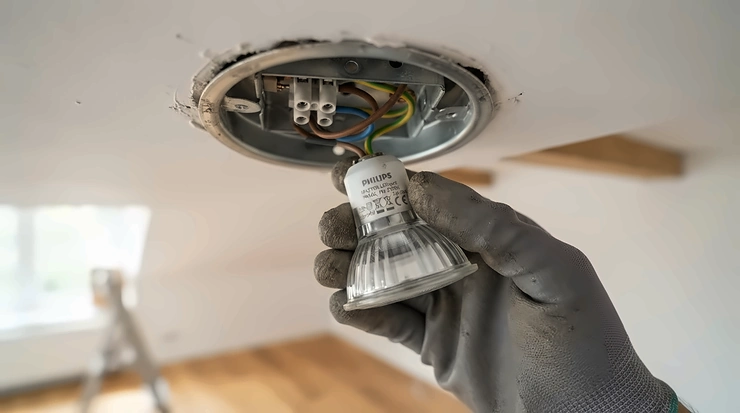
Bathroom spotlights vs downlights comes down to direction and spread. Spotlights are usually tiltable fittings that throw a focused beam. Downlights sit fixed in the ceiling and wash a wider area with light. In UK bathrooms both must carry an IP rating suited to their zone, and both punch holes in a ceiling that fire safety rules care about. 💡
Here’s the twist: in the shops and on Amazon UK the two words are used almost interchangeably. A “bathroom spotlight kit” might contain fixed downlights, and a “downlight” listing might be fully adjustable. So the label matters less than three specifics: the IP rating, the fire rating, and the beam angle.
Get those right and recessed bathroom spotlights will make a small room feel calm, bright and a little bit expensive. Get them wrong and you’ll be squinting at your own reflection under a hard glare, or ripping out fittings that never should have gone above a shower. Nobody wants that on a Tuesday morning.
Before you buy, it helps to understand how bathroom zones and IP ratings divide the room by proximity to water. I’ve researched seven real fittings across budget, mid-range and premium tiers. Below you’ll find honest analysis of what each one does well, where each one compromises, and which bathroom each suits. ⚡
Quick Comparison: 7 Bathroom Downlights and Spotlights at a Glance
Prices below are indicative ranges drawn from UK electrical retailer listings at the time of research, not Amazon prices. They vary by seller, finish and pack size, so check current price before buying. I’ve left out star ratings deliberately. I couldn’t verify consistent, current Amazon UK review scores for these exact variants, and I won’t invent them.
| Product | Type | Fire rating | Bathroom (IP65) route | Price range (indicative) | Best For |
|---|---|---|---|---|---|
| Aurora EFD Pro | GU10 can, insulation coverable | 30/60/90 min | IP65 bezel, sold separately | Around £10-£20 with bezel | Renovations under loft insulation |
| Integral Evofire | GU10 open design | 30/60/90 min | IP65 versions | Around £10-£20 | Small, steamy bathrooms |
| Saxby ShieldONE 65 | GU10 can, 65mm cut-out | 30/60/90 min | IP65 bezel, sold separately | Around £8-£15 all-in | Tight ceilings, finish choice |
| Aurora EFD | GU10 can | 30/60/90 min | IP65 version | £8-£13 range | Tight budgets |
| Integral Lux Fire | Integrated 9W LED | 30/60/90 min | IP65 | £10-£16 range | Fit-and-forget simplicity |
| ALL LED Atom | Integrated 5W, CCT selectable | Fire rated | IP65 | Around £10-£20 | Adjustable colour temperature |
| Aurora R6 | Integrated 6W, Class II | Fire rated | Listed in IP65 ranges | Around £10-£20 | Simple wiring, switchable options |
Read the table as a decision map rather than a league table. The GU10 fittings (Aurora EFD Pro, Integral Evofire, Saxby ShieldONE 65, Aurora EFD) let you swap bulbs and choose your own beam angle. The integrated models (Integral Lux Fire, ALL LED Atom, Aurora R6) trade that flexibility for convenience. Budget buyers should note that Saxby ShieldONE 65 looks cheapest until you add the IP65 bezel and the lamp.
💬 Just one click — help others make better buying decisions too!😊
Top 7 Bathroom Downlights and Spotlights: Expert Analysis
1. Aurora EFD Pro — insulation coverable with slim bezels
The Aurora EFD Pro (model EN-DLM981X) is the fitting to look at if your bathroom ceiling sits under a blanket of loft insulation.
Aurora’s listing says it is fibre insulation coverable up to 300mm, for LED lamps only. In practice that means no hood or guard to buy, which removes a classic installation headache. It has a 75mm cut-out and tested 30, 60 and 90 minute fire ratings. It also has a push-fit loop-in/loop-out terminal block, which saves faffing about at the ceiling.
Here is what the listing won’t shout about: the fitting is only IP20 with the standard bezel. For bathroom zones you must buy the IP65 bezel separately. One buyer question on a trade listing shows exactly this confusion, so read the part numbers twice.
Reviews are hard to summarise reliably. One UK trade listing shows a review count of 75, but I couldn’t verify the star average. If I had to pick this for a loft-insulated en-suite, I’d do it on the strength of the spec sheet rather than crowd opinion.
Pros:
- ✅ Insulation coverable without extra accessories
- ✅ Push-fit terminals speed up installation
- ✅ Slim twist-and-lock bezels in several finishes
Cons:
- ❌ IP65 needs a separately bought bezel
- ❌ Lamp not included, adding to the total
Expect to spend around £10-£20 per fitting once the bezel is added (check current price). That is a fair premium for the install-time savings.
2. Integral Evofire — open design that runs cooler
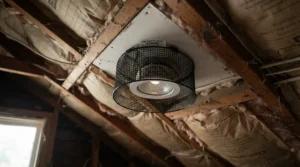
The Integral Evofire (for example ILDLFR70D003, with IP65 variants such as ILDLFR60D104) takes a different engineering route from most fire rated cans.
Instead of burying your lamp inside a metal canister, it uses a fully open design. Integral says lamps run up to 10°C cooler than in a typical can-style fire rated fitting. That is a manufacturer claim, but it makes physical sense. Heat is the enemy of LED drivers, and bathrooms are warm, humid places already. Cooler running should help lamp longevity.
Other verified specs include a 70mm cut-out, steel construction, a 1mm blend-in bezel and fire ratings of 30/60/90 minutes. A GU10 holder and insulation guard are supplied. Integral also lists a seven-year warranty, extended in March 2025.
On reviews, I couldn’t verify a robust pool for the specific variants, so treat sentiment as unknown. What the warranty does tell you is that the maker is confident about heat management.
This is my pick for small, steamy shower rooms with bulbs you’ll replace in a few years’ time.
Pros:
- ✅ Open design lets lamp heat escape
- ✅ Ultra-thin 1mm bezel looks discreet
- ✅ Seven-year manufacturer warranty
Cons:
- ❌ GU10 lamp bought separately
- ❌ Costs more than basic canister fittings
Budget around £10-£20 per fitting (indicative). It is good value if you plan to keep the bathroom for a decade.
3. Saxby ShieldONE 65 — tiny cut-out, swap-in bezels
The Saxby ShieldONE 65 (109805) wins on flexibility, because the fitting and the bezel are separate decisions.
The fitting needs only a 65mm hole, which suits cramped ceilings where joists leave little room. You then choose from around ten bezel styles, including fixed, tilt and IP65 options. That makes it one of the few ways to get an adjustable spotlight look with a fire rated body behind it.
Saxby’s manual lists 30, 60 and 90 minute fire ratings, I-joist certification to 30 minutes, UKCA conformity and dimming with a dimmable lamp. Note the lamp limit: a maximum of 7W LED GU10.
That cap is sensible for heat, but it rules out punchy lamps. For a single-person shower room it is plenty; for a big family bathroom you’ll just use more fittings.
I couldn’t verify review sentiment for this range on Amazon UK. The honest takeaway is that it’s popular with electricians for its bezel choice, but I have no sourced data to quantify that.
Pros:
- ✅ 65mm cut-out suits tight ceilings
- ✅ Ten bezel finishes, including IP65 options
- ✅ Very low cost for the fitting itself
Cons:
- ❌ Seven-watt lamp ceiling limits brightness
- ❌ Bezel and lamp are extra purchases
The can alone sits under £5 at retailers, but all-in expect around £8-£15 per light. It’s brilliant value if you shop smart.
4. Aurora EFD — IP65 on a budget
The Aurora EFD (bathroom version EN-FD103W, with chrome and satin nickel siblings) is the no-fuss entry point.
The EN-FD103W is sold as a single IP65 product, so there’s no separate bezel to forget. It is a traditional can design in aluminium, tested for 30, 60 and 90 minute ceilings, with a three-year guarantee quoted by one UK retailer. You supply a GU10 lamp; retailers suggest an Aurora or Philips 5W LED.
Its limits are real, though. Retailers position the Aurora EFD Pro as the insulation coverable upgrade, so if you have deep loft insulation, check the guidance before choosing this model.
Reviews for this exact code weren’t verifiable in my research. What I can say is that its popularity among installers fits its simple, no-surprises specification.
For a family bathroom where money is tight, this is the sensible, slightly dull choice. In lighting, dull often means reliable.
Pros:
- ✅ IP65 included in one product code
- ✅ Three finishes to match taps
- ✅ Low cost of entry
Cons:
- ❌ Bulkier traditional canister design
- ❌ Not the insulation coverable option
Typically a £8-£13 range per fitting (check current price). Excellent value for straightforward ceilings.
5. Integral Lux Fire — integrated LED, no bulb to buy
The Integral Lux Fire (ILDLFR70A005 in matt white) is for people who’d rather not think about GU10 bulbs at all.
The LED is integrated. It’s a 9W COB source giving 640 lumens at 3000K warm white, with a 36° beam angle and a 70mm cut-out. It is IP65, dimmable, and fire rated to 30, 60 and 90 minutes. Integral also states air-tightness compliance with Parts C and L.
The 36° beam is narrow. In a small room it creates pools of light with softer edges, which looks lovely over a vanity but can feel patchy across a shower. The “equivalent to 51W” claim is marketing shorthand for halogen, so ignore it and focus on the 640 lumens.
The trade-off is serviceability. If the LED dies, the whole unit goes. I couldn’t verify review sentiment, so the long-term reliability picture is incomplete. A listing on one retailer mentions an older trade review for the range, but I wouldn’t lean on it.
Pros:
- ✅ One-box solution, no bulbs to match
- ✅ Dimmable with a compatible dimmer
- ✅ Soft-edged COB glow looks premium
Cons:
- ❌ Whole unit replaced if the LED fails
- ❌ Narrow beam may leave gaps
Around £10-£16 per unit (check current price), and cheaper in multi-packs. Good value for hassle-free installs.
6. ALL LED Atom — selectable colour temperature
The ALL LED Atom (AFD05/F/WH/CCT fixed, AFD05/A/WH/CCT adjustable) is the one that lets you change your mind after installation.
The verifiable specs are a 5W integrated LED, IP65, dimmable, fire rated, and CCT selectable. That last feature is the clever bit. Instead of agonising between warm and cool white, you choose at fitting stage. That helps if the bathroom doubles as a make-up zone or you’re unsure how light will feel against your tiles.
It also comes in fixed and adjustable versions, so this is one of the few integrated models that genuinely covers both the “downlight” and “spotlight” sides of the debate. I couldn’t verify its lumen output or exact cut-out from the sources I could access, so check the datasheet before ordering. At 5W, I’d expect modest output, so plan on more fittings for larger rooms.
No review data was verifiable for this model, so I can’t comment on field reliability.
Pros:
- ✅ Selectable colour temperature on installation
- ✅ Fixed and adjustable versions available
- ✅ IP65 and dimmable in one package
Cons:
- ❌ Five-watt output suits smaller rooms only
- ❌ Key figures harder to verify from listings
Likely around £10-£20 per light (indicative). It is good value for flexibility, as long as the datasheet checks out.
7. Aurora R6 — Class II simplicity with switchable options
The Aurora R6 (for example AU-R6/40, a 6W fire rated fixed model at 4000K) suits people who want a neat integrated fitting with some adjustability.
It is an integrated downlight, and a retailer notes it is Class II. That means double insulated, so no earth connection is needed. Always confirm this with the installation instructions and an electrician. Aurora also offers switchable variants, including a colour-switchable 6W version, and the model sits in IP65 ranges at retailers. Confirm the exact IP rating on the datasheet for the variant you buy.
The 4000K version is cool white. That is honest, practical light for shaving and make-up, but a bit clinical for a candlelit bath. If you want warm, choose a different variant.
I couldn’t verify review sentiment. Aurora is a well-known UK brand, but that isn’t the same as proof of long-term performance.
Pros:
- ✅ Class II construction simplifies wiring
- ✅ Switchable wattage and colour variants
- ✅ Slim integrated design
Cons:
- ❌ Whole unit replaced on failure
- ❌ Variant codes are easy to mix up
Expect roughly £10-£20 (indicative). It is a sound mid-range pick if the variant matches your needs.
Practical Guide: Planning and Fitting Your Bathroom Spotlight Kit
Amazon listings won’t tell you how to plan a ceiling. This is the sequence I’d follow, grounded in published guidance rather than guesswork.
Step 1: Map your zones. Sketch the room and mark Zone 1 (above the bath or shower up to 2.25m) and Zone 2 (0.6m around it). Anything recessed there should be IP65. The IET’s guidance on installing downlighters safely is a useful independent reference on clearances, lamp wattage and building regulations.
Step 2: Count your lumens. A common rule of thumb is roughly 300-400 lumens per square metre for bathrooms. It isn’t a regulation, just a starting point. A 2m x 2m room needs around 1,400 lumens, which is three fittings at about 450 lumens each.
Step 3: Check the void. Some building control guidance recommends a minimum ceiling void of 75mm and limits fittings to roughly one per 2m² of ceiling. Check with your local authority.
Step 4: Cut accurately. Use a hole saw matched to the stated cut-out (65mm, 70mm or 75mm). An oversized hole undermines the fire rating, so measure twice.
Step 5: Use a registered electrician. All bathroom circuits should be RCD protected at 30mA.
Maintenance schedule: wipe bezels every three months, check for loose fittings annually, and keep the extractor fan working.
First 30 days mistakes: pairing non-dimmable GU10 bulbs with a dimmer, exceeding the lamp wattage limit, and mixing colour temperatures across one ceiling.

Real-World Scenarios: Which Setup Suits Which Bathroom?
Specs only matter once they meet a real room. Here are three profiles with reasoning.
Scenario 1: The tight-budget family bathroom. Imagine a 2.4m x 1.7m bathroom used four to six times daily by a family, with a renovation budget under £150 for lighting. Four Aurora EFD IP65 fittings with 5W warm white GU10 bulbs keep costs low. Total fitting cost sits roughly in the £35-£55 range before bulbs. It’s sensible, repairable, and nothing fancy.
Scenario 2: The en-suite under a bedroom. Picture a compact en-suite below a bedroom, with a ceiling needing fire protection and a mid-range budget. The Integral Evofire earns its place, because open-design cooling suits a small, steamy space used daily. Add a dimmer for night-time visits.
Scenario 3: The loft-insulated master wet room. Consider a larger wet room under deep loft insulation, used by two people for make-up and shaving, with a premium budget. The Aurora EFD Pro handles insulation without accessories. Pair it with 4000K, high-CRI GU10 bulbs near the mirror and a warm dimmed scene for evenings.
The lesson is that the best fitting depends on ceiling construction first, then on how you use the room.
How to Choose Bathroom Spotlights vs Downlights
If you only read one section, make it this one. These are the steps I’d follow, in order.
- Check the zone first. Anything above a bath or shower must be IP65 in my book. It’s the simplest way to stay safe and compliant.
- Confirm the fire rating. If there’s a room or floor above, look for fire rated bathroom downlights tested to 30, 60 or 90 minutes, or plan a hood.
- Decide fixed or adjustable. Fixed downlights give even general light. Tilt fittings (spotlights) help with accent lighting but risk glare.
- Pick the beam angle. Narrow for accents, wide for general light. More on this below.
- Choose the colour temperature. Warm (2700-3000K) relaxes; neutral (4000K) suits grooming.
- Check lamp limits. Many fire rated cans cap GU10 bulbs at around 7W.
- Decide integrated or replaceable. GU10 bulbs are easier to swap; integrated LEDs are neater.
Here’s how the two fitting styles compare in practice:
| Feature | Downlights (fixed) | Spotlights (tilt) |
|---|---|---|
| Typical coverage | Even, wider wash | Focused, directional |
| Glare risk | Lower | Higher if aimed poorly |
| Flexibility | Low | High |
| Best For | General bathroom light | Mirror, tile or feature accents |
For most bathrooms, fixed downlights do the heavy lifting and a couple of tilt spotlights add drama. If you only pick one style, pick fixed. It’s harder to get wrong.
✨ Don’t Miss These Carefully Selected Options!
🔍 Take your bathroom lighting to the next level with the fittings above. Click on any highlighted product name to check current pricing and availability on Amazon UK. These picks will help you create a bright, safe and beautiful bathroom your whole household will love!
Bathroom Zones and IP Ratings: A UK Safety Guide
Water and electricity are famously poor flatmates, so UK regulations divide bathrooms into zones. Zone 0 is inside the bath or shower tray itself. Zone 1 is above the bath or shower up to 2.25m. Zone 2 extends 0.6m beyond that.
The IP code, formally the Ingress Protection rating, has two digits. The first covers solid objects and dust, the second covers water. IP65 means dust tight and protected against water jets, which is why it’s the standard choice for recessed bathroom spotlights above showers.
Here’s a trap worth knowing: fire rated does not mean waterproof. Integral points out that some fire rated downlights are only IP20 and so unsuitable for bathrooms. Similarly, the Aurora EFD Pro is IP20 until you add its IP65 bezel.
Check the datasheet for the exact part number you’re buying. If the listing and the datasheet disagree, ask the seller. Also note that all bathroom circuits should be protected by a 30mA RCD, and electrical work should be done by a qualified, registered electrician.
Fire Rated Bathroom Downlights vs Fire Hoods
Every hole in a ceiling is a weak spot in a fire. That’s why fire rated bathroom downlights exist: they reinstate the ceiling’s fire resistance around the opening.
Under Approved Document B, floors in dwellings must achieve a minimum fire resistance. A trade article on the topic notes 30 minutes for the upper floor of a typical two-storey home. Always confirm what applies to your property with building control.
If a ceiling is a fire barrier, the rating can be restored with a fire rated downlight, fire hoods (covers), or a box built from the ceiling material. Fire hoods sit above standard downlights in the void. They work, but they need space and have lamp wattage limits, so follow the manufacturer’s instructions closely.
| Feature | Fire rated bathroom downlights | Fire hoods over standard downlights |
|---|---|---|
| Installation | Single fitting, simpler | Two parts, more fiddly |
| Void space needed | Moderate | More, hood needs clearance |
| Flexibility of fitting choice | Limited to the range | Wide choice of downlight |
| Best For | Most bathroom renovations | Shallow or unusual ceilings |
Fire rated bathroom downlights are the simpler route for most homes. Fire hoods make sense if you’ve fallen for a specific fitting, but remember the IP65 fitting underneath still matters.
Beam Angle: Why It Changes Everything in a Small Room
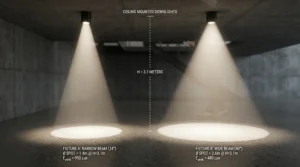
Beam angle is the spread of light from a lamp, usually measured where intensity drops to half. It shapes how your bathroom feels more than wattage does.
Do the geometry. With a ceiling at 2.4m, a 36° beam creates a pool about 1.6m across at floor level. A 60° beam covers roughly 2.8m, and a wide 110° beam spreads over 6m or more, though with much lower intensity at the edges.
Narrow beams (24-40°) create drama over a vanity or niche, but leave dark patches elsewhere. Medium beams (around 60°) are the best all-rounders. Wide beams give a flat, even wash, ideal for tiny rooms but a bit dull.
The Integral Lux Fire uses a 36° beam, so it suits accent lighting, not general light. GU10 fittings such as the Aurora EFD Pro let you choose the beam by changing the lamp. In practice, I’d start with 60° for general light and add narrower lamps only over the mirror.
GU10 Bulbs: Choosing the Right Lamp for Your Fitting
GU10 bulbs are the twist-lock, mains-voltage lamps used in most UK spotlights. The fitting provides IP protection and fire rating, but the lamp determines brightness, colour and beam.
Check these four things. First, wattage: many fire rated cans cap lamps at 7W LED, as with the Saxby ShieldONE 65. Second, lumens: a 5W LED typically produces roughly 400-450 lumens. Third, dimmability: non-dimmable GU10 bulbs on a dimmer flicker or fail. Fourth, colour: 3000K warm, 4000K neutral.
For mirror work, look for a high colour rendering index (CRI 90 or above is a sensible target). Skin tones and make-up look much more honest.
Never swap in a higher wattage lamp than the fitting allows, even if it physically fits. Heat is what compromises insulation coverable fittings and lamp lifespan.
Bathroom Spotlight Kit: Convenient Bundle or False Economy?
A bathroom spotlight kit bundles fittings, lamps and sometimes a driver or transformer into one box. The appeal is obvious: no part-number puzzles.
Here’s what to check before buying one. Does it state IP65, not just “bathroom suitable”? Is it fire rated bathroom downlights or only standard fittings? Are GU10 bulbs included, and are they dimmable? Is a fire hood or intumescent guard included?
Kits can be genuinely good value for straightforward rooms. The risk is that bundled bulbs may be generic, and swapping them later means checking wattage limits. If a kit doesn’t clearly list fire rating and IP rating, I’d treat it as incomplete, however cheap it looks.
Building your own from components like the Aurora EFD plus quality GU10 bulbs often costs only a little more and gives you control over beam angle and colour. For a first-time renovator who wants simplicity, a well-specified kit is a perfectly respectable choice. Just read the fine print.
Long-Term Cost & Maintenance
Cheap fittings are only cheap if they last. Running costs are tiny, though. Six 5W LEDs used three hours a day draw roughly 33 kWh a year. At around 25p-30p per unit (check your tariff), that’s roughly £8-£10 annually.
The bigger cost is replacement. GU10 setups let you swap a lamp for a few pounds. Integrated units like the Integral Lux Fire mean replacing the whole fitting.
| Option | Typical upfront | Replacement route | Best For |
|---|---|---|---|
| Aurora EFD + GU10 bulbs | £8-£13 per fitting plus lamp | Swap lamp only | Budget buyers |
| Integral Evofire + GU10 bulbs | Around £10-£20 plus lamp | Swap lamp only | Long-term owners |
| Integral Lux Fire | £10-£16 per unit | Replace whole unit | Low-maintenance fans |
Looking at the numbers, the GU10 route usually wins on total cost of ownership over ten years. Integrated models win only if you value a simple install above everything else.
Common Mistakes When Buying Bathroom Spotlights vs Downlights
- Assuming fire rated means IP65. It doesn’t. Check both ratings.
- Forgetting the bezel. The Aurora EFD Pro and Saxby ShieldONE 65 need separate IP65 bezels.
- Ignoring lamp limits. A 10W lamp in a 7W fitting is a fire risk.
- Aiming tilt spotlights at the mirror. You’ll create glare and shadows.
- Placing lights directly above your head. It carves dark eye sockets. Position fittings in front of you.
- Mixing colour temperatures. A cool and a warm lamp side by side looks accidental.
The common thread is reading the datasheet rather than the headline.
FAQ
❓ Can I use spotlights above a shower?
❓ Do I need fire rated bathroom downlights in every bathroom?
❓ Is a bathroom spotlight kit cheaper than buying separately?
❓ What beam angle is best for a small bathroom?
❓ Can I use any GU10 bulbs in an IP65 downlight?
Conclusion
Bathroom spotlights vs downlights isn’t really a fight. Fixed downlights give you a calm, even base layer, and a few tilting spotlights add precision where you want it. What matters far more is IP65 above wet zones, a fire rating that suits your ceiling, and lamps with a sensible beam angle.
If I were choosing on the evidence, I’d pick the Aurora EFD for tight budgets, the Integral Evofire for small, steamy rooms, and the Aurora EFD Pro for loft-insulated ceilings. The Saxby ShieldONE 65 suits tight ceilings and design flexibility, while the Integral Lux Fire, ALL LED Atom and Aurora R6 cover the integrated, no-bulb route.
One honest caveat: I couldn’t verify detailed Amazon UK review data for these exact variants, so use this guide as spec-based analysis and read the latest listing reviews yourself. Always confirm part numbers, IP ratings and fire ratings on the datasheet, and use a registered electrician for installation.
✨ Ready to Light Up Your Bathroom?
🔍 Check current pricing and availability for the fittings above on Amazon UK, and create a safe, beautifully lit bathroom you’ll love every single day! 💡
Recommended for You
- Bathroom Ceiling Lights For Small Bathrooms: 7 Best Picks (2026)
- Over Mirror Bathroom Lights: 7 Best Picks For Flawless Light (2026)
- IP44 Bathroom Lights: 7 Best Safe & Stylish Picks (UK 2026)
Disclaimer: This article contains affiliate links. As an Amazon Associate, I earn from qualifying purchases. If you purchase products through these links, we may earn a small commission at no additional cost to you.
✨ Found this helpful? Share it with your friends! 💬🤗
