
In This Article
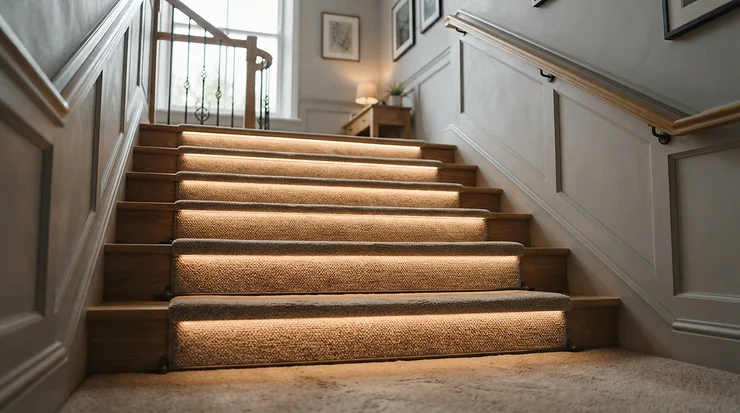
LED strip lights for stairs are slim, low-voltage ribbons of light fixed to the tread, riser, nosing or underside of each step so every edge stays visible in the dark. Most UK kits pair them with a motion sensor, a plug-in power supply, and either an adhesive backing or an aluminium channel to hold them in place.
Everyone has done the 2 a.m. stair shuffle: one hand on the bannister, one foot feeling for a step that isn’t where your brain says it is. It’s funny until it isn’t. RoSPA’s older people safety guidance puts falls on stairs and steps at the top of its list of home accident risks, and the charity’s wider figures, quoted in HSE-commissioned research, estimate over 700 deaths and more than 43,000 hospital admissions a year in England from stair falls at home.
Lighting won’t fix every hazard. It does fix one of the cheapest and most overlooked: not being able to see where each step ends.
Here’s the catch with shopping for LED strip lights for stairs on Amazon UK. The listings blur together. Some are proper stair step lighting kits. Others are under-cabinet strips with “stairs” bolted onto the title. This guide sorts one from the other. It compares seven real, UK-listed options, explains what the specs mean in practice, and walks through installation, power and safety. Prices are ranges only and are indicative, so check current price on the live listing.
Quick Comparison Table: LED Strip Lights for Stairs at a Glance
| Product | Power Type | Sensor Setup | Indicative Price Range | Best For |
|---|---|---|---|---|
| KOMIGANLED KMG-3233 | Mains kit with plug-in power supply | Step-by-step motion | £25-£45 | First-time buyers on a straight flight |
| SuperlightingLED 20-Step Kit | Mains kit | Motion + daylight sensor | £35-£60 | Longer or deeper staircases |
| MALIIGAZA Stair Lights Kit | Mains kit, main-wire design | Motion + daylight sensor | £25-£45 | Tweakers who want adjustable colour temperature |
| NIVOTA Dual Sensor Strip | Plug-in adapter | Dual motion sensors | £15-£30 | Simple under stair tread LED strip runs |
| WOBANE Rechargeable 5m | Battery (2 × 2000mAh) | Dual motion sensors | £15-£30 | Renters and no-wiring installs |
| HOUHUI Dual Sensor 5m (12V) | 12V power supply | Dual motion sensors | £15-£30 | Budget stair edge LED lights and hallways |
| Inscrip Stair Light Controller Kit | Controller-based system | Motion-triggered, multi-channel | £35-£70 | Custom builds with aluminium channel |
The headline difference is the power approach, not the LED. Battery strips such as the WOBANE Rechargeable 5m trade wiring effort for recharging chores, while mains kits like the KOMIGANLED KMG-3233 and MALIIGAZA Stair Lights Kit cost a little more but never need topping up. For busy family staircases, the plug-in kits make more sense. For a rented flat where you can’t touch the walls, the battery option earns its keep.
💬 Just one click — help others make better buying decisions too!😊
Top 7 LED Strip Lights for Stairs: Expert Analysis
1. KOMIGANLED KMG-3233 Stair Lighting Kit — best all-round stair step lighting kit
This is the kit I’d steer a first-timer towards because it arrives as a finished system rather than a box of parts and good intentions. The KMG-3233 uses 40-inch (100 cm) cuttable strips and is sold in versions sized for different step counts, with a wall-switch variant also listed.
Cuttable matters more than it sounds. Most British staircases are narrower than a metre, so you trim each strip to fit the tread instead of folding excess strip into a messy loop. The step-by-step motion triggering means lights cascade along the flight instead of snapping on all at once, which looks smarter and gives your eyes a gentler transition at 3 a.m.
Based on the spec comparison, it suits a straight, standard-width flight best. Winders and half-landings need extra planning. I couldn’t verify a representative sample of reviews at the time of research, so check the verified-purchase reviews on the live listing for sensor reliability and how the adhesive backing holds on painted wood.
Pros:
- ✅ Sold in step-count sizes, so little guesswork
- ✅ Cuttable 100 cm strips fit most treads
- ✅ Warm 3000K or cool 6000K options
Cons:
- ❌ Adhesive hold depends heavily on surface prep
- ❌ Confirm the UK plug and power supply details first
Indicative range: £25-£45. Check current price. Strong value for a complete kit.
2. SuperlightingLED 20-Step Motion Sensor Kit — best for longer staircases
Twenty steps is a lot of staircase, and this is one of the few kits openly sized for it. It uses 47.2-inch cuttable COB strips, a PIR motion sensor and a daylight sensor, in 3000K warm or 6000K cool white. The manufacturer’s own spec pages also show an addressable RGB version supplied with an aluminium channel.
COB (chip-on-board) strips matter on stairs. Standard strips show individual LED dots that glare when you look down at a step. COB gives a continuous line of light with no hot spots, so it reads as a clean edge rather than a string of tiny torches. The daylight sensor stops the lights firing at midday, which saves power and spares the sensor from pointless triggers.
My take: it suits open-plan homes with long flights, loft conversions and anyone who wants the wiring handled for them. Verified review data was thin when I researched it, so double-check UK listing availability and delivery before ordering.
Pros:
- ✅ Sized for 20 steps without joining kits
- ✅ COB strips give smooth, dot-free light
- ✅ Daylight sensor avoids pointless daytime triggering
Cons:
- ❌ Cool white can feel clinical in living spaces
- ❌ UK availability varies between listings
Indicative range: £35-£60. Check current price. Good value if your staircase is long.
3. MALIIGAZA Motion Sensor Stair Lights Kit — most adjustable colour and brightness
Where most kits give you one colour temperature, the MALIIGAZA listing advertises a 2700K-6500K range, dimming and 12 lighting modes. That’s a lot of knobs for something that lights a staircase.
A tunable colour temperature is genuinely useful here. Warm 2700K-3000K light flatters wood and suits bedrooms off the landing, while cooler white around 4000K shows tread edges more crisply for older eyes. The main-wire design and daylight sensor also mean fewer separate cables to hide along the skirting.
On paper this is the pick for people who like to tinker and for households with mixed needs: a teenager who wants a colour mood, a grandparent who needs crisp edges. Reviewers’ views weren’t verifiable in my research, so read recent buyer feedback before you commit, especially on the remote or controller.
Pros:
- ✅ Wide 2700K-6500K colour temperature range
- ✅ Dimmable with multiple lighting modes
- ✅ Main-wire design cuts cable clutter
Cons:
- ❌ More settings can mean more fiddling
- ❌ Confirm step count suits your flight
Indicative range: £25-£45. Check current price. Excellent value for flexibility.
4. NIVOTA Dual Sensor Stair Light Strip — simplest plug-in strip
Sometimes you don’t want a kit; you want a strip that works. The NIVOTA listing describes a dual motion sensor strip with a power adapter, in a 16.4 ft (5 m) length. Two sensors, one at each end, mean the light wakes up whichever way you approach.
Here’s what the spec sheet won’t tell you outright: a single continuous strip suits an under stair tread LED strip run along a stringer or handrail underside better than it suits step-by-step cascading. It lights the whole flight at once rather than step by step. That’s fine for a quick nighttime glow, but it won’t give the “walking light” effect of a stair step lighting kit.
It suits owners of straightforward stairs who want one-evening installation. I couldn’t verify review data, so scan the listing for comments on sensor range and adhesive strength before buying.
Pros:
- ✅ Dual sensors work from either end
- ✅ 5 m length covers most staircases
- ✅ Plug-in power adapter included
Cons:
- ❌ No step-by-step cascading effect
- ❌ Adhesive may struggle on textured paint
Indicative range: £15-£30. Check current price. Great value for simplicity.
5. WOBANE Rechargeable Motion Sensor LED Strip 5m — best no-wiring option
Rented flat? Landlord who gets twitchy about drilling? The WOBANE Rechargeable 5m listing describes a wireless strip with dual motion sensors and two 2000mAh batteries. There’s no plug-in power supply, no trailing cable and no socket hunting.
That freedom comes with a trade-off worth understanding. Battery capacity limits how long the strip runs between charges, and frequent night-time triggering by kids, pets or insomniacs will drain it faster than a quiet household. A staircase used a dozen times a day is a different animal from a hallway used twice.
My honest analysis: it’s brilliant for guest staircases, loft access, temporary setups and tenants. It’s a poorer choice for the main flight in a busy family home where forgetting to recharge means a dark staircase. Verified review samples weren’t available when I researched it, so check battery-life comments on the live page.
Pros:
- ✅ No wiring, no plug-in power supply
- ✅ Dual sensors cover both directions
- ✅ Easy to remove without damage
Cons:
- ❌ Needs regular recharging
- ❌ Heavy use shortens battery runtime
Indicative range: £15-£30. Check current price. Good value for renters.
6. HOUHUI Dual Motion Sensor Strip 5m (12V) — budget stair edge LED lights
The HOUHUI listing describes a 5 m, 12V warm white strip with two motion sensors, marketed for under-bed, stair, closet and hallway use. It’s more of a multi-purpose strip than a dedicated stair product.
Warm white is the sensible default for stairs. It’s easy on the eyes after dark and it doesn’t wash out the edges of a carpeted or painted tread. The 12V system is lower-voltage than mains, which is good for safe handling, though you still need to check the power supply is UKCA or CE marked and has a proper UK plug.
Use it for stair edge LED lights along a stringer, a hallway runner, or the first and last steps where you want a “pool” of light. Don’t expect step-by-step cascading. I couldn’t verify review data, so budget buyers should read the latest comments about adhesive strength.
Pros:
- ✅ Dual sensors for two-way detection
- ✅ 12V low-voltage operation
- ✅ Versatile beyond just stairs
Cons:
- ❌ Not stair-specific, so no step sequencing
- ❌ Confirm power supply certification
Indicative range: £15-£30. Check current price. Strong budget value.
7. Inscrip Stair Light Controller Kit — best for custom aluminium channel builds
The Inscrip Stair Light Controller Kit is a different beast: a motion-triggered controller system designed to run strips step by step, with the listing title pointing to a multi-channel (32-channel) capacity. Confirm the exact spec on the live page before ordering.
Controllers like this make sense when you’re building a more permanent job: strips inside an aluminium channel set into the nosing, or a long flight with landings. You choose the strip and channel, and the controller handles the sequencing. It’s more effort than a boxed kit and more satisfying when it’s done.
This is the one for confident DIYers, joiners and anyone planning a refit. It’s overkill for a quick weekend upgrade. I found no verifiable review sample in my research, so check recent buyer comments on wiring clarity.
Pros:
- ✅ Multi-channel step-by-step sequencing
- ✅ Works with your choice of strip and channel
- ✅ Scales to long or complex flights
Cons:
- ❌ Strips and channels bought separately
- ❌ Steeper learning curve for beginners
Indicative range: £35-£70 for the controller alone. Check current price. Worth it for custom builds.
Top 7 Specification Comparison
| Product | Strip Length / Coverage | Power | Sensors | Colour Options | Best For |
|---|---|---|---|---|---|
| KOMIGANLED KMG-3233 | 100 cm per strip, step-count sizes | Mains/plug-in | Step-by-step motion | 3000K / 6000K | Standard flights |
| SuperlightingLED 20-Step Kit | 47.2-inch COB strips | Mains/plug-in | Motion + daylight | 3000K / 6000K | Long staircases |
| MALIIGAZA Stair Lights Kit | 1 m cuttable strips | Mains/plug-in | Motion + daylight | 2700K-6500K | Tuning light feel |
| NIVOTA Dual Sensor Strip | 5 m continuous | Plug-in adapter | Dual motion | Warm white | Simple runs |
| WOBANE Rechargeable 5m | 5 m continuous | 2 × 2000mAh battery | Dual motion | White options | Renters |
| HOUHUI Dual Sensor 5m | 5 m continuous | 12V supply | Dual motion | Warm white | Budget edge lighting |
| Inscrip Controller Kit | Strips sold separately | Controller system | Motion, multi-channel | Depends on strip | Custom builds |
Looking at the comparison above, the KOMIGANLED KMG-3233 and MALIIGAZA Stair Lights Kit deliver the most complete stair step lighting kit experience for typical homes, while the SuperlightingLED 20-Step Kit is the sensible answer for longer flights. Budget buyers should note that the NIVOTA Dual Sensor Strip, HOUHUI Dual Sensor 5m and WOBANE Rechargeable 5m light the flight rather than sequencing step by step. Anyone planning an aluminium channel build should look hardest at the Inscrip Stair Light Controller Kit.
How to Install LED Strip Lights for Stairs: A Step-by-Step Guide
Installation is where most people either fall in love with the result or swear at a peeling strip at 11 p.m. This is the order that avoids the second outcome.
- Measure first. Measure every tread width and note your step count. Cut nothing until you’ve confirmed both.
- Clean the surface. Wipe the mounting area with isopropyl alcohol and let it dry. Dust and polish are the number one enemy of adhesive backing.
- Test before sticking. Lay the strips out, connect the controller and power supply, and check every step lights up and the sensor triggers properly.
- Mount the strips. Press each one firmly along the underside of the nosing or the riser, and hold for 30 seconds so the adhesive bonds.
- Hide the cables. Run the main wire along the stringer or skirting using small clips. Avoid crossing a walking route.
- Position the sensors. Place one at the top and one at the bottom, away from direct sunlight, and tilt them so they catch someone approaching rather than a passing pet.
Two honest warnings. Don’t stick strips directly to carpet, because adhesive won’t bond reliably and heat has nowhere to go. And don’t daisy-chain beyond the manufacturer’s maximum run, which is commonly around 5 m for standard strips. Past that, the far end dims.
First 30 days: re-press any corners that lift, and re-check the sensor angle. Three weeks in, the adhesive has fully cured and you’ll know whether the sensor is triggering too early or too late.
Real-World Scenarios: Matching LED Strip Lights for Stairs to Your Home
Theory is cheap. Here are three households, three budgets, three sensible choices.
The young family in a 1930s semi. A straight 13-step flight, two toddlers who sleep badly, and a budget of under £50. The KOMIGANLED KMG-3233 is the logical fit. Step-by-step lighting guides night-time trips, a plug-in power supply keeps things low-maintenance, and cuttable strips suit the narrow treads. Add a soft warm 3000K tone and it won’t wake sleeping children.
The tenant in a rented flat. A short flight, a landlord’s no-drilling rule, and a desire to take it all with them when they move. The WOBANE Rechargeable 5m wins here. No wiring, no plug-in power supply, nothing permanent. The only discipline required is a charging habit.
The homeowner doing a loft conversion. Twenty steps, an oak staircase and a willingness to spend a weekend. The SuperlightingLED 20-Step Kit handles the length, or the Inscrip Stair Light Controller Kit paired with an aluminium channel set into the nosing gives a built-in look. Frequency of use is high, so mains power beats batteries here.
Notice the pattern: the right choice follows your staircase and your tolerance for fiddling, not the biggest spec number.
How to Choose LED Strip Lights for Stairs
Choosing well takes about ten minutes and saves a refund. Work through these in order.
- Count your steps. A stair step lighting kit sized for your step count is far easier than improvising with a long strip.
- Decide on mains or battery. Plug-in power supply kits are low-maintenance. Battery strips are flexible but need recharging.
- Pick the light position. Under the nosing lights the tread without glare. Along the riser lights the face of the step. Along the stringer lights the whole flight.
- Choose colour temperature. Warm 2700K-3000K feels homely, and 4000K shows edges more crisply.
- Check the sensors. Dual sensors or a motion-plus-daylight combination avoid daytime triggering.
- Confirm certification. Look for a UKCA or CE-marked power supply and a proper UK plug.
- Plan the fixing. Adhesive backing suits painted or varnished flat surfaces, and an aluminium channel suits anything permanent.
Designing Buildings notes that falls on stairs most commonly happen on the way down, and that poor lighting, uneven treads and missing handrails all raise the risk. It’s a useful reminder that tread-edge visibility, not mood lighting, is the point.
Under Stair Tread LED Strip vs Stair Edge LED Lights
These two phrases get used interchangeably, and they shouldn’t. They produce different light and suit different jobs.
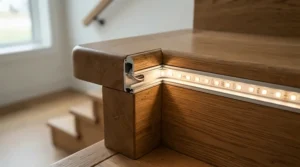
An under stair tread LED strip sits beneath the overhang of each step’s nosing. The light shines downward onto the tread below, so the LEDs themselves stay hidden and glare stays low. This is the classic “floating step” look, and it’s the better choice for anyone who wants to see the step edge without being dazzled.
Stair edge LED lights sit on the front edge or along the riser or stringer. They show the edge of each step more boldly, which helps people with poor eyesight, but the strips are more exposed to scuffs, shoes and cleaning products.
My view is that for everyday family stairs the under-nosing placement is gentler and more forgiving, while edge placement suits commercial settings or staircases where contrast matters most. You can mix them: nosing lights on the treads, a single stringer strip for orientation.
Practical rule: hide the LEDs, show the light. If you can see individual diodes from the top of the stairs, the strip is in the wrong place.
Stair Step Lighting Kit: What You Actually Get in the Box
A proper stair step lighting kit is more than strips. Here’s what to expect, and why each piece matters.
The strips. Usually cuttable, often COB, typically around 40-48 inches each. They carry the adhesive backing on the reverse.
The main wire or controller. This is the brains. It either links strips together in sequence or controls them via a central unit, giving the step-by-step cascade effect.
The sensors. One at each end of the flight, ideally. Some kits add a daylight sensor.
The power supply. A plug-in unit that converts mains to low-voltage DC.
Fixings. Clips, spare adhesive pads and occasionally end caps.
What’s usually missing: cable clips beyond the basics, an aluminium channel and sometimes extension leads. Kits such as the SuperlightingLED 20-Step Kit note extension cables as extras, so budget a few pounds more.
The value of a boxed kit over loose strips is time and compatibility. Everything speaks the same voltage and connector language. For a first project, a boxed kit like the KOMIGANLED KMG-3233 or MALIIGAZA Stair Lights Kit removes the maths. For a bespoke job, the Inscrip Stair Light Controller Kit gives you control at the price of effort.
Aluminium Channel: Is It Worth It for Stair LEDs?
Short answer: yes, if the job is permanent. An aluminium channel is a metal housing that holds the strip, acts as a heat sink and clips a diffuser over the top.
Aluminium channel suppliers describe the benefits consistently: the channel improves durability and heat dissipation, while the diffuser softens individual LED points into a smooth, continuous glow. Stair-nosing versions exist specifically for steps, with a profile designed so the LEDs are hidden and light shines down on the step below without blinding the person using the stairs. UK suppliers list stair profiles around 54-60 mm wide, usually for strips up to 12 mm.
On a stair, a channel has three jobs. It protects the strip from boots and hoovers. It spreads heat so the adhesive backing doesn’t soften over time. And it hides the strip edges for a tidy finish.
The trade-off is cost and effort. A channel adds roughly £15-£30 per metre in some UK ranges, and fitting means screws, end caps and sometimes cutting the nosing. For a rented home or quick upgrade, skip it. For an oak staircase you’re keeping for twenty years, it’s the difference between “looks DIY” and “looks fitted”.
Match your channel width to your strip width. A channel built for 12 mm strips won’t take a 20 mm strip.
Adhesive Backing: Making Stair LEDs Stick for Good
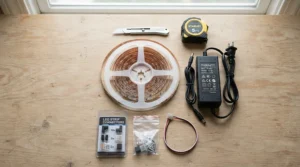
Almost every strip comes with an adhesive backing, and it’s both the great convenience and the great weak point. Most “my lights fell off” stories come down to preparation, not product.
What the adhesive likes: clean, dry, smooth, non-porous surfaces such as gloss-painted wood, varnished timber, laminate and metal. What it hates: dust, polish, textured paint, fresh paint that hasn’t fully cured, and carpet.
How to give it a fighting chance:
- Degrease with isopropyl alcohol and let it evaporate fully.
- Warm the surface slightly if the room is cold, since adhesive bonds poorly below around 10°C.
- Press along the full length for 30 seconds, not just the ends.
- Wait before powering up if the strip has been under tension or bent.
- Use clips every 30-50 cm as insurance on heavy-traffic stairs.
Heat matters too. Strips running hot soften adhesive over months, which is why an aluminium channel and a correctly sized plug-in power supply make adhesion last longer. If the adhesive backing peels at the ends first, the strip is likely curling away from the surface. Add a small clip or a dab of clear mounting tape.
Plug-in Power Supply: Powering Stair LEDs Safely
A plug-in power supply turns UK mains into the low-voltage DC (usually 12V or 24V) that strips need. It’s the unglamorous part that determines whether your setup is safe.
What to check:
- Certification. Look for UKCA or CE marking and a proper UK plug. Some UK COB strip listings explicitly specify a UKCA power supply, which is the standard to hunt for.
- Voltage match. The supply must match the strip’s voltage exactly. 12V on a 24V strip underperforms, and 24V on a 12V strip risks damage.
- Wattage headroom. Choose a supply rated at least 20% above the strip’s total wattage so it doesn’t run flat out.
- Cable length. Longer cables lose voltage. Keep the run from supply to first strip short.
Placement matters as well. Put the supply somewhere ventilated and accessible, not buried in a cupboard under the stairs wrapped in dust sheets. Don’t extend mains cable yourself. If you need a longer reach, extend on the low-voltage side with proper connectors, or ask a qualified electrician.
Battery options like the WOBANE Rechargeable 5m sidestep the question, while a 12V product such as the HOUHUI Dual Sensor 5m still needs a supply. Either way, buy certified equipment from reputable sellers.
LED Strip Lights for Stairs vs Traditional Stair Lighting
Is a strip actually better than the lighting you already have? Mostly, yes, but the full picture is worth seeing.
| Feature | LED Strip Lights for Stairs | Ceiling Pendant/Spotlights | Wall-Mounted Step Lights | Best For |
|---|---|---|---|---|
| Light at tread level | Excellent | Poor (shadows) | Good | LED strips |
| Installation effort | Low to moderate | Moderate to high | High | Strips for DIY |
| Running cost | Very low | Low | Low | All similar |
| Motion sensing | Common | Rare | Sometimes | Strips |
| Aesthetic flexibility | High | Medium | Medium | Strips |
Looking at the comparison above, LED strip lights for stairs win on tread-level light and installation effort because they sit exactly where the hazard is. A ceiling light lights the person; a strip lights the step. Wall-mounted units suit hardwired, permanent schemes but need electrical work.
The honest caveat is that strips complement rather than replace your main stair light. You still want a decent overhead for cleaning, carrying laundry and spotting toys on the flight. Think of the strips as night mode.
Safety, Regulations and Compliance for Stair LEDs
Stairs are regulated, and rightly so. Approved Document K, covered by the Planning Portal’s Part K guidance, deals with protection from falling, collision and impact, including the stairs, ladders, ramps and guarding of a building. It governs rise, going, handrails and headroom for new work, and LED strips don’t change any of those requirements.
What lighting should never do is create a new hazard. Keep these rules in mind:
- Don’t obstruct. Cables, clips and channels shouldn’t protrude into the walking line.
- Don’t blind. Strips that glare upward from tread level make descent harder, not easier.
- Don’t overload. Never exceed the supply’s rated wattage or the manufacturer’s maximum strip run.
- Use certified kit. UKCA or CE marked supplies and drivers only.
- Get an electrician for mains work. Anything hardwired belongs with a qualified professional.
For landlords, the picture is slightly different. Fixed stair lighting in a rented property can fall under wider housing and electrical safety expectations, so check with a qualified electrician if you’re installing anything beyond plug-in kit.
Long-Term Cost and Maintenance of Stair LED Strips
LED strips are cheap to run. A typical stair kit draws a few watts, and because motion sensors keep it off most of the day, the annual electricity cost is pennies, not pounds. The real cost sits in the purchase and in replacements.
Total cost of ownership breaks into three parts. First, the kit, typically £15-£70 depending on type. Second, extras such as an aluminium channel, clips and a spare plug-in power supply. Third, time: one afternoon for a boxed kit, a weekend for a custom channel build.
Cost per use is where strips shine. A £35 kit lit on a family staircase twenty times a day works out at less than a penny per use over its first year, and LEDs commonly last tens of thousands of hours.
Maintenance is light but real:
- Monthly: wipe the strips and sensors with a dry cloth.
- Quarterly: check adhesive corners and cable clips.
- Annually: test every step and replace any strip that’s flickering.
Battery strips such as the WOBANE Rechargeable 5m add a recharging habit, and eventually the cells will need replacing. Mains kits like the KOMIGANLED KMG-3233 shift the cost to the plug-in power supply, which is the component most likely to fail first. Buy a quality one and it’s money well spent.
FAQ: LED Strip Lights for Stairs
❓ How many metres of LED strip do I need for stairs?
❓ Can I fit LED strips on carpeted stairs?
❓ Are battery-powered stair lights worth buying?
❓ Do I need an electrician to install stair LED strips?
❓ Which colour temperature is best for stair lighting?
Conclusion: Which LED Strip Lights for Stairs Should You Buy?
Let’s land the plane. For most UK households, a complete stair step lighting kit like the KOMIGANLED KMG-3233 or MALIIGAZA Stair Lights Kit hits the sweet spot of effort, cost and results. Long flights call for the SuperlightingLED 20-Step Kit. Simple, quick runs suit the NIVOTA Dual Sensor Strip or HOUHUI Dual Sensor 5m. Renters should look hard at the WOBANE Rechargeable 5m. And if you’re planning a permanent aluminium channel build, the Inscrip Stair Light Controller Kit gives you the control.
Whatever you choose, remember the point. The goal is to make every step edge visible, not to build a nightclub. HSE-commissioned research on stair safety in dwellings underlines how serious stair accidents are in the home, which is exactly why cheap, well-placed light is one of the best small upgrades you can make. Prep your surfaces, buy certified power, and keep cables out of the walking line.
✨ Ready to light your staircase properly?
🔍 Click on any highlighted product above to check current pricing and availability, and give your stairs the safe, stylish glow they deserve.
Recommended for You
- Hallway Ceiling Lights: 7 Brilliant Picks For UK Homes (2026)
- Motion Sensor Hallway Lights: 7 Brilliant Picks For UK Homes (2026)
- Bathroom Night Light With Motion Sensor: 7 Best UK Picks (2026)
Disclaimer: This article contains affiliate links. As an Amazon Associate, I earn from qualifying purchases. If you purchase products through these links, we may earn a small commission at no additional cost to you.
✨ Found this helpful? Share it with your friends! 💬🤗
