
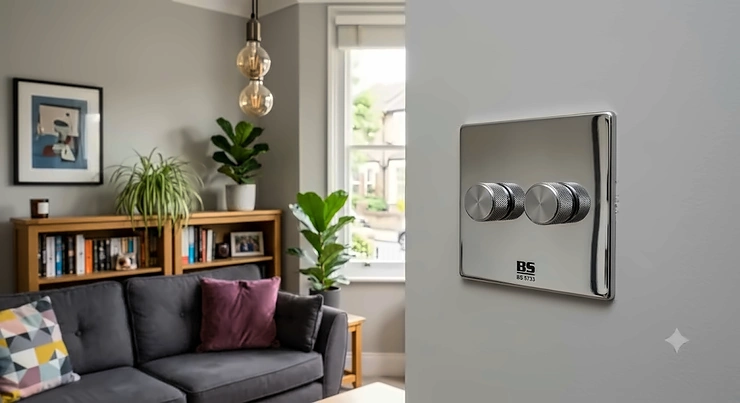
In This Article
A dimmer switch for LED lights sounds like it should be the simplest purchase on your DIY list. Twist a dial, lights go down, job done. Except it isn’t quite that simple, and if you’ve ever installed a bargain dimmer only to watch your new LED bulbs buzz, flicker, or refuse to go below 40% brightness, you already know why this topic deserves more than a five-minute scroll through a hardware aisle.
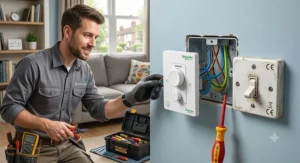
Here’s the short version: a dimmer switch for LED lights is an electrical control device that reduces voltage delivered to a light fitting, allowing brightness to be adjusted rather than simply switched on or off, with modern versions using trailing-edge electronics specifically engineered for the low-wattage, driver-based nature of LED bulbs. Traditional dimmers were built for incandescent bulbs, which don’t care much how power reaches them. LEDs are fussier. They contain internal drivers that convert mains voltage into the low-voltage DC current the diodes actually need, and an incompatible dimmer confuses that driver, which is precisely where flickering, buzzing, and premature bulb failure come from.
This guide walks through seven genuinely available UK dimmer switches spanning budget rotary units through to app-controlled smart dimmers, with honest commentary drawn from real specifications and aggregated customer sentiment rather than invented “hands-on” claims. You’ll also get a proper breakdown of leading edge versus trailing edge technology, a fix-it guide for LED flicker, a compatibility checklist, and the regulatory context that UK homeowners often skip past until an electrician asks awkward questions. According to the IET’s Part P guidance, understanding notifiable work matters before anyone reaches for a screwdriver — more on that later.
Whether you’re retrofitting a single pendant light in a reading nook or rewiring an entire open-plan kitchen-diner, the right dimmer switch compatible LED setup comes down to matching wattage, dimming curve, and control style to how you actually live in the room. Let’s get into it.
Quick Comparison Table
| Dimmer Switch | Best For | Dimming Type | Price Range |
|---|---|---|---|
| Varilight V-Pro JQP401W | Best all-rounder | Trailing edge | £15-£25 |
| Ledvia LED Dimmer Switch | Best budget double dimmer | Trailing edge | Under £20 |
| British General Nexus Metal (Pearl Nickel) | Best premium finish | Trailing edge | £30-£45 |
| Philips Hue Smart Dimmer Switch | Best smart/wireless | Digital (Zigbee) | £20-£30 |
| iolloi Universal LED Dimmer | Best no-neutral budget pick | Trailing edge | Under £15 |
| BG Nexus Metal Brushed Steel NBS81 | Best single-gang premium | Trailing edge | £25-£35 |
| Smart Spring 200W Rotary Dimmer | Best entry-level rotary | Leading/trailing edge | Under £12 |
Looking at the spread above, there’s a clear pattern: cheaper switches tend to use fixed trailing-edge circuitry that works fine for a handful of LED bulbs, while the pricier metal-finish and smart options add either premium materials or software-driven compatibility that handles a wider mix of lamp types. The Varilight V-Pro JQP401W sits in the middle of that curve deliberately — it’s the one most electricians reach for first because it balances price, reliability, and broad LED compatibility. If you’ve got a mix of dimmable and older non-dimmable bulbs on the same circuit, though, none of these tables replace a quick check of your bulb packaging, which we’ll cover properly in the compatibility section further down.
💬 Found a pick you like already? Bookmark this page — you’ll want to cross-check it against the compatibility checklist before you buy!😊
Top 7 Dimmer Switches for LED Lights: Expert Analysis
Choosing the right LED dimmer switch isn’t just about price. It’s about matching the dimmer’s technology to your specific bulbs, your wiring (particularly whether you have a neutral wire at the switch), and how you actually want to control the room. Below are seven real, currently available products, spanning budget rotary units to full smart-home integration.
1. Varilight V-Pro JQP401W — the industry-standard all-rounder
The Varilight V-Pro JQP401W has built its reputation by being the dimmer electricians default to when they’re not sure what’s on the other end of the cable, and that flexibility is the whole point.
This is a 1-gang, 2-way trailing-edge dimmer rated at up to 120W and suitable for 1-10 dimmable LED lamps, with an intelligent circuit that automatically detects the connected load and can be switched between leading-edge and trailing-edge driving modes via software rather than hardware. In practice, that dual-mode flexibility means the same physical switch can rescue a lighting circuit that a pure trailing-edge unit would reject outright, which matters more than the spec sheet lets on. Soft-start technology brings bulbs up to their set level over roughly a second, reducing the inrush current spike that shortens LED driver lifespan.
Based on the spec comparison with cheaper own-brand dimmers, the Varilight V-Pro JQP401W earns its higher price through adjustable minimum brightness — a feature that stops LEDs cutting out abruptly at the low end of the dial, which is one of the most common flicker complaints on budget units. This makes it the sensible pick for anyone retrofitting a mixed-bulb room (say, a living room with LED downlights and a couple of decorative filament LEDs) rather than a single, known bulb type.
Reviewers consistently report smooth, flicker-free dimming with Philips and similar dimmable LED ranges, and praise the ability to set a usable minimum brightness rather than the light snapping off. A recurring negative theme, though, is a minority of buyers reporting premature failure after several months of daily use, with a few noting they’d purchased the same model more than once in under a year.
Pros:
- ✅ Dual leading/trailing edge modes for tricky circuits
- ✅ Adjustable minimum brightness stops light cut-out
- ✅ Trusted UK brand with a 3-year manufacturer warranty
Cons:
- ❌ Some reports of failure after months of daily use
- ❌ Costs more than basic own-brand rotary dimmers
At around £15-£25, the Varilight V-Pro JQP401W represents strong value if you want one dimmer that’s likely to work regardless of what’s plugged into it, rather than the cheapest option on the shelf.
2. Ledvia LED Dimmer Switch — best budget double dimmer
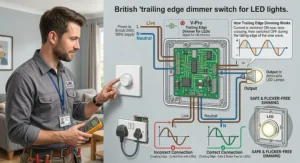
For anyone dimming two separate circuits from a single faceplate — think a living room with wall lights on one gang and a ceiling pendant on the other — the Ledvia LED Dimmer Switch is a straightforward two-gang trailing-edge unit that keeps costs down without cutting obvious corners.
It’s rated across a 3-150 watt range per gang, uses a rotary push on/off mechanism, and is built for dimmable LED and halogen lighting in either 1-way or 2-way wiring configurations. That wattage ceiling is generous for LED loads specifically, since even a room with a dozen 5W GU10 LED spotlights only draws 60W, well inside the switch’s headroom. What most buyers overlook about wattage ratings on LED dimmers is that the minimum load matters as much as the maximum — too few or too-low-wattage bulbs on one gang can cause exactly the flicker this switch is meant to prevent.
Here’s what to weigh: at this price point, you’re getting genuine trailing-edge circuitry rather than a repackaged leading-edge dimmer with an “LED-friendly” sticker slapped on it, which is a trap cheaper unbranded switches sometimes fall into.
Reviewers consistently report an easy installation experience, describing the dimmer as fitting snugly into standard UK back boxes with smooth dimming from full brightness down to near-off without buzzing. A smaller number of reviewers mention wanting clearer instructions for identifying which terminal does what during a DIY swap.
Pros:
- ✅ Two independent gangs on one faceplate
- ✅ Wide 3-150W range comfortably covers most LED loads
- ✅ Easy fit into standard UK back boxes
Cons:
- ❌ Instructions could be clearer for first-time DIY installers
- ❌ White finish only — limited for premium interiors
Priced under £20 in most cases, the Ledvia LED Dimmer Switch is hard to beat if your main goal is controlling two zones cheaply and reliably.
3. British General Nexus Metal 2-Gang (Pearl Nickel) — best premium finish
If your dimmer switch sits somewhere it’ll actually be looked at — a hallway, a dining room, anywhere with decent light fittings — the British General Nexus Metal 2-Gang Pearl Nickel dimmer earns its higher price through finish quality as much as electronics.
Underneath the pearl nickel faceplate sits an intelligent trailing-edge circuit that monitors connected load and provides soft-start protection against thermal, current, and voltage overload, suitable for LED, dimmable CFL, and traditional lighting. Silent operation is a specific design target here, meaning no audible buzz at partial dimming levels, which cheaper plastic dimmers sometimes struggle with once the LED load drops below their comfortable range.
What most buyers overlook about metal-plate dimmers like this one is that the material isn’t purely cosmetic — metal faceplates dissipate heat more effectively than moulded plastic, which matters on circuits running close to the dimmer’s rated capacity for extended periods, such as a kitchen island light left on low for hours during dinner parties.
Reviewer sentiment for this specific finish is harder to verify independently at scale — genuine review volume for the Pearl Nickel variant specifically is lower than for the standard white moulded range, so rather than invent feedback, it’s fairer to say the underlying Nexus 800-series circuitry (used across the whole range) has an established track record for silent, flicker-free LED dimming.
Pros:
- ✅ Premium pearl nickel finish suits higher-end interiors
- ✅ Metal plate aids heat dissipation under sustained load
- ✅ Silent trailing-edge operation, built-in overload protection
Cons:
- ❌ Limited independently verifiable review volume for this specific finish
- ❌ Noticeably pricier than the white moulded equivalent
Expect to pay in the £30-£45 range, which is a fair value trade if the visual upgrade over standard white plastic genuinely matters to the room.
4. Philips Hue Smart Dimmer Switch — best smart, wireless option
The Philips Hue Smart Dimmer Switch solves a completely different problem to the four hard-wired options above: it doesn’t touch your mains wiring at all, which makes it the fastest legitimate way to add dimming control to a room without an electrician.
It’s a battery-powered, Zigbee-based wireless remote that runs on a single CR2032 coin cell (rated for roughly three years of typical use), attaches to a wall or magnetic mount via included adhesive, and can be lifted off and carried around like a handheld remote. Paired with Hue smart bulbs directly, or with a Hue Bridge for scene control and time-of-day automation, it controls up to ten lights per switch.
On paper, this means the “dimmer” isn’t dimming mains voltage at all — it’s sending a wireless command that tells the smart bulb’s own internal driver to change output. That’s a meaningfully different mechanism from the trailing-edge switches above, and it sidesteps LED driver flicker issues almost entirely, because there’s no analogue waveform being chopped in the first place. What the spec sheet won’t tell you, but reviewers note, is how genuinely useful the “detachable remote” format is in practice — several users specifically mention keeping it on a nightstand or coffee table rather than mounted on the wall.
Reviewers consistently report smooth setup within the Hue app and low battery-replacement frequency, generally citing two to three years per battery. A recurring drawback raised is that value drops sharply if you don’t already own Hue-compatible bulbs, since the switch itself doesn’t dim non-Hue LEDs.
Pros:
- ✅ No rewiring — install in minutes, no electrician needed
- ✅ Doubles as a portable remote, not just a wall switch
- ✅ Avoids driver-flicker issues entirely via digital control
Cons:
- ❌ Only useful with Hue (or compatible smart) bulbs
- ❌ Ongoing ecosystem cost if you don’t already own Hue kit
At around £20-£30 for the switch alone (plus the cost of compatible bulbs), this is the pick for renters, smart-home enthusiasts, or anyone who wants dimming without touching a consumer unit.
5. iolloi Universal LED Dimmer Switch — best no-neutral budget pick
Older UK properties frequently lack a neutral wire at the light switch itself, which rules out most smart switches outright. The iolloi Universal LED Dimmer Switch is built specifically around that constraint, at a genuinely low price point.
It’s a 1-gang, 2-way, push on/off rotary trailing-edge dimmer covering a 3-100W range, explicitly designed to work without a neutral wire present, and rated compatible with dimmable LED, incandescent, and halogen bulbs. Reviewers consistently note the “universal” branding holds up reasonably well across different LED brands rather than being locked to a narrow approved list, which is a common frustration with some ultra-budget dimmers that only work reliably with one or two bulb manufacturers.
Here’s what to weigh: at this price, don’t expect the adjustable minimum-brightness software found on the Varilight above — the iolloi is a simpler fixed-curve trailing-edge unit, which is entirely adequate for a single room of matched LED bulbs but less forgiving if you mix wattages or brands on the same circuit.
Aggregated feedback on dimmability is broadly positive, with buyers citing smooth performance and no flicker across common dimmable LED ranges; a smaller cluster of comments describe occasional buzzing when paired with very low-wattage (under 3W) filament-style LED bulbs specifically.
Pros:
- ✅ Works without a neutral wire — ideal for older UK homes
- ✅ Genuinely broad LED brand compatibility for the price
- ✅ Simple, tool-free push on/off rotary operation
Cons:
- ❌ No adjustable minimum-brightness setting
- ❌ Occasional buzzing reported with very low-wattage filament LEDs
Priced under £15 in most listings, this is the practical choice for anyone dimming a single, straightforward LED circuit on a tight budget.
6. BG Nexus Metal Brushed Steel NBS81 — best single-gang premium option
Where the Pearl Nickel double dimmer above suits a statement room, the BG Nexus Metal Brushed Steel NBS81 is the single-gang version built for consistency across a whole house that’s already using brushed steel switch plates elsewhere.
Rated at 200W on a 2-way trailing-edge circuit, it’s built at just 44mm deep for a slim profile against the wall, with a lacquered brushed-steel surface specifically intended to resist visible fingerprints — a small detail, but a genuinely practical one for a switch touched dozens of times a day. The same soft-start and overload protection circuitry found across the Nexus range brings lamps up to a set brightness over roughly a second, reducing driver stress at power-on.
What most buyers overlook about matching switch plates room-to-room is the resale and rental-appeal angle: a consistent finish across a property reads as more considered and better maintained than a mismatched mix of white plastic and premium metal, which is exactly the kind of small-scale interior consistency that estate agents and lettings inspections tend to flag positively.
Because this is a newer addition to the Nexus metal range, independently verifiable aggregated customer review volume specifically for the NBS81 code is currently limited; the underlying trailing-edge circuitry, however, is shared with the wider Nexus Metal family, which has an established reputation for silent, buzz-free LED dimming.
Pros:
- ✅ Slim 44mm profile, fingerprint-resistant lacquered finish
- ✅ 200W headroom comfortably covers most single-room LED loads
- ✅ Shares proven soft-start circuitry with the wider Nexus range
Cons:
- ❌ Limited independently verifiable reviews for this specific code
- ❌ Premium metal pricing versus basic moulded alternatives
Typically priced in the £25-£35 range, it’s a sound pick for anyone standardising a property’s switch plates on a premium finish room by room.
7. Smart Spring 200W Rotary Dimmer — best entry-level rotary switch
Not every job needs adjustable dimming curves or app control. The Smart Spring 200W Rotary Dimmer is a genuinely basic, low-cost switch for anyone who just wants a working dial and nothing else.
It’s a push on/off rotary dimmer available in single or double gang, rated to 200W, and explicitly developed for dimmable LED lamps with a manual choice between trailing-edge and leading-edge operation depending on the bulbs fitted. CE certification confirms it meets European electrical safety requirements, which is worth checking on any switch this cheap, since compliance corners are exactly where rock-bottom pricing sometimes cuts.
Based on the spec comparison with the pricier options above, the trade-off here is obvious and honest: you get functional dimming and a legitimate LED-rated trailing-edge mode, but none of the soft-start refinement, adjustable minimum brightness, or heat-dissipating metal plate found further up this list. For a spare room, utility space, or landlord property where dimming is a nice-to-have rather than a design feature, that’s a perfectly reasonable trade.
Verified, large-scale aggregated review data specifically for this budget model is thinner than for the more established brands above, so rather than overstate customer sentiment, it’s more honest to note that its value proposition rests primarily on price and basic CE-certified compliance rather than a long independent review track record.
Pros:
- ✅ Genuinely low entry price for a CE-certified dimmer
- ✅ Manual leading/trailing edge choice adds some flexibility
- ✅ Simple rotary operation, no app or pairing required
Cons:
- ❌ No soft-start or adjustable minimum-brightness features
- ❌ Thinner independent review history than established brands
At well under £12, it’s a sensible low-risk pick for secondary rooms where budget matters more than refinement.
Practical Usage Guide: Installing a Dimmer Switch for LED Lights
Fitting a dimmer switch is one of the more approachable bits of domestic electrical work, but a handful of first-30-days mistakes cause most of the flicker complaints that end up in review sections. Start by isolating the circuit at the consumer unit and proving it’s dead with a proper voltage tester — not by trusting the light switch itself, since a faulty switch can leave a circuit live even when the room is dark.
Once the old switch is out, check whether your installation has a neutral wire present in the back box; this determines whether smart, mains-powered dimmers are even an option, versus the trailing-edge units covered above that only need line and switched-line connections. Match the dimmer’s minimum load rating against your actual bulb wattage total — a common first-month mistake is fitting a single low-wattage LED bulb to a dimmer rated from, say, 10W minimum, which is precisely when buzzing and flicker appear, because the switch can’t reliably detect such a small load.
After wiring, most trailing-edge dimmers benefit from a brief “calibration” period — some models need the dial run through its full range once or twice to correctly detect the connected load type. For maintenance, LED dimmers have no moving contacts to wear the way old rotary rheostats did, so there’s little routine upkeep beyond an occasional dust of the faceplate and checking that terminal screws haven’t loosened after the first few weeks of thermal cycling, which is worth a five-minute check at the one-month mark.
Real-World Scenarios: Matching a Dimmer to How You Live
Picture a first-time buyer in a two-bedroom terrace with a mix of inherited GU10 downlights and a couple of newer LED filament bulbs in the lounge — budget-conscious, no interest in smart-home fuss, wants it to simply work. The Varilight V-Pro JQP401W suits that brief precisely because of its dual leading/trailing-edge mode; if the older filament LEDs turn out to be less dimmer-friendly than the downlights, the switch can adapt rather than being returned.
Now consider a renter in a converted flat who isn’t allowed to touch the fixed wiring at all. That’s the exact use case the Philips Hue Smart Dimmer Switch was built for — no consumer unit access required, and the whole kit can move to the next flat when the tenancy ends.
Finally, think about a family upgrading a period home’s hallway and landing, where matching brushed-steel switch plates throughout matters for resale value as much as function. The BG Nexus Metal Brushed Steel NBS81, fitted consistently room to room, does more for that property’s finished feel than a mix of whatever was cheapest at the time.
LED Flicker Fix: Why Your Lights Flicker and How to Stop It
LED flicker almost always traces back to one of three causes, and diagnosing which one you’ve got saves a lot of wasted bulb-swapping.
Wrong dimmer technology is the most common culprit: fitting an old leading-edge dimmer, designed for incandescent bulbs, to modern LEDs confuses the bulb’s internal driver, since leading-edge circuits chop the front of the AC waveform in a way trailing-edge electronics don’t. The fix is straightforward — swap to a genuine trailing-edge or dual-mode dimmer such as the Varilight V-Pro JQP401W.
Insufficient load is the second cause, and it catches people out constantly: dimmers have a minimum wattage threshold, and a single 5W LED bulb sitting well under a dimmer’s rated minimum can cause exactly the flicker you’re trying to eliminate. The practical solution is either adding bulbs to bring total wattage up, or switching to a dimmer with a genuinely low minimum load rating, like the iolloi Universal LED Dimmer.
Bulb-driver mismatch rounds out the trio — not every “dimmable” LED bulb is actually compatible with every trailing-edge dimmer, because driver quality varies enormously between manufacturers. If flicker persists after confirming correct dimmer type and adequate load, the most reliable fix is switching to LED bulbs from a manufacturer that explicitly lists compatibility with your specific dimmer brand, rather than assuming “dimmable” on the packaging guarantees a smooth match.

How to Choose a Dimmable LED Switch
Working through these seven criteria in order will get most buyers to the right choice faster than scrolling reviews at random.
- Confirm neutral wire presence — check your existing back box before considering any smart, mains-powered dimmer switch, since its absence rules smart options out entirely.
- Total up your actual bulb wattage — add up every LED bulb the circuit will carry, then check it comfortably clears the dimmer’s stated minimum load.
- Choose trailing edge for LEDs specifically — leading-edge dimmers were built for incandescent bulbs and are the single biggest cause of flicker complaints on LED circuits.
- Decide gang count based on zones, not aesthetics — a two-gang dimmer only helps if you genuinely want two circuits controlled independently from one plate.
- Weigh smart versus hard-wired based on wiring access — a wireless option like Philips Hue sidesteps rewiring entirely if a neutral wire isn’t present.
- Match the faceplate finish to the room’s other fittings — a premium metal dimmer looks out of place next to standard white sockets, and vice versa.
- Check the manufacturer’s LED compatibility list where available — some brands, including Varilight, publish specific compatible-bulb guidance that’s worth five minutes of checking before buying.
Leading Edge vs Trailing Edge Dimmer: What’s the Real Difference?
The leading edge vs trailing edge dimmer question sounds technical, but the practical difference is simple: it’s about which part of the AC power waveform gets cut to reduce brightness, and that timing difference has real consequences for LED bulbs specifically.
As The Electrical Counter’s dimmer guide explains, both types are technically phase-cutting dimmers, named after the part of the AC wave they cut off. Leading edge dimmers, the older and more common technology historically, switch off at the start of each AC cycle and switch back on partway through — a method that suits resistive loads like incandescent and halogen bulbs perfectly well, since those bulbs don’t care about waveform shape. Trailing edge dimmers do the opposite, cutting power at the end of the waveform instead, which produces a smoother, quieter transition that’s specifically better suited to the capacitive, electronic-driver loads inside most LED bulbs.
On paper this means trailing edge dimmers virtually always outperform leading edge dimmers for LED lighting on flicker, noise, and low-end dimming range, and this is exactly why every genuinely LED-rated dimmer covered in this guide — the Varilight V-Pro JQP401W, the Ledvia LED Dimmer Switch, both British General Nexus models, and the iolloi Universal LED Dimmer — uses trailing edge circuitry as standard, some with a manual leading-edge fallback mode for older or mixed-bulb circuits. The exception worth knowing is very low-wattage LED loads, which trailing edge dimmers sometimes struggle to detect below their minimum threshold — precisely the “insufficient load” flicker cause covered above.
Finding a Dimmer Switch Compatible with LED Lights
Compatibility problems rarely come down to the dimmer alone — they’re almost always a mismatch between three variables: the dimmer’s technology, the bulb’s internal driver, and the total connected wattage.
Start by checking the bulb packaging itself, since UK LED packaging is required to state clearly whether a bulb is dimmable at all — a genuinely large proportion of budget LED bulbs simply aren’t, regardless of what dimmer is fitted. Next, cross-reference the dimmer’s published compatible-bulb list if the manufacturer provides one; Varilight, for instance, maintains guidance on specific dimmable ranges that work reliably with its V-Pro series, and skipping that check is one of the more avoidable mistakes covered in the next section.
Reviewers consistently note that mixing bulb brands on a single dimmed circuit is a frequent, quietly frustrating cause of inconsistent dimming — two visually identical GU10 bulbs from different manufacturers can behave completely differently on the same trailing-edge dimmer, because their internal drivers aren’t built the same way. Where possible, fitting identical bulbs (same brand, same model) across a dimmed circuit remains the single most reliable way to guarantee a dimmer switch compatible LED setup with consistent results.
Common Mistakes When Buying a LED Dimmer Switch
The single most frequent mistake is buying based on gang count and colour alone, without checking whether the switch is genuinely trailing-edge rated for LEDs — some budget listings use “LED compatible” loosely on switches that are, underneath, standard leading-edge units. A close second is ignoring minimum load ratings entirely, which is how so many buyers end up with a single downlight flickering on an otherwise perfectly good dimmer.
Buying a smart dimmer without first checking for a neutral wire is another recurring, entirely avoidable error — several reviewers across smart-switch listings mention returning products after discovering their back box simply doesn’t support the wiring requirement. Finally, assuming all “dimmable” LED bulbs are interchangeable is a mistake that surfaces months after installation, typically when a replacement bulb from a different brand starts flickering on a previously reliable circuit.
Long-Term Cost & Maintenance
Dimmer switches themselves are low-maintenance by nature — there’s no moving contact to wear the way old-style rotary rheostats had, so the electronics inside a trailing-edge dimmer should comfortably outlast several bulb-replacement cycles. The real long-term cost consideration is compatibility churn: replacing a failed or discontinued LED bulb with a different brand’s equivalent, several years down the line, is the point where previously invisible driver mismatches tend to surface as flicker.
Budget dimmers in the sub-£15 bracket, like the iolloi Universal LED Dimmer or Smart Spring 200W Rotary Dimmer, carry a real (if modest) risk of needing replacement sooner if driven consistently near their minimum or maximum load limits, whereas mid-range options with adjustable minimum brightness, such as the Varilight V-Pro JQP401W, tend to tolerate bulb swaps and mixed loads more gracefully over a multi-year period. Smart switches like the Philips Hue Smart Dimmer Switch add a small recurring cost in coin-cell batteries roughly every two to three years, but avoid electrical maintenance entirely since there’s no mains wiring involved.
Safety, Regulations & Compliance for UK Dimmer Switches
Fitting a like-for-like dimmer switch replacement in England and Wales is generally straightforward DIY territory and does not typically require building control notification, but it’s worth understanding where that line sits before assuming every job is exempt. Under Approved Document P of the Building Regulations, covering electrical safety in dwellings, certain categories of electrical work — new circuits, consumer unit replacements, and work in special locations such as bathrooms — are classed as notifiable and must either be certified by a registered competent-person scheme electrician or reported to local authority building control.
Straightforward switch replacements on an existing circuit generally fall outside notifiable work, but anyone uncertain, or working in a kitchen, bathroom, or other special location, should check current guidance from a body such as Electrical Safety First before starting, or simply hand the job to a registered electrician. All dimmer switches sold for UK domestic use should carry a CE or UKCA mark confirming compliance with relevant electrical safety standards — worth a quick visual check on the packaging of any unusually cheap import before it goes anywhere near your consumer unit.
✨ Not confident about the wiring yourself? A qualified electrician can fit any of the switches above properly and safely in under an hour — always the safer call for anything beyond a simple like-for-like swap.
Dimmer Switches vs Standard On/Off Switches: What You Actually Gain
| Factor | Standard Switch | LED Dimmer Switch |
|---|---|---|
| Brightness control | Fixed (on/off only) | Fully adjustable |
| Bulb lifespan impact | Neutral | Can extend lifespan via soft-start |
| Energy use at partial brightness | No saving possible | Genuine reduction possible |
| Mood/ambience flexibility | None | High |
| Installation complexity | Simplest | Slightly more involved (compatibility checks) |
The clearest advantage a dimmer switch offers over a standard on/off switch isn’t just ambience — it’s the ability to genuinely reduce energy draw at partial brightness, since less voltage delivered means less power consumed, not merely dimmer-perceived light. Soft-start circuitry, found on switches like the British General Nexus Metal range and the Varilight V-Pro JQP401W, also reduces the inrush current spike LEDs experience at power-on, which several driver manufacturers link to longer working life. The trade-off is a slightly steeper buying decision than a standard switch, since compatibility genuinely varies — which is exactly why this guide exists.

Frequently Asked Questions
❓ Do LED bulbs need a special dimmer switch?
❓ Can I fit a dimmer switch myself in the UK?
❓ Why does my LED flicker on a dimmer switch?
❓ What is the difference between a leading edge and trailing edge dimmer?
❓ Do smart dimmer switches need a neutral wire?
Conclusion
Choosing a dimmer switch for LED lights comes down to three honest questions: what wiring do you actually have, what bulbs are you actually running, and how much control do you actually want. For most mixed-bulb rooms, the Varilight V-Pro JQP401W remains the safest all-rounder thanks to its dual dimming modes. Renters and smart-home fans are better served by the Philips Hue Smart Dimmer Switch, while anyone on a tight budget without a neutral wire should look first at the iolloi Universal LED Dimmer.
None of the seven options here are the “wrong” choice in isolation — they’re built for genuinely different wiring situations, budgets, and bulb combinations, and the compatibility checklist above matters more than brand loyalty. Get the trailing-edge technology, minimum load, and neutral-wire question right, and flicker-free dimming genuinely is as simple as it should have been all along.
✨ Ready to stop the flicker for good? 🔍
Compare current prices on the picks above and check them against your own bulb wattage before you buy — a five-minute check now saves a returns-desk trip later!
Recommended for You
- Colour Changing Uplighter: 7 Best Smart Floor Lamps for 2026
- 7 Best Uplighter for Living Room Picks (2026): Warm Up Any Space
- Up and Down Wall Lights Indoor: 7 Brilliant Picks for 2026
Disclaimer: This article contains affiliate links. As an Amazon Associate, I earn from qualifying purchases. If you purchase products through these links, we may earn a small commission at no additional cost to you.
✨ Found this helpful? Share it with your friends! 💬🤗
