
In This Article
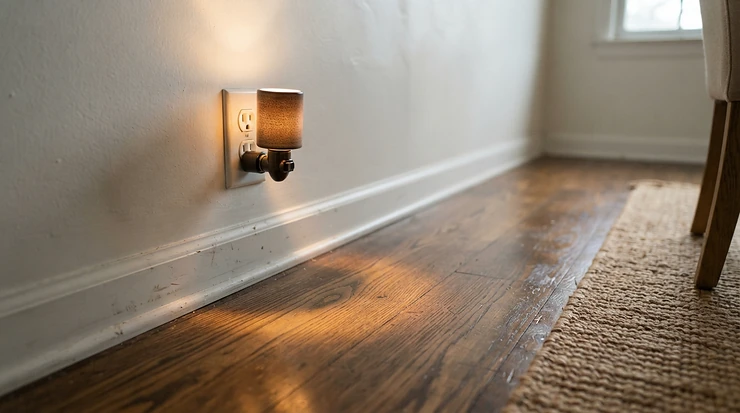
It’s 2:47am. Somebody needs the loo, somebody else needs a glass of water, and the hallway between them is a black tunnel booby-trapped with a stray trainer. Flick the main light on and a sleepy shuffle becomes a full-blown interrogation scene. This is exactly the job plug-in night lights for hallway use were made for: a small, steady glow that shows the way without waking the house.
There’s a serious side, too. NHS falls-prevention advice from Kent Community Health notes that one in three people over 65 falls each year. Plenty of those falls happen on the hurried trip to the bathroom in the dark, and the advice is to consider leaving a hall or landing light on overnight. A modest plug-in unit does that job for pennies.
So I’ve compared seven real, UK-plug models on published specs, aggregated review themes and running costs. You’ll find a hallway night light with dusk to dawn sensor, a plug-through option for socket-starved homes, and a red-glow pick for a child bedroom corridor. Everything here is analysis, not hands-on testing, and I’ll flag where the evidence is thin.
What Are Plug-In Night Lights for Hallway Use?
Plug-in night lights for hallway use are compact lamps built around low-wattage LEDs. They push straight into a standard UK 3-pin socket and glow softly after dark, usually switched automatically by a built-in dusk-to-dawn sensor. They need no batteries, cost pennies to run, and give just enough light to navigate landings, stairs and corridors safely.
Quick Comparison: Plug-In Night Lights for Hallway at a Glance
Short on time? This table sorts the seven by what each does best. Wattage and brightness come from listings I could verify. Where a figure wasn’t published, I’ve said so rather than guess.
| Product | Pack | Listed power | Light character | Best For |
|---|---|---|---|---|
| LOHAS Dimmable | 2 | About 1W | 3000K warm white, 0–80 lm slider | Tuning brightness per hallway |
| Fulighture | 2 | 0.3W | 3000K warm white | Lowest running cost |
| Briignite 4-pack | 4 | 0.6W | Warm white, 60 lm | Long or L-shaped corridors |
| Masterplug NLPT/2-MP | 2 | Not stated | Soft glow, plug-through body | Keeping a socket free |
| Lifemax | 2 | Not stated | 30,000-hour LED, slim body | Older relatives, narrow hallways |
| Greenic | 2 | Under 0.5W | Red glow | Light-sleeping children |
| PURSNIC | 2 | Not stated | Adjustable brightness | Budget dimming |
Looking at the table, Fulighture wins on sheer frugality, while LOHAS Dimmable is the only pick with a wide, published brightness range. If your hallway is long, Briignite 4-pack gives the most coverage per purchase, and Masterplug NLPT/2-MP is the answer when sockets are scarce. Buyers on a tight budget should note that PURSNIC trades some review confidence for its low price.
💬 Just one click — help others make better buying decisions too!😊
Top 7 Plug-In Night Lights for Hallway: Expert Analysis
A quick note on method. Every verdict below rests on published specifications and aggregated review themes. I haven’t handled these lights, and I won’t pretend otherwise. Price bands are indicative, based on retailer listings I could see, so check current price before buying. Where review evidence is thin, I say so instead of dressing it up.
1. LOHAS Dimmable Plug-in Night Light 2-Pack — best for fine-tuning brightness
The star here is the slider: stepless dimming from 0 to 80 lumens, where most rivals give you one fixed glow. Add a warm 3000K colour, an automatic dusk-to-dawn sensor and RG0-rated LED beads (the listing’s shorthand for the lowest photobiological risk group), and the unit draws about 1W. In practice, you can set roughly 20–30 lumens in a narrow terrace hallway to avoid glare, then nudge it up on a wide landing where the same output would vanish.
On paper, the extra wattage over the 0.3W models costs roughly 80p a year per light, so flexibility is the real selling point. It suits mixed households: an adult who wants to see the skirting board, a toddler who’d rather have darkness.
Reviewers describe the lights as small, plug-straight-in units with good value, and one buyer praised the dimming as a welcome upgrade over older fixed orange lights. The verified sample was small, so take that as a hint rather than a verdict.
Pros:
- ✅ Stepless 0–80 lm dimming suits any hallway
- ✅ Warm 3000K colour is easy on tired eyes
- ✅ Automatic dusk-to-dawn sensor needs no fiddling
Cons:
- ❌ Highest draw in this group, at about 1W
- ❌ Slider is manual, so set it once
Indicative twin-pack band: roughly £8–£15; strong value if you want control.
2. Fulighture Night Light 2-Pack — lowest running cost at 0.3W
The headline figure is 0.3W per unit, the thriftiest in this round-up. The listing pairs that with a 3000K warm white glow and a photocell dusk-to-dawn sensor, and it’s pitched at kids’ rooms, hallways and stairs. The listing also carries an “Energy Class G” tag, which looks alarming but is largely a quirk of the scale.
It grades lumens per watt, not total consumption, and for a light meant to be dim, watts are the number that matters. At 0.3W, expect around 1.3 kWh a year, or about 35p per light. Low wattage usually means gentle output, so this suits a short corridor or a landing rather than a cavernous hall. I couldn’t confirm a lumen figure in the listing I saw.
It’s the pick for people who want to fit it and forget it. There’s no dimmer, so you’re accepting one fixed brightness. At the time of research I couldn’t verify a sizeable independent review pool, so the spec sheet is the main evidence.
Pros:
- ✅ Just 0.3W, about 35p a year per light
- ✅ Warm 3000K tone suits bedroom-adjacent spaces
- ✅ Twin-pack covers hallway plus landing
Cons:
- ❌ No dimmer or brightness modes
- ❌ Lumen output not clearly stated
Indicative twin-pack band: roughly £7–£14; excellent value if low cost is your priority.
3. Briignite Plug in Night Light 4-Pack — best for long corridors
Four units in one box is the hook, and it changes how you light a hallway. Each unit is listed at 0.6W and 60 lumens with a warm white glow and an automatic on/off sensor. The listing describes compact bodies that don’t block neighbouring outlets.
Think of the four as stepping stones: one by the bedroom door, one mid-corridor, one at the stairs, one near the bathroom. Sixty lumens is on the brighter side for a night light, so it’s well suited to long or L-shaped layouts. Running costs stay trivial: four lights at roughly 69p each comes to about £2.77 a year in total.
The catch is glare. Don’t put one directly opposite a bedroom door that’s left ajar, or it’ll behave like a lighthouse for light sleepers. The review evidence is slim: the retailer snapshot I found showed only a handful of ratings, so there’s no strong consensus to report.
Pros:
- ✅ Four lights cover a whole corridor route
- ✅ 60 lm gives genuinely usable brightness
- ✅ 0.6W keeps costs at pennies per year
Cons:
- ❌ Fixed brightness may glare at bedroom doors
- ❌ Very small verified review pool
Indicative multipack band: roughly £10–£20; good value per light if you need coverage.
4. Masterplug NLPT/2-MP Plug Through Night Light — best for keeping your socket
In a hallway, sockets are precious real estate. They tend to be claimed by the vacuum cleaner, a phone charger or the robot mop’s dock. The plug-through design lets the night light sit in the socket while leaving the socket itself usable, so you lose nothing.
This twin-pack from a long-established UK electrical accessories brand uses photocell dusk-to-dawn switching, has a tear-drop shape with a polished clear finish, and carries a one-year warranty. It’s pitched at children’s bedrooms and landings. The practical meaning is simple: if your only hallway socket is already spoken for, this is the one that won’t force a trade-off.
Plug-through bodies are typically a little chunkier than slimline units, so check clearance in narrow passages. Wattage and lumen figures weren’t published in the sources I found, which is a minor irritation. I also couldn’t verify a sizeable review pool for this exact model. It is widely stocked by electrical suppliers, which counts for something.
Pros:
- ✅ Plug-through keeps your socket fully usable
- ✅ UK brand with a one-year warranty
- ✅ Automatic dusk-to-dawn photocell switching
Cons:
- ❌ Power and lumen figures not published
- ❌ Fixed output with no dimming
Indicative twin-pack band: roughly £9–£14; fair value for the socket-saving trick.
5. Lifemax LED Night Light 2-Pack — slim, low-heat pick for older relatives
Lifemax is a Berkshire company known for daily-living aids, and the listing aims squarely at older and disabled users as well as children. The LEDs are rated for over 30,000 hours, which at 12 hours a night is nearly seven years, and the light is described as generating almost no heat. A light sensor handles dusk and dawn switching.
The detail I like most is the profile: about 11 × 9 × 2 cm when plugged in, so it sticks out only around 2cm. In a narrow hallway, that means less to catch with an elbow, a walking aid or a dressing-gown cord. It suits an older relative’s route from bedroom to bathroom, where a slim, unfussy glow beats anything clever.
Like the others, it has one fixed brightness. Wattage and lumen output weren’t in the sources I saw, and I couldn’t verify a large review sample, so judge it mainly on form and spec.
Pros:
- ✅ Slim 2cm profile stays out of the way
- ✅ 30,000-hour LED rating means years of use
- ✅ Low-heat design is calm around children
Cons:
- ❌ Fixed glow with no dimmer
- ❌ Review evidence thin in sources checked
Indicative twin-pack band: roughly £8–£15; solid value for a low-fuss, long-lived unit.
6. Greenic Red LED Night Light 2-Pack — best for light-sleeping children
A red glow is the point of difference. The listing describes a soft red, flicker-free light at under 0.5W with an acrylic shade and a dusk-to-dawn sensor. It carried a 4.3 out of 5 average across 834 ratings in the snapshot I found, the largest review pool of the seven. Why red? Sleep guidance consistently favours dark rooms, and some NHS paediatric guidance for children with sensory-processing difficulties suggests considering a red night light. A red hallway glow feels less like “lights on” at a bedroom door. The trade-off is practical: everything looks red-tinted, so you’ll see shapes rather than colours. That’s fine for navigating, less ideal for an older adult who needs good contrast to spot trip hazards. For a child bedroom corridor, though, it’s an elegant fit. At under 0.5W, running costs stay around 58p a year or less per light.
Pros:
- ✅ Red glow is gentle on sleepy eyes
- ✅ Under 0.5W means pennies per year
- ✅ 4.3-star average across 834 ratings
Cons:
- ❌ Red tint makes colours hard to read
- ❌ One fixed brightness, no dimmer
Indicative twin-pack band: roughly £6–£12; very good value for bedtime-focused hallways.
7. PURSNIC Adjustable Night Light 2-Pack — best budget dimmable
This is dimming at the bottom of the price ladder. The listing promises a dusk-to-dawn photocell sensor and adjustable brightness in a twin-pack. A deal-tracker snapshot showed 3.9 out of 5 from 43 reviews, with prices in roughly the £7–£13 range. Where LOHAS Dimmable is the polished dimmable option, PURSNIC is the cheap experiment. If glare is your worry but you don’t want to spend much, it lets you find your preferred brightness without committing. The 3.9 average sits below Greenic‘s 4.3 and hints at more variation between units, so check on day one that the sensor switches on and off when it should. The sample is small, so don’t over-read it. Specs beyond the basics are sparse, including wattage and lumens, so treat it as a sensible trial rather than a spec-sheet champion.
Pros:
- ✅ Adjustable brightness at a very low price
- ✅ Photocell switches on and off automatically
- ✅ Twin-pack covers hallway plus landing
Cons:
- ❌ 3.9-star average hints at variable quality
- ❌ Sparse specs and small review sample
Indicative twin-pack band: roughly £7–£13; fair value if you accept some uncertainty.
Here is the full side-by-side. Price bands are indicative, so check current price before you buy.
| Product | Listed power | Brightness | Review snapshot | Indicative price (pack) | Best For |
|---|---|---|---|---|---|
| LOHAS Dimmable | About 1W | 0–80 lm, stepless | Small verified sample, positive on value | £8–£15 | Mixed households |
| Fulighture | 0.3W | Fixed, not stated | No sizeable sample verified | £7–£14 | Lowest running cost |
| Briignite 4-pack | 0.6W | 60 lm fixed | Very small sample | £10–£20 | Long corridors |
| Masterplug NLPT/2-MP | Not stated | Fixed, not stated | No sizeable sample verified | £9–£14 | Socket-starved homes |
| Lifemax | Not stated | Fixed, not stated | No sizeable sample verified | £8–£15 | Older relatives |
| Greenic | Under 0.5W | Fixed red glow | 4.3/5 from 834 ratings | £6–£12 | Light-sleeping children |
| PURSNIC | Not stated | Adjustable | 3.9/5 from 43 reviews | £7–£13 | Budget dimming |
Read the review column honestly: only Greenic has a large rating pool behind it, and PURSNIC‘s 3.9 average from 43 reviews hints at more variation. For most hallways I’d start with Fulighture or Briignite 4-pack on specs, then move to LOHAS Dimmable if glare becomes an issue. Price gaps across the set are small, so choose on light behaviour and socket fit rather than on saving a couple of pounds.
✨ Don’t Miss These Exclusive Deals!
🔍 Take your hallway lighting to the next level with these carefully selected night lights. Click on any highlighted item to check current pricing and availability. These small upgrades will help you create a safe, calm night-time route your whole family will love!
Hallway Night Light With Dusk to Dawn Sensor: How the Sensor Really Behaves
Almost every pick above leans on one humble component: a photocell that reads the light around the unit and switches the LED accordingly. A hallway night light with dusk to dawn sensor is wonderfully hands-off, right up until the sensor’s idea of “dark” differs from yours.
Where a Dusk-to-Dawn Sensor Gets Confused
- Streetlamp spill: a bright lamp outside the hall window can keep the sensor convinced it’s still daytime.
- Landing spill: a unit beside a lit room may not trigger until that room’s light goes off.
- Windowless corridors: if the sensor never sees daylight, the light may stay on around the clock. One reviewer of a comparable 0.5W twin-pack reported exactly this in a room with little natural light: the lights came on immediately and stayed on.
Is Always-On a Disaster?
Not really. A 0.6W light running 24 hours uses about 5.3 kWh a year, which is roughly £1.38 at current capped electricity rates. The bigger casualty is lifespan: a 30,000-hour LED rating lasts about 3.4 years running 24/7, versus nearly seven years at 12 hours a night.
Practical Fixes
Choose a socket that catches at least some daylight or ambient glow. Look for a model with a manual ON/OFF/AUTO switch, which some listings advertise, though none of the seven listings I read promised one. Or simply accept always-on in a windowless hall and treat it as a very cheap permanent glow.
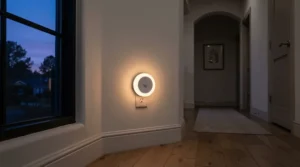
How to Choose Plug-In Night Lights for Hallway Use: 7 Steps
Choose by plug type first, then sensor, brightness, colour, socket footprint, wattage and safety marks. Here’s the reasoning behind each.
- Confirm a UK 3-pin plug. Some continental night lights ship with EU plugs, so the listing must say UK explicitly.
- Pick the sensor type. A dusk-to-dawn sensor gives constant guidance; motion models save power but light up only when triggered.
- Match brightness to hallway size. As a rule of thumb from the spec comparison, a short narrow hall is happy at 5–20 lumens, while a long or wide one wants 40–80.
- Choose the colour. Warm 2700–3000K suits most hallways; red or amber suits a child bedroom corridor.
- Count your sockets. If every outlet is spoken for, go plug-through.
- Check the wattage. Anything up to about 1W is trivially cheap, so don’t agonise.
- Verify safety marks and the seller. Look for UKCA or CE marking, a named maker, and recent reviews that mention sensor behaviour.
Plug-In LED Night Light Features That Actually Matter (And Those That Don’t)
Listings love a long feature list. A good plug-in LED night light only needs to get a handful of things right, and the rest is marketing garnish.
Worth Your Attention
- Sensor reliability: the whole concept depends on it, so read reviews for “stays on” or “never comes on”.
- Brightness range: a slider like the one on LOHAS Dimmable beats guessing.
- Plug profile: a slim body such as Lifemax, or plug-through like Masterplug NLPT/2-MP, matters in narrow hallways and crowded sockets.
- Colour temperature: warm light is kinder than cool white at 3am.
Safe to Ignore
- Colour-wheel RGB modes: a disco hallway helps nobody.
- Lifetime hours above roughly 20,000: you’ll replace the light for style or damage before the LED fades.
- “Eye-friendly” claims without detail: RG0 rating is meaningful shorthand, but vague wording isn’t.
- Energy Class G on tiny LEDs: it grades efficiency per lumen, not what you’ll pay.
A socket night light is a simple device. Put your attention on sensor, brightness, fit and safety, and the rest takes care of itself.
Low-Wattage LEDs: Long-Term Cost and Maintenance
Running costs are where low-wattage LEDs earn their keep. Ofgem’s October to December 2026 price cap averages 26.32p per kWh for standard variable tariffs paid by Direct Debit, so I’ve used that as the baseline. I’ve assumed about 12 hours of darkness a night on average across the year, which is more in winter and less in summer.
| Light | Annual use (kWh) | Approx. annual cost |
|---|---|---|
| 0.3W (Fulighture) | 1.31 | About 35p |
| Under 0.5W (Greenic, at 0.5W) | 2.19 | About 58p |
| 0.6W (Briignite 4-pack, per light) | 2.63 | About 69p |
| 1W (LOHAS Dimmable) | 4.38 | About £1.15 |
| 5W bulb left on overnight | 21.9 | About £5.76 |
The gap between the thriftiest and the thirstiest night light is around 80p a year per light, so pick on usability, not wattage. The real saving comes from replacing a bulb left on all night, which costs roughly five times more than the priciest option here. Your own tariff may differ, and the cap is reviewed quarterly.
Maintenance in Five Minutes a Year
There are no bulbs to replace. Unplug the unit and wipe it with a dry cloth, test the sensor when the clocks change, and check that the plug body isn’t warm, discoloured or buzzing. Over seven years the purchase price dwarfs the electricity, which makes build quality the thing worth paying for.
Socket Night Light vs Motion Sensor, Battery Lights and the Landing Bulb
A socket night light is one answer to night-time navigation, not the only one. Plug-in motion-sensor models exist from brands such as Integral and Masterplug, and some NHS falls leaflets suggest motion-activated lighting too. Here’s how the options stack up.
| Option | Running cost | Effort | Best For |
|---|---|---|---|
| Plug-in dusk-to-dawn socket night light | Pennies a year | Fit once | Constant, gentle guidance |
| Plug-in motion-sensor night light | Lower still | Fit once | Rarely used routes |
| Battery stick-on motion light | Batteries | Periodic swaps | Sockets-free spots like stairs |
| Hall bulb left on | Several pounds a year | Switch flicking | Not recommended |
A dusk-to-dawn socket night light wins on simplicity: no batteries, no triggers, and a glow that’s already there before your foot lands. Motion models save a few pence but can leave you half a second late into the dark, and battery lights add a recurring chore. For most hallways, I’d go with a dusk-to-dawn sensor on the main route and add motion lighting only where the glow isn’t needed all night.
Plug-In Night Lights for a Child Bedroom Corridor
Parents have a particular puzzle: you want enough light for a child to find the loo without making the bedroom itself bright. NHS Every Mind Matters sleep advice stresses that it’s easier to drop off when a room is quiet, dark and cool. The trick is to light the child bedroom corridor, not the bedroom.
Toddlers and Primary-School Children
Plug the light into a socket outside the bedroom, ideally with the glow aimed along the corridor rather than at the door. A reviewer of a comparable 0.3W twin-pack described fitting them on the landing so the children could find their way to the toilet at night. Greenic suits this best thanks to its red glow, while Fulighture gives a warmer alternative at very low wattage.
Safety With Little Hands
Toddlers pull things out of sockets. If you can, choose a socket above their reach or fit a socket cover. Treat every night light as “not a toy”, as manufacturers of comparable units warn.
Older Children and Teens
They’ll want to see more. A dimmable option such as LOHAS Dimmable lets you find a compromise between “I can’t see anything” and “it’s like daytime”.
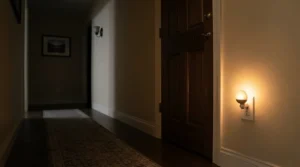
How to Set Up and Maintain Plug-In Night Lights for Hallway Use
Where you put the light matters almost as much as which one you buy.
Placement Rules of Thumb
- Start at the bedroom door, then walk the route to the bathroom or stairs.
- Space lights roughly every 3–5 metres along a long corridor, as a rule of thumb, so there are no dark gaps.
- Use low sockets to light trip hazards at skirting level, and higher sockets to spread light across a wider floor area.
- Mind the sensor. Keep it clear of bright lamps and curtains. One manufacturer listing I found recommends an installation height of 45–155cm.
The First 30 Days
Do a dusk test: draw the curtains, turn off the main lights and walk the route. Check the sensor comes on and off sensibly over a few days. Common first-month mistakes include blocking a needed socket, aiming a bright light at a bedroom door, and forgetting to move a light that sits beside a landing lamp.
Ongoing Care
Dust the unit every few months, retest the sensor when the clocks change, and replace anything that feels warm or buzzes.
Real-World Scenarios: Three Hallways, Three Best Picks
The Terraced Family Home With a Light-Sleeping Toddler
You’ve got a narrow 6-metre hallway, one toddler who hates brightness, and sockets at skirting height. I’d lean toward Greenic for its red, flicker-free glow, with a Fulighture at the top of the stairs for a touch more visibility. Budget is low, use is every night, and the total running cost is around £1 a year.
The Parent’s Bungalow With a Long Corridor
The bedroom-to-bathroom route is long and the user is an older adult. Briignite 4-pack gives coverage along the whole corridor, and a Lifemax unit by the bathroom door provides a slim, low-heat anchor. Warm white beats red here for contrast.
The Rented Flat With Scarce Sockets
You have two hallway sockets, both in use, and a tight budget. Masterplug NLPT/2-MP lets you keep using both sockets, and if you want dimming on the cheap, PURSNIC is a low-risk trial.
If you’re unsure, work out how many metres your route is and how many sockets you can spare, then choose from there.
Problem → Solution Guide: Fixing Common Night Light Headaches
- “It stays on all day.” Likely a windowless corridor where the dusk-to-dawn sensor never sees daylight. Move to a socket with more ambient light, or accept the cost of about £1.38 a year for a 0.6W unit running continuously.
- “It never comes on.” Streetlamp or landing-light spill is probably fooling the sensor. Move the unit away from the light source, or shield its sensor from the spill.
- “It’s too bright at the bedroom door.” Switch to a lower-output model such as Fulighture, or a dimmable one like LOHAS Dimmable or PURSNIC.
- “It hogs my only socket.” Go plug-through with Masterplug NLPT/2-MP.
- “It’s warm, buzzing or flickering.” Unplug it and stop using it. Don’t try to repair it, and check for safety marks next time.
Safety, Regulations and Plug Standards for UK Night Lights
A night light is mains equipment that sits in a socket for years, often unattended, so it deserves slightly more scrutiny than its size suggests.
Plug and Mark Checks
UK domestic plugs must conform to BS 1363, and some continental ranges are specified with EU plugs. One major lighting brand’s datasheets for its Lunetta range, for instance, specify an EU plug, so the listing must say UK 3-pin explicitly. Electrical Safety First says electrical products must carry the maker’s name or trademark plus a CE or UKCA mark, and recommends buying from retailers you trust. The charity also reports that one in ten Brits have first-hand experience of an electrical fire or shock from a product bought online. Marks can be faked, so use them as a first filter, not a guarantee.
Marketplace Caution
Online marketplaces aren’t legally required to check the safety of every third-party listing. Prefer listings sold and dispatched by the retailer or the brand itself, check the seller’s name, and be wary of items with no maker details.
Everyday Safety
Most plug-in night lights are rated for dry indoor use, so keep them out of bathrooms. Ordinary sockets generally aren’t allowed inside UK bathrooms anyway. Keep them away from curtains, and unplug anything that looks damaged. None of this suggests the seven picks are unsafe. It’s a checklist to run before you buy.
FAQ
❓ Can I use plug-in night lights for hallway stairs?
❓ Is a hallway night light with dusk to dawn sensor better than a motion one?
❓ Are 4-packs better value than 2-packs?
❓ What should I check before buying a plug-in LED night light online?
❓ Which colour suits a child bedroom corridor best?
Conclusion
The best plug-in night lights for hallway use aren’t complicated. They’re small, cheap to run and quietly useful on the nights you’ll barely remember. On specs and review evidence, my shortlist looks like this: Fulighture for the lowest cost, Briignite 4-pack for long corridors, LOHAS Dimmable if glare is a worry, Masterplug NLPT/2-MP when sockets are scarce, Lifemax for slim, low-heat guidance, Greenic for a child bedroom corridor, and PURSNIC as the cheap dimmable experiment.
Whichever you choose, remember the three checks that matter most: a UK 3-pin plug, a sensible sensor position, and a seller you trust. The running cost is trivial, and a well-placed light can make a dark hallway safer for everyone from toddlers to grandparents.
✨ Ready to light up your hallway?
🌙 Click on any highlighted product above to check current pricing and availability, and pick the glow that fits your home. A safer, calmer night-time route is only one socket away!
Recommended for You
- Hallway Pendant Lights For High Ceilings: 7 Stunning Picks (2026)
- Staircase Wall Lights: 7 Best Picks For Safer UK Stairs (2026)
- Wall Lights For Hallways: 7 Best Picks For UK Homes (2026)
Disclaimer: This article contains affiliate links. As an Amazon Associate, I earn from qualifying purchases. If you purchase products through these links, we may earn a small commission at no additional cost to you.
✨ Found this helpful? Share it with your friends! 💬🤗
