
In This Article
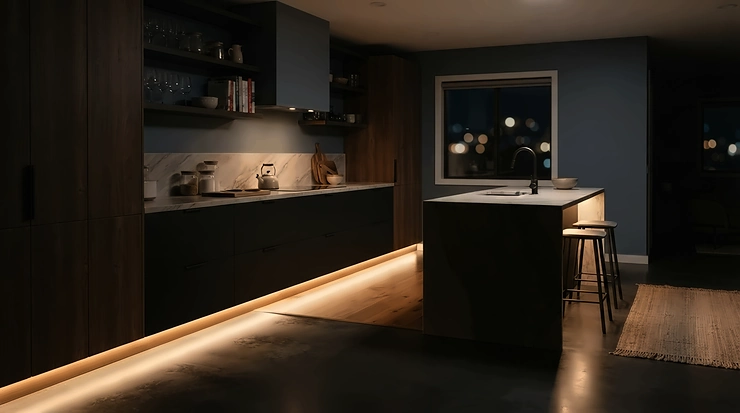
Plinth lights for kitchen units are small, low-voltage LED fittings recessed into the kickboard beneath your base cabinets, casting a soft wash of light across the floor. Also called kickboard lights, they add night-time visibility, ambience and a designer finish for very little money, and most run on a compact 12V driver.
Here’s what nobody mentions while you’re agonising over worktops and door colours: the floor-level glow is what makes a kitchen feel finished. Overhead spots are for chopping onions. Plinth lights for kitchen layouts are for the 2am glass of water, the midnight fridge raid, and the moment guests wander in and say “ooh”. Lighting designer Sally Storey, speaking to Ideal Home, singles out plinth lighting as an important layer in big, open-space kitchens. It’s easy to see why. Low light kills glare, adds depth and stops a room feeling like a flat, brightly lit box.
The market, though, is a muddle. Search for a kitchen plinth light kit and you’ll wade through decking lights that double as kickboard fittings, smart RGB packs, stainless-steel minis and LED tape. This guide sorts the wheat from the chaff: seven products listed on Amazon UK at the time of research, ranked by who they suit, with every spec translated into plain English. Whether you’re planning LED plinth lighting kitchen upgrades for a new fit or a tired refresh, you’ll find budget picks, colour changing plinth lights and one premium smart strip.
A quick note on method. Everything below draws on manufacturer specs, retailer listings and aggregated review themes, not a bench test. Think of it as a well-researched shortlist rather than a lab report.
Quick Comparison: 7 Plinth Lights for Kitchen at a Glance
Here’s the whole field on one screen. Price bands are indicative, drawn from listings seen at the time of research, so check current price before you buy.
| Product | Fitting Style | Light Colour | Control | Price Band | Best For |
|---|---|---|---|---|---|
| Long Life Lamp Company PL5CW | Recessed round, 30mm | 6500K cool white | Wall switch | Under £30 | Budget refits |
| Lighting Innovations 15mm Plinth Lights | Recessed round, 15mm | Warm white (other colours offered) | Wall switch | Under £30 | Discreet, pin-prick look |
| Loops Square LED Mini Plinth Light Kit | Surface-mount square | 4000–4500K natural white | Wall switch | £30–£60 | Rentals and handleless kitchens |
| National Lighting IKON PRO CCT | Recessed round, 25mm or 35mm | Twist-head 3000K/4000K | Plug-in driver | £40–£70 | Flexible warm/cool choice |
| HIBOITEC 10PCS Dimmable Decking Lights | Recessed round | Warm white | Timer, dimmer, dusk-to-dawn | Mid-£40s | Set-and-forget automation |
| INDARUN RGBW WiFi Decking Lights (Ø31mm) | Recessed round | RGB + warm white | App, Alexa, Google Home, remote | £30–£50 | Colour-changing fun |
| Philips Hue Lightstrip Plus | Flexible LED strip | 2000–6500K + colour | Bluetooth app, Hue Bridge | £70–£100+ (2m base) | Premium smart kitchens |
On paper, the Long Life Lamp Company PL5CW and Lighting Innovations 15mm Plinth Lights win on sheer affordability, while the Philips Hue Lightstrip Plus only justifies its premium if you’ll genuinely use the smart features. The middle of the table is where it gets interesting: the National Lighting IKON PRO CCT and HIBOITEC 10PCS Dimmable Decking Lights add practical control without app faff. And if colour changing plinth lights are your goal, the INDARUN RGBW WiFi Decking Lights (Ø31mm) is the cheapest way in.
💬 Just one click — help others make better buying decisions too!😊
Top 7 Plinth Lights for Kitchen: Expert Analysis
1. Long Life Lamp Company PL5CW — cheapest route to a plug-in glow
Sometimes the best plinth lights for kitchen refits are the ones that ask the fewest questions. This ten-fitting kit arrives with a plug-type transformer, so you can test the whole lot on the floor before drilling a single hole.
Each 30mm head holds an integrated 6500K LED, measures 27mm deep and needs a 24mm cut-out. That’s a hole-saw job, not a weekend project. Cables let you space heads up to 95cm apart, generous enough for a long galley run without buying a second kit. The 20,000-hour rating works out at roughly 13 years at four hours a night, and one retailer’s spec sheet lists the whole kit at around 5W, so running costs are pennies.
Here’s what the spec sheet only whispers: 6500K is daylight white, the colour of a dentist’s waiting room. On white gloss units it’s crisp; on oak or sage green it can feel chilly. The same listing shows an indoor IP20 rating, which suits a kickboard nicely but won’t love an enthusiastic mop. If you can live with the cool tone, it’s remarkably good value.
I couldn’t verify a representative body of Amazon reviews for this exact listing, so I won’t pretend to summarise one. Scan recent verified-purchase comments before buying.
Pros:
- ✅ Plug-in transformer, no wiring needed
- ✅ Generous 95cm gaps between heads
- ✅ Ten fittings for a small outlay
Cons:
- ❌ 6500K can feel stark in warm kitchens
- ❌ IP20 rating, indoor use only
Price and verdict: budget tier, roughly £20–£30 at the time of research (check current price). A strong value pick if cool white suits your cabinets.
2. Lighting Innovations 15mm Plinth Lights — smallest visible footprint
If you want your kickboard light kitchen scheme to look like a scatter of tiny stars rather than a row of portholes, this is the kit. The heads are just 15mm across, smaller than a penny, finished in brushed chrome.
Each light comes with 1.4 metres of cable, and each set includes an indoor LED driver and ten lights, with three colour options. That cable length is the real quiet win: it gives you freedom to route around plumbing and appliance feet without splicing. The catch is the flip side of small: tiny heads throw less light, so expect pinpoints rather than a soft pool. To get that “wash” effect, space them closer than you would larger fittings.
Based on the spec comparison, this suits modern, minimalist kitchens where the fittings should disappear and the glow should do the talking. It suits traditional shaker kitchens less well, where chunkier heads often read as more natural. Check the listing for the driver’s maximum capacity before ordering more lights, because the public detail on wattage and beam angle is thin.
Review data I could verify for this exact listing was limited, so weigh recent buyer comments yourself before committing.
Pros:
- ✅ Barely-there 15mm heads
- ✅ Long 1.4m cable per fitting
- ✅ Brushed chrome suits modern kickboards
Cons:
- ❌ Modest brightness per tiny head
- ❌ Sparse public detail on wattage and beam angle
Price and verdict: budget tier, roughly £20–£30 at the time of research (check current price). Ideal when subtlety beats brightness.
3. Loops Square LED Mini Plinth Light Kit — no-drill square profile for handleless kitchens
Not every kickboard wants a round hole. This Loops-branded square kit sits on the surface of the board, held by strong self-adhesive backing, which means no hole saw and no sawdust.
The natural-white 4000–4500K light is a sensible middle ground, and each 1.5W fitting is listed at 45 lumens per watt. Do the sum and you get roughly 65–70 lumens per head, right in the accent-lighting sweet spot retailers typically quote at 50–70 lumens. The kit lists 20,000 hours, an IP20 rating and a 15W, six-port driver (two are listed for ten heads), with 1.5m cables per light. Square fittings also tend to look cleaner and more architectural in handleless and contemporary kitchens, according to LED Supplier’s guidance.
The practical wrinkle is adhesive. Kickboards that are dusty, greasy or textured can defeat sticky pads, so degrease and dry the surface first. Surface-mounting also leaves a visible lip, which some people love as a design detail and others find fussy.
Because I couldn’t verify a representative set of reviews for this listing, treat the specs as claims and check recent buyer feedback on adhesion.
Pros:
- ✅ No hole cutting, tool-light install
- ✅ Square look suits handleless doors
- ✅ Around 65–70 lumens per head
Cons:
- ❌ Surface-mounted lip is visible
- ❌ Adhesive needs a clean, flat surface
Price and verdict: mid-range tier, indicatively £30–£60 (check current price). A tidy choice for rentals and contemporary kitchens.
4. National Lighting IKON PRO CCT — twist-to-switch warm or cool white
Deciding between warm and cool white is the classic plinth lighting agony. This kit sidesteps it: each head twists 180 degrees and re-plugs into the loom to swap between 3000K warm white and 4000K cool white.
Two things to understand. First, “colour changing” here means colour temperature, not RGB rainbows. Second, the kit is decking-derived: 10 x 0.75W LED heads, a 15W driver, a 5m extension cable, two five-way looms and a 3-pin plug, with a 2-year guarantee. Heads are rated IP67 which, under the IP Code, means dust-tight and tested for short-term immersion, far beyond what a kickboard demands, and reassuring in a splashy utility room. The 25mm version wants a 20mm cut-out and 80mm minimum void, so measure your cavity first. Listings quote 120 lumens for the 25mm and 280 lumens for the 35mm; with 0.75W heads, I’d read those as rough kit-level figures, so confirm before assuming brightness.
Buyers describe it as easy to fit, good quality and simple to flip between warm and cool. One reviewer refitting a kitchen plinth used only seven of the ten heads and still had enough cable.
Pros:
- ✅ Twist heads between 3000K and 4000K
- ✅ IP67 build handles damp areas
- ✅ Extension cable and 2-year guarantee included
Cons:
- ❌ Needs 80mm minimum void behind the board
- ❌ Lumen figures in listings are ambiguous
Price and verdict: mid-range tier, indicatively £40–£70 (check current price). Best for buyers who want to try warm and cool before committing.
5. HIBOITEC 10PCS Dimmable Decking Lights — dimming, timer and dusk-to-dawn
Automation is the selling point here. This ten-light kit comes with a smart low-voltage transformer offering dimming, a timer and dusk-to-dawn sensing, so your plinth lights for kitchen use can switch themselves on when the room gets dark.
The heads are IP67-rated, run at 12V, and a sister listing puts each at 0.6W. The maker claims a 50,000-hour life, a 30-minute install for a full set, and three years of cover; those are manufacturer claims, so treat them as marketing until proven. At the time of research the listing sat in the mid-£40s and carried around 4.6 out of 5 from over a hundred ratings, though I couldn’t read individual comments.
Now the analytical bit. Photocell sensors judge darkness where the sensor sits. If the transformer lives in a cupboard or plinth void, it may think it’s always night. Position the sensor where it can see real daylight, or use the timer instead. A separate three-colour, remote-controlled HIBOITEC listing offers white, warm white and warm tones with five brightness levels, useful if you want remote control without an app.
Pros:
- ✅ Dimmable with timer and dusk-to-dawn
- ✅ IP67 heads shrug off damp
- ✅ Generous three-year cover claimed
Cons:
- ❌ Photocell placement needs thought
- ❌ Decking-style styling, not kitchen-specific
Price and verdict: mid-£40s at the time of research (check current price). A strong all-rounder for hands-off automation.
6. INDARUN RGBW WiFi Decking Lights (Ø31mm) — app and Alexa colour control
For colour changing plinth lights on a sensible budget, this is the practical entry point. It combines red, green, blue and warm white in one head, controlled by app over WiFi or Bluetooth, by Alexa or Google Home, or by a bundled remote.
The 4-in-1 RGBW design matters: the warm white channel means you can use it as ordinary warm light most nights, then go blue or magenta for parties. Pure RGB lights make poor whites; this doesn’t. The listing describes timers, fades, group control and about 1m of cable between lamps, so ten heads span roughly nine metres. The brand’s own listings mention 2.4GHz WiFi networks only, so check your router. Confirm the cut-out diameter before drilling.
Reviewers report that setup via app and Alexa works well once done, with timers and fades appreciated. The common complaint is thin printed instructions, so you may need to scan the QR code for the proper guide.
Colour changing plinth lights are fun until the novelty fades, so I’d treat the warm white as the daily setting and colour as the treat. If you never use apps, the extra cost buys you nothing.
Pros:
- ✅ RGB plus warm white, usable every day
- ✅ App, Bluetooth, Alexa and remote control
- ✅ Timers, fades and group control
Cons:
- ❌ Thin printed instructions, QR code needed
- ❌ 2.4GHz WiFi only
Price and verdict: mid-range tier, indicatively £30–£50 (check current price). The best budget route to colour.
7. Philips Hue Lightstrip Plus — premium smart strip for long runs
This is the odd one out: a strip, not a spot. But plenty of homeowners use it on kickboards, and it delivers the continuous glow that spot fittings can’t.
The 2m base kit offers around 1600 lumens, white from 2000K to 6500K plus full colour, and extends to 10m with 1m add-ons (Bluetooth-compatible V4 only). It cuts at marked points every 33cm, with a connector to reuse offcuts, and sticks on with 3M adhesive. Bluetooth handles basic app control; a Hue Bridge unlocks the full smart-home suite. Reviewed.com named the Bluetooth Lightstrip Plus its “Best Upgrade” for brightness and effects, while noting the Bridge is an extra cost.
Here’s the plinth-specific insight: a plinth spot delivers roughly 50–70 lumens. A strip pouring out 800 lumens per metre at full tilt is overkill, so you’ll live at 5–10 per cent dimming. Forum users on AVForums who fitted Hue strips to kitchen plinths describe better colour spread and control than cheaper tapes, though one kitchen fitter raised a fair concern about how stick-on strips behave near pivoting dishwasher doors.
Pros:
- ✅ Continuous, even glow, no scalloping
- ✅ Extendable to 10m, cuttable at marked points
- ✅ Deep smart-home integration
Cons:
- ❌ Highest cost, extensions extra
- ❌ Stick-on adhesive is less forgiving of knocks
Price and verdict: premium tier, roughly £70–£100+ for a 2m base kit (check current price). Best for smart-home fans with long kickboard runs.
How to Install Plinth Lights for Kitchen Kickboards: A Practical Guide
Fitting a kitchen plinth light kit is one of the friendlier weekend jobs. The low-voltage side is forgiving, and mistakes tend to be cosmetic rather than catastrophic. The mains side is different, so read step 4 carefully.
1. Map the run before you drill
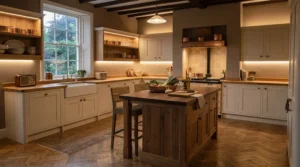
Lay the kickboard flat, mark leg and clip positions, then space heads roughly 30–50cm apart. Retailers suggest most kitchens land between six and twelve fittings. Lay the kit on the floor and confirm every head lights before you cut anything.
2. Cut clean holes
Match the hole saw to the listing: 24mm for the Long Life Lamp Company PL5CW, 20mm or 25mm for the National Lighting IKON PRO CCT. Clamp scrap board behind the kickboard to stop chipping, and drill from the front.
3. Fit the heads last
The National Lighting IKON PRO CCT is designed so looms go in first and heads plug in at the end, which protects fittings from dust and paint. Copy that trick on any kit with detachable connectors.
4. Site the driver sensibly
Keep it accessible, ventilated and away from the dishwasher’s splash zone. Plug-in drivers keep things simple; anything hardwired should go to a registered electrician. The government’s Approved Document P places prefabricated kitchen lighting wiring, joined by plug-and-socket connectors, within Part P’s scope, with notification depending on the work involved.
5. Avoid the first-30-day mistakes
Don’t pinch cables under removable kickboard clips, don’t over-tighten spring clips, and label the driver’s ports. Re-check connections after a month, once the kickboard has been popped on and off a few times.
Which Plinth Lights for Kitchen Suit Your Home? Three Real-World Scenarios
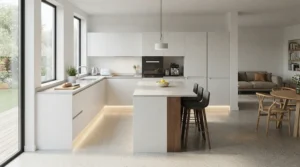
Specs only mean something when they meet a real kitchen. Here are three typical profiles, each matched to the product that fits best.
Scenario 1: The rented galley (under £60, nightly use)
A 3m kickboard run, a landlord who frowns at holes and no appetite for wiring. The Loops Square LED Mini Plinth Light Kit sticks on with self-adhesive backing and needs no hole saw, so it peels off at move-out. Degrease the surface first; adhesives hate dust.
Scenario 2: The family kitchen with an island (about 7m, smart speaker at home)
Long L-shaped runs and kids who love pressing buttons suit the INDARUN RGBW WiFi Decking Lights (Ø31mm): warm white by default, party colours on Friday. With about 1m between lamps, ten heads comfortably span the run. Watch the driver’s capacity if you add more.
Scenario 3: The design-led open-plan (about 8m, handleless doors, flexible budget)
Here the Philips Hue Lightstrip Plus earns its keep: even light, no scalloping, dimming to a whisper, and Hue scenes that tie the plinth into the rest of the room. Budget for extensions, since the base kit is 2m and stretches to 10m with add-ons.
✨ Don’t Miss These Top Picks!
🔍 Take your kitchen lighting to the next level with these carefully selected products. Click on any highlighted item to check current pricing and availability. These picks will help you create a warm, welcoming glow your family will love!
Problem → Solution: Fixing the Most Common Plinth Lighting Headaches
Problem 1: Flicker or buzzing when dimmed
Usually a dimmer that isn’t LED-compatible or a driver that isn’t dimmable. Check the listing says dimmable, then pair it with a matching LED dimmer. The HIBOITEC 10PCS Dimmable Decking Lights are sold with their own dimming transformer, sidestepping the guesswork.
Problem 2: Half the lights stay dark
Suspect an overloaded driver or a loose connector before blaming the LEDs. Add up total wattage, compare it with the driver rating and port count, then re-seat every plug. One round mini-kit listing I came across says its bundled driver runs a maximum of four lights despite shipping ten heads, so always confirm capacity before buying.
Problem 3: Scalloped hot spots on the floor
Tight beams create bright pools with dark gaps. Move heads closer (30cm rather than 50cm), or switch to a strip like the Philips Hue Lightstrip Plus, which spreads light continuously.
Problem 4: The light feels too cold
Swap to a 3000K set, or twist the National Lighting IKON PRO CCT heads to the warm setting. Cool 6500K, as on the Long Life Lamp Company PL5CW, can feel stark in wood-toned kitchens.
How to Choose Plinth Lights for Kitchen Cabinets: 7 Steps That Matter
To choose plinth lights for kitchen cabinets, match fitting size, colour temperature, brightness, driver capacity and control style to your kickboard and daily routine. Work through these seven steps in order.
- Measure the kickboard run. More metres means more fittings; retailers say most kitchens use between six and twelve.
- Check hole size and void depth. A 15mm head, a 30mm head and a strip all need different cavities, so read the listing’s minimum void before you fall for a look.
- Pick a colour temperature. 3000K warm white gives a cosy glow; 4000K neutral suits kitchens with bright overhead lighting.
- Aim for gentle output. Around 50–70 lumens per fitting is typical for accent lighting; much more becomes glare.
- Size the driver. Total wattage and port count must cover every head with headroom.
- Choose your control. A wall switch is simplest; timers, remotes and apps add convenience and cost.
- Check marks and warranty. Look for UKCA or CE marking and a sensible guarantee, such as the 2 years on the National Lighting IKON PRO CCT.
LED Plinth Lighting Kitchen vs LED Strip Lights: A Straight Comparison
Spots or tape? The retailers can’t agree, because each is selling one of them. One spot-fitting supplier argues fittings look more durable and premium with a more secure mount, while an LED-tape specialist points out that tape cuts to exact lengths and avoids the spotting effect. Both statements are true and both are sales pitches, so let’s weigh the physics instead.
| Feature | Spot-style plinth lights | LED strip lights |
|---|---|---|
| Look | Neat dots of light, high-end feel (e.g. Loops Square LED Mini Plinth Light Kit) | Continuous glow, no spotting (e.g. Philips Hue Lightstrip Plus) |
| Install | Holes or adhesive, plug-in driver | Stick-on tape, cut at marked points |
| Durability | Metal fittings, secure mounting | Adhesive can loosen if knocked |
| Cost | Budget-friendly kits | Smart strips cost more |
| Best For | Traditional or handleless kitchens wanting a tidy finish, e.g. National Lighting IKON PRO CCT | Long runs and smart-home fans, e.g. Philips Hue Lightstrip Plus |
Read across and the trade-off is clear: spots buy you a crafted look and a firmer fixing, tape buys you evenness and flexibility. For LED plinth lighting kitchen projects on a normal budget, spots win; for long, unbroken runs, the Philips Hue Lightstrip Plus is the better tool despite the price.
Colour Changing Plinth Lights: Party Trick or Practical Upgrade?
“Colour changing” covers three quite different things, and confusing them is the fastest route to disappointment.
First, colour-temperature switching: the National Lighting IKON PRO CCT twists between warm and cool white, while a three-colour HIBOITEC 10PCS Dimmable Decking Lights sister listing offers white, warm white and warm tones with remote control. Second, full RGB or RGBW, like the INDARUN RGBW WiFi Decking Lights (Ø31mm), with millions of hues and app scenes. Third, tunable-white-plus-colour strips, the territory of the Philips Hue Lightstrip Plus.
My honest take: colour changing plinth lights are best judged by how often you’d use the colours. Most households settle on one warm white and stick with it, making twist-CCT the sensible choice. Families with teenagers or a habit of hosting will get more from RGBW, provided the warm white channel is good, as it is on the INDARUN RGBW WiFi Decking Lights (Ø31mm). If you buy colour changing plinth lights purely for novelty, expect the fun to fade around week three.
Kickboard Light Kitchen, Toe Kick Lighting, Base Cabinet LED Light: Same Idea, Different Names
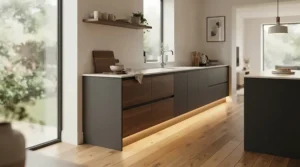
Shop around and you’ll meet three names for one idea. A kickboard light kitchen listing, a plinth light and toe kick lighting all describe low-level LEDs beneath base units; LED Supplier confirms plinth lights and kickboard lights are literally the same fitting. “Toe kick” is the American term for the recessed strip at the base of a cabinet, so US-centric guides use it.
A base cabinet LED light is a broader phrase. It can mean fittings in the kickboard, but also lights under a worktop overhang or inside drawers, so read the product description carefully before assuming it fits a plinth.
The UK buying rule that ties all this together: avoid imported US-spec kits built for 120V supplies. Choose UK-plug or 12V driver kits with UKCA or CE marking, because a toe kick lighting set built for another country’s mains is a false economy. Keyword confusion aside, the physical job is identical: a small, dimmable, low-heat glow at floor level.
Features That Actually Matter (And Those That Don’t)
What matters: driver capacity (wattage and port count), colour temperature, cut-out size and void depth, cable length between heads, and warranty length. Dimming is worth paying for if your kitchen is open-plan and doubles as a living space. A timer, like the one on the HIBOITEC 10PCS Dimmable Decking Lights, quietly saves you from leaving lights on overnight.
What doesn’t: headline lifespan claims. A 50,000-hour rating sounds thrilling, but at four hours a night even 20,000 hours is thirteen years, longer than most kitchens survive. Sixteen million colours is another number that flatters a spec sheet more than it improves your evenings. And IP67, as on the National Lighting IKON PRO CCT, is lovely but unnecessary on a dry kickboard; retailer guidance is that most LED plinth lights don’t need a high IP rating because they sit low and away from direct water.
Spend your money on the driver, the control and the colour temperature. Those three decide whether you’ll love the result.
Long-Term Cost and Maintenance of Plinth Lights for Kitchen
Plinth lighting is astonishingly cheap to run. Take a kit drawing 5W, like the Long Life Lamp Company PL5CW listing suggests, used four hours a day: that’s about 7.3kWh a year, roughly £2–£3 at typical UK rates of 26p–35p per kWh. Even a maxed-out 15W driver lands at around £6–£8 annually.
The Energy Saving Trust notes that lighting is a small part of the average UK household energy bill and that upgrading to efficient LEDs is one of the easiest, cheapest DIY upgrades. Plinth lights follow the same logic: the running cost is negligible, so buy on fit and control rather than pennies.
| Tier | Indicative Spend | What You Get | Watch-Outs | Best For |
|---|---|---|---|---|
| Budget | Under £30 | Simple switch-operated kits, e.g. Long Life Lamp Company PL5CW | Cool white, limited control | Basic refits |
| Mid-range | £30–£70 | Twist-CCT, timers or RGBW, e.g. National Lighting IKON PRO CCT | Check void depth and driver capacity | Most families |
| Premium | £70+ | Smart strips, e.g. Philips Hue Lightstrip Plus | Cost of extensions | Smart homes |
Look at the pattern: the cost jump between tiers buys control and convenience, not much more light. For most kitchens, mid-range is where usefulness peaks. Maintenance is light: dust the heads, re-seat connectors when the kickboard is removed, and keep a spare driver’s spec noted, since drivers usually fail before LEDs do.
Safety, Regulations and IP Ratings: What UK Kitchens Actually Require
Most plinth lights for kitchen setups run at low voltage (12V) from a mains-fed driver, which is why the fitting side is DIY-friendly while the mains side isn’t. A plug-in driver is the simplest and safest route; anything hardwired to a spur or circuit should be done by a competent electrician. One retailer’s 240V kit states installation must be by a professional licensed electrician, which is a fair reminder that not every kit is low-voltage.
On IP ratings, IP20 is enough for a dry kickboard, but consider IP44 or above in utility rooms or near sinks. Steam mops and enthusiastic cleaning are the real enemies. Heads rated IP67, such as the National Lighting IKON PRO CCT and HIBOITEC 10PCS Dimmable Decking Lights, sit comfortably beyond that.
Smart kits add a network angle. The INDARUN RGBW WiFi Decking Lights (Ø31mm) and Philips Hue Lightstrip Plus rely on app and account security, so use a strong WiFi password and keep firmware updated. Finally, look for UKCA or CE marking on drivers in particular, and keep the paperwork for your buyer’s solicitor if you ever sell.
FAQ
❓ Do plinth lights for kitchen units work with Alexa or Google Home?
❓ How deep does a kickboard cavity need to be for recessed plinth lights?
❓ Can I mix brands in one kitchen plinth light kit?
❓ Are LED plinth lighting kitchen setups safe to leave on overnight?
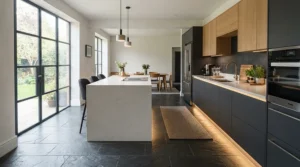
❓ Will plinth lights look good on a glossy or dark kitchen floor?
Conclusion
So, which plinth lights for kitchen use should you buy? If you want the cheapest sensible start, the Long Life Lamp Company PL5CW and Lighting Innovations 15mm Plinth Lights cover cool-white and pin-prick looks for under £30. If you need a no-drill install for a rental or a handleless kitchen, the Loops Square LED Mini Plinth Light Kit is the tidy answer. Want to swap between warm and cool? The National Lighting IKON PRO CCT does it with a twist. The HIBOITEC 10PCS Dimmable Decking Lights automate the whole job, the INDARUN RGBW WiFi Decking Lights (Ø31mm) bring colour changing plinth lights within reach, and the Philips Hue Lightstrip Plus is the premium play for long, smart-connected runs.
Whatever you choose, remember the three things that decide success: driver capacity, colour temperature and cut-out size. Get those right and even a modest kitchen plinth light kit will lift the whole room. Get them wrong and no amount of stainless steel will save you.
Ready to try LED plinth lighting kitchen style? Measure your kickboard, note your void depth, and check current prices before you buy.
Recommended for You
- LED Strip Lights Under Cabinet Kitchen: 7 Top UK Picks (2026)
- Smart LED Strip Lights Kitchen: 7 Best Picks For UK Homes (2026)
- LED Strip Lights For Kitchen: 7 Best UK Picks (2026)
Disclaimer: This article contains affiliate links. As an Amazon Associate, I earn from qualifying purchases. If you purchase products through these links, we may earn a small commission at no additional cost to you.
✨ Found this helpful? Share it with your friends! 💬🤗
