
In This Article
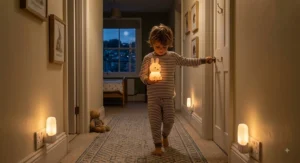
Somewhere around the second birthday, a switch flips. The same toddler who happily slept in a pitch-black room since birth suddenly needs the landing light on, the door ajar, and a full safety briefing before you’re allowed to leave. If that sounds familiar, you’re not doing anything wrong — you’re just parenting a small human whose imagination has finally caught up with the dark
A night light for kids is a low-level lamp, usually LED, designed to soften a bedroom’s darkness without fully lighting it, helping children who fear the dark fall asleep and stay asleep without disrupting melatonin production. The trouble is that “just buy a night light” undersells how different these products actually are. Some plug straight into the wall and forget about you. Others double as star projectors, white noise machines, or sleep-training clocks that teach your toddler when it’s actually acceptable to get up.
We’ve dug through real product specs, aggregated customer feedback, and UK safety standards to build this guide around genuine research rather than recycled marketing copy. According to NHS advice on sleep and young children, a nightlight or a dim landing light left on can help a child who’s afraid of the dark settle more easily, which is a useful starting principle before you even open your wallet. Below, we compare seven real products spanning budget plug-ins to premium smart devices, explain what actually matters when buying one, and walk through practical scenarios so you can match a light to your own child rather than to a marketing photo.
Quick Comparison Table
| Product | Type | Best For | Price Range |
|---|---|---|---|
| Tommee Tippee Groclock | Sleep-trainer clock | Teaching wake-up times | £30-£40 range |
| Cloud b Twilight Turtle Classic | Plush star projector | Constellation-loving toddlers | £25-£35 range |
| VAVA Egg Baby Night Light Plus | Silicone touch lamp | Nursery feeds & nappy changes | £25-£35 range |
| Pabobo Nomadic Star Mushroom Projector | Star & sound projector | Babies who wake and cry | £30-£45 range |
| Integral LED Plug-in Night Light | Plug-in sensor light | Budget, child-safe hallway use | Under £15 |
| Pabobo LumiBlo Blow-Control Lantern | Portable lantern | Travel and grandparents’ houses | £20-£30 range |
| Hatch Rest | Smart all-in-one device | Families wanting one gadget for everything | £60-£90 range |
Looking at the table, the split really comes down to how much “job” you want the light to do. If you only need gentle reassurance, the Integral LED Plug-in Night Light or VAVA Egg Baby Night Light Plus will cover it without asking you to learn an app. If bedtime itself is the battle — not just the dark — the Tommee Tippee Groclock or Hatch Rest earn their higher price tags by tackling the routine, not just the room. Families who move between houses often (grandparents, co-parenting, holidays) will get more day-to-day value from something portable like the Pabobo LumiBlo Blow-Control Lantern than from a mains-only unit.
💬 Found a favourite already? Save this comparison so you can check current pricing before you decide!🤗
Top 7 Night Lights for Kids: Expert Analysis
1. Tommee Tippee Groclock — teaches toddlers when it’s OK to get up
The standout feature of the Tommee Tippee Groclock isn’t the light at all — it’s the behaviour change it’s built to encourage. This sleep-trainer clock uses glowing stars and a sun face to show a child when it’s still sleep time and when it’s time to get up, which sidesteps the obvious problem that a three-year-old can’t read a clock face. Parents set a wake window, and the display gradually shifts from a starry night scene to a sunny “OK to rise” image as the time approaches. It’s USB-powered rather than battery-hungry, and the adjustable brightness means it can double as a genuine bedroom night light once the training job is done.
Who is this for? Honestly, this is less a “night light” purchase and more a bedtime-routine tool that happens to glow. Families dealing with 5am wake-ups or a toddler wandering the house before dawn tend to get the most out of it, since the sun/stars visual gives a concrete, toddler-legible boundary that “because I said so” never quite achieves. Reviewers consistently report that the two-mode setting (weekday versus weekend, or nap versus night) is one of the more practical touches, letting parents adjust for nursery mornings without resetting the whole device.
Pros:
- ✅ Visual cue system toddlers grasp without reading a clock
- ✅ USB-powered, so no constant battery replacement
- ✅ Doubles as a soft night light once training is done
Cons:
- ❌ Optional alarm sound divides opinion among reviewers
- ❌ Some units report a shorter USB cable than expected
Priced in the £30-£40 range, it sits firmly in the mid-tier, and the value case rests on whether early wake-ups are genuinely your problem to solve — if so, this earns its keep faster than a purely decorative light ever could.
2. Cloud b Twilight Turtle Classic — the constellation projector kids ask for by name
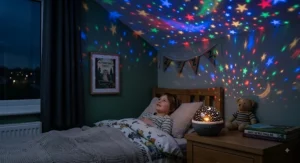
The Cloud b Twilight Turtle Classic turns lights-out into a small event rather than a chore. Flip it on and it projects genuine star constellations onto the ceiling in a choice of three colours, while the shell itself glows softly enough to work as a standalone night light. It runs on batteries rather than mains power, which — while less convenient for constant use — makes it genuinely portable between bedroom, travel cot, or a sleepover bag without hunting for a socket.
What most buyers overlook about this model is the educational layer bundled in: it ships with a star guide so children can start matching the projected patterns to real constellations, which nudges bedtime from “lights off, fight begins” toward “lights off, let’s find the Plough.” For a child who fears the dark specifically because it feels empty and featureless, giving the ceiling something interesting to look at genuinely changes the emotional tone of the room. Reviewers frequently mention the 45-minute auto-shutoff as a double-edged feature — brilliant for saving batteries, less brilliant if your child wakes at 2am and wants it back on without a parent’s help.
Pros:
- ✅ Projects genuine star constellations onto the ceiling
- ✅ Soft ambient glow works as a standalone night light too
- ✅ Battery-powered, so it travels easily
Cons:
- ❌ 45-minute auto-shutoff can’t be restarted by a toddler alone
- ❌ Some reviewers note the coloured bulbs are not user-replaceable
At around £25-£35, this is a strong mid-range pick for children roughly aged two to six who respond well to a bit of gentle wonder rather than plain illumination.
3. VAVA Egg Baby Night Light Plus — the rechargeable nursery workhorse
The VAVA Egg Baby Night Light Plus is built for the 2am nappy change more than the bedtime story. Its egg shape is made from toy-grade materials with a soft, rounded design that’s safe for babies to touch and hold, and the touch-control top means you’re not fumbling for a switch with a baby balanced on one arm. In practical terms, that soft-touch dimming is the whole point: you can bring the light up just enough to see a nappy fastening without blasting your child fully awake.
Key specs translate directly into real-world convenience here. It offers RGB colour options plus a dedicated warm-light setting for actual sleep use, and the built-in white noise with a 30/60/90-minute timer function means it can quietly cover the gap between “settled” and “properly asleep” without you standing in the doorway. Reviewers who’ve owned the light for years consistently point to battery longevity as its best trait, with families reporting units still working after several years of nightly use — genuinely rare in this category, where cheap rechargeables often die within a year.
Pros:
- ✅ Soft silicone build feels safe in small hands
- ✅ Touch dimming avoids fully waking a settled baby
- ✅ Long-reported battery lifespan across repeat buyers
Cons:
- ❌ RGB modes are more of a bonus feature than daily-use
- ❌ Doesn’t include a plug-in mains option, USB charge only
In the £25-£35 range, this is the light most naturally suited to the “nursery night light” brief — a room where feeding, changing, and settling all happen in the dark, repeatedly, every single night.
4. Pabobo Nomadic Star Mushroom Projector — built for babies who wake upset
The Pabobo Nomadic Star Mushroom Projector, sold under the Timoleo name in some listings, leans into a specific pain point: babies who don’t just wake, but wake crying. Its optional cry sensor detects a child’s crying and automatically triggers the light and sound, which means a genuinely useful hands-off response during those middle-of-the-night wake-ups where fumbling for a switch only makes things worse. The mushroom-shaped projector casts a soft starfield onto the ceiling while offering a choice between a gentle lullaby or white-noise heartbeat sounds.
Based on the spec comparison with simpler projectors, the auto shut-off after roughly 25 minutes is a sensible middle ground — long enough to cover the settling window, short enough not to run all night on battery power. Amazon’s aggregated review data flags a genuinely mixed picture worth knowing before you buy: customers rate the light itself highly, but brightness and sound quality feedback is split, with some finding it not very bright and others noting the tune selection is limited. That’s a useful, honest data point rather than a dealbreaker — it simply means this suits families who want a subtle glow over a beam-you-can-read-by kind of light.
Pros:
- ✅ Cry sensor responds automatically without a parent intervening
- ✅ Choice of lullaby or white-noise heartbeat sound
- ✅ Auto shut-off balances battery life with settling time
Cons:
- ❌ Reviewers report inconsistent brightness across units
- ❌ Limited tune variety noted by repeat users
Priced around £30-£45, this is a solid pick specifically for babies whose wake-ups are distressed rather than simply drowsy.
5. Integral LED Plug-in Night Light — the child-safe budget default
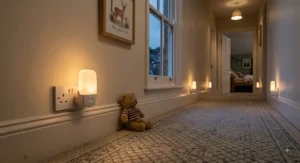
Not every child needs a projector, a sensor, or an app — sometimes the brief is simply “keep the landing lit so nobody trips at 3am,” and the Integral LED Plug-in Night Light does exactly that for very little outlay. It plugs directly into a standard UK socket, uses a dusk-to-dawn sensor to switch itself on and off, and draws so little power that running cost sits at roughly 2p per week. There’s genuinely nothing to programme, charge, or forget.
What stands out from a child-safety perspective is the build itself: it’s cool to the touch with rounded edges, specifically designed as a safe option for children’s bedrooms and playrooms. That matters more than it sounds — a toddler exploring a night light with curious fingers shouldn’t encounter a hot casing or sharp corners, and this design choice removes that risk entirely. The trade-off, and it’s a fair one at this price, is that you get a single soft glow rather than colour options, star projections, or sound. For hallways, stairs, and any room where the goal is simple wayfinding rather than a bedtime experience, that’s not really a downside at all.
Pros:
- ✅ Auto on/off sensor removes any daily setup
- ✅ Cool-touch, rounded-edge design suited to small hands
- ✅ Running cost is negligible at roughly 2p a week
Cons:
- ❌ Single warm-glow setting only, no colour or dimming
- ❌ Fixed plug orientation depends on your socket layout
At under £15, this is the light we’d point budget-conscious parents toward first, particularly for landings, stairs, or a second child’s room where a premium feature set isn’t the priority.
6. Pabobo LumiBlo Blow-Control Lantern — the light that travels as well as your child does
The Pabobo LumiBlo Blow-Control Lantern solves a genuinely charming, genuinely practical problem: toddlers who want to control their own light but can’t yet manage a fiddly switch in the dark. You turn it on and off, and adjust intensity, by blowing gently on a star-shaped sensor on its base — a long blow dims it, a short blow toggles it, no buttons required. For a child old enough to want some agency over bedtime but too young for anything more complex, that’s a small design decision with an outsized emotional payoff.
The practical case for this one is portability. It’s rechargeable via micro-USB and holds enough charge for roughly 24 one-hour cycles on a single charge, or around a week of use in its default timer mode, and its handle doubles as a clip so it attaches to a bag, a travel cot, or a door. Families who split time between two homes, or who visit grandparents regularly, tend to rate this highest precisely because the bedtime object stays consistent even when the bedroom doesn’t — and consistency, more than brightness or colour, is often what actually helps a toddler settle somewhere unfamiliar.
Pros:
- ✅ Blow-control lets toddlers operate it independently
- ✅ Long battery cycle suited to travel and sleepovers
- ✅ Clip-on handle attaches to bags, cots or doors
Cons:
- ❌ Blow sensor occasionally needs a firmer breath to register
- ❌ No mains-power backup if the battery runs flat
At £20-£30, it’s a strong mid-range pick specifically for families who move between locations, rather than a single fixed bedroom.
7. Hatch Rest — the smart all-in-one for families who want one gadget, not five
The Hatch Rest is the premium pick here because it genuinely replaces several separate purchases rather than just adding features for the sake of it. It combines a customisable night light, a sound machine with multiple noise and nature options, and a “time-to-rise” function that uses colour changes to tell a toddler when it’s actually acceptable to get out of bed — essentially folding the Groclock’s job and a white noise machine’s job into one app-controlled device. Everything is adjusted via the companion app, which means parents can set programs and control colour, brightness, sound and volume remotely without walking into the room and disturbing a sleeping child.
Here’s what the spec sheet won’t tell you outright: the real value of an app-based system shows up over months, not on night one. Being able to nudge brightness down from your phone at 11pm, or set a consistent bedtime and wake programme that repeats itself automatically, removes a surprising amount of nightly decision fatigue. It also includes a toddler lock feature and stays cool throughout the night for safety, which matters given it’s mains-powered and likely to run for hours at a stretch. The catch is the obvious one: this needs Wi-Fi and a smartphone to unlock its full feature set, and buyers should confirm current UK plug compatibility before purchase, since versions have varied by import batch.
Pros:
- ✅ Combines night light, sound machine and wake cue in one device
- ✅ Full app control without entering the room
- ✅ Toddler lock and cool-touch design for overnight use
Cons:
- ❌ Requires Wi-Fi and a smartphone for full functionality
- ❌ Premium price compared with single-purpose lights
At around £60-£90 depending on generation and bundle, it’s the most expensive light on this list, but for families actively wrestling with sleep training, feeding schedules, and wake times all at once, it’s arguably solving three problems for the price of one rather than one problem at a premium.
Practical Usage Guide: Setting Up a Night Light for Real Bedtime Success
Buying the right light is only half the job — how you introduce it matters just as much. Start by positioning it away from the bed itself; a light glowing directly at eye level, even a dim one, can be more stimulating than reassuring. Aim for a spot across the room, on a shelf or plugged into a socket near the door, so it lights the space without shining into your child’s face.
For the first thirty days, resist the urge to add extra features straight away. If you’ve bought something like the Hatch Rest or Pabobo Nomadic Star Mushroom Projector, introduce just one function at a time — the light first, the sound or projection a few nights later — so your child associates calm with the device rather than novelty overload. A common mistake we see reflected in aggregated reviews is parents cycling through every colour and sound on night one, which can actually delay settling rather than help it.
Maintenance is minor but worth scheduling. Rechargeable models like the VAVA Egg Baby Night Light Plus or Pabobo LumiBlo Blow-Control Lantern should be topped up on a set night each week — Sunday works well — rather than waiting for a flat battery at bedtime, which is precisely when you don’t want to discover it. For plug-in sensor lights like the Integral LED Plug-in Night Light, an occasional wipe of the sensor lens prevents dust from confusing the dusk-to-dawn trigger, which is the most common cause of a plug-in light switching on too early or too late.
Real-World Scenarios: Matching a Night Light to Your Child
The newborn nursery. If you’re feeding and changing every three hours overnight, prioritise touch-dimming and warm tones over colour or projection features — the VAVA Egg Baby Night Light Plus is built precisely for this stage, where the goal is seeing without waking anyone fully.
The toddler who’s just discovered fear. Around age two to three, imagination outpaces reasoning, and a plain glow sometimes isn’t enough reassurance on its own. A projector like the Cloud b Twilight Turtle Classic gives the ceiling something interesting rather than blank, which tends to shift the emotional tone of the room from empty to cosy.
The early riser wrecking your mornings. If 5am wake-ups are the actual problem rather than fear of the dark, a sleep-trainer clock earns its keep here. The Tommee Tippee Groclock or the Hatch Rest‘s time-to-rise programme both give a toddler a concrete, visual “not yet” they can understand without you saying a word.
The family always on the move. Grandparents’ houses, holidays, and sleepovers all benefit from something battery-powered and self-contained. The Pabobo LumiBlo Blow-Control Lantern travels well precisely because the bedtime object itself doesn’t change, even when the room around it does.
Night Lights for Toddlers vs Kid’s Bedroom Lamps for Older Children
A toddler night light and an older child’s kid’s bedroom lamp are solving genuinely different problems, even though they sit in the same product category on Amazon. A toddler night light needs to survive being poked, dropped, and occasionally chewed, which is why silicone builds like the VAVA Egg Baby Night Light Plus and simple plug-ins like the Integral LED Plug-in Night Light dominate that end of the market — soft edges, minimal buttons, and nothing that shatters.
By the time a child reaches five or six, the requirements shift toward independence and personality. A kid’s bedroom lamp at this stage is often something the child wants a say in choosing, and features like adjustable colour, a dimmer they can operate themselves, or a projector they can switch off unaided become genuinely useful rather than gimmicky. This is where something like the Hatch Rest‘s app-based colour library, or the Cloud b Twilight Turtle Classic‘s constellation modes, start to earn their keep as a bedroom feature a child takes pride in rather than a purely functional safety item. The practical rule of thumb: buy for durability and simplicity under three, and start factoring in the child’s own preferences and sense of control from around four or five onward.
How to Choose a Night Light for Kids
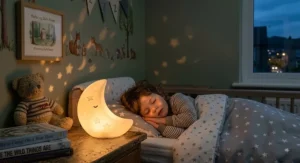
- Match brightness to purpose, not preference. A light bright enough to read by is rarely the right choice for actual sleep. The Sleep Charity’s guidance for parents notes that the bedroom environment plays a genuinely important role in a good night’s sleep, and a soft, warm glow is usually enough to help a child feel safe without disrupting melatonin production.
- Check the colour temperature. Warmer, red or amber tones are gentler on a settling brain than cool white or blue light, which research consistently links to delayed sleep onset.
- Decide between mains and rechargeable power. Mains-powered plug-ins never need charging but stay fixed in place; rechargeable options like the VAVA Egg Baby Night Light Plus travel but need a weekly top-up routine.
- Consider whether you actually need extra features. Sound, projection and apps add cost and complexity — useful for some families, unnecessary for others who just want the room lit.
- Verify the build is genuinely child-safe. Rounded edges, cool-touch casings, and toy-grade or BPA-free materials should be non-negotiable, not a nice-to-have.
- Think about your child’s specific bedtime problem. A light won’t fix early wake-ups; a projector won’t necessarily fix fear of the dark rooted in separation anxiety. Match the tool to the actual issue.
- Set a realistic budget band. Genuinely useful options exist from under £15 right up to £90-plus — more money buys convenience and features, not necessarily better sleep.
Common Mistakes When Buying a Night Light for Kids
The most frequent mistake we see reflected across aggregated reviews is buying on brightness and colour appeal rather than on colour temperature and purpose — a light that looks impressive lit up in a shop photo can be genuinely too stimulating for actual bedtime use. A close second is assuming every “night light” is interchangeable, when in practice a sleep-trainer clock, a plug-in sensor light, and a projector are solving three different problems and shouldn’t be chosen on price alone.
Parents also commonly underestimate battery logistics. A gorgeous rechargeable lantern that dies mid-week because nobody set a charging reminder causes exactly the bedtime disruption it was bought to prevent. Finally, skipping the safety check is a real and avoidable risk — always confirm UK plug compatibility and a recognised safety marking before buying from a lesser-known brand, particularly with imported projector-style lights, which vary more in build quality than the plainer plug-in category.
Safety, Regulations & What “Child-Safe” Actually Means
“Child-safe” isn’t just marketing language in the UK — it maps onto real regulation. Electric toys and light-up children’s products sold in Great Britain fall under the Toys (Safety) Regulations 2011, and according to GOV.UK’s guidance on product marking, manufacturers currently have the flexibility to use either the UKCA or CE mark to show compliance in Great Britain. Practically, that means checking the packaging or listing for one of these two marks before buying, particularly for projector-style lights with small batteries or detachable parts.
Beyond the legal mark, a genuinely child-safe night light for a bedroom should stay cool to the touch even after hours of continuous use, use rounded rather than sharp housing, and avoid any small parts that could detach with repeated handling by curious fingers — exactly the design brief behind the Integral LED Plug-in Night Light‘s casing. For battery-powered options, check that the compartment requires a tool or deliberate action to open, a standard feature on reputable brands like Cloud b and Pabobo, and a genuine safety gap on cheaper unbranded imports. If a listing doesn’t mention a UK plug fitting, a recognised marking, or battery-compartment security at all, treat that absence as a red flag rather than an oversight.
Long-Term Cost & Maintenance: What a Night Light Actually Costs Over Time
Upfront price only tells part of the story. A £12 plug-in sensor light like the Integral LED Plug-in Night Light costs next to nothing to run — roughly 2p a week — and has no battery to eventually degrade, so its total cost of ownership over three years stays close to the sticker price. A rechargeable option like the VAVA Egg Baby Night Light Plus, by contrast, costs more upfront but replaces the need for disposable batteries entirely, and reviewers reporting several years of reliable use suggest the real per-year cost ends up genuinely competitive once you account for that saving.
Where costs can creep up is with app-connected devices like the Hatch Rest. The hardware itself is a one-off purchase, but some extended features are gated behind an optional subscription, so it’s worth checking current terms before assuming every feature is included forever. Battery-only projectors sit in the middle: cheap to buy, but ongoing AA or AAA battery costs add up faster than most parents expect if a child insists on the light running nightly rather than on a timer.
What to Expect: Real-World Performance After the First Month
The honest picture, based on aggregated review sentiment across this category, is that most night lights deliver on their core promise — soft, safe illumination — but the “extra” features are where satisfaction varies most. Projector-style lights tend to delight in week one and then get used more for their plain glow than their star patterns by week four, which is worth knowing before you pay a premium purely for the projection feature. Sleep-trainer clocks like the Tommee Tippee Groclock typically take one to two weeks of consistent reinforcement before a toddler reliably respects the visual cue — expect a bumpy first fortnight rather than instant results.
App-controlled devices such as the Hatch Rest generally settle into daily use faster than expected once the initial setup is done, since most parents build a fixed routine within the app and then rarely open it again beyond occasional adjustments. Across the board, the single biggest predictor of long-term satisfaction in aggregated reviews isn’t the brand or price point — it’s whether the light actually matched the specific bedtime problem the family was trying to solve in the first place.
Frequently Asked Questions
❓ Is it OK for a child to sleep with a night light on every night?
❓ What colour night light is best for kids' sleep?
❓ At what age do children usually need a night light?
❓ Can a night light disrupt a child's sleep instead of helping it?
❓ Do plug-in night lights use much electricity?
Conclusion
There’s no single “best” night light for kids — only the right light for the specific problem your household is actually trying to solve. If bedtime itself is the fight, a sleep-trainer clock like the Tommee Tippee Groclock or an all-in-one device like the Hatch Rest does more heavy lifting than a plain glow ever could. If your child simply needs gentle reassurance that the dark isn’t empty, something like the Cloud b Twilight Turtle Classic or Pabobo Nomadic Star Mushroom Projector turns the ceiling into something worth looking at. And if the brief is genuinely just “keep the landing safe without overthinking it,” the Integral LED Plug-in Night Light remains the sensible, low-cost default most families never need to upgrade from.
Whichever direction you go, the underlying advice from sleep professionals stays consistent: keep it dim, keep it warm-toned, and keep the routine around it calm and predictable. The light is only ever half the equation — the habit you build around it does the rest. For further support with bedtime fears and routines specifically, Action for Children’s Parent Talk service offers free advice from experienced parenting coaches if you’d like guidance beyond product choice alone.
✨ Ready to Choose Yours?
🌙 Compare the seven picks above against your own bedtime routine, check current pricing and availability, and pick the one that solves your actual problem — not just the prettiest box on the shelf.
Recommended for You
- 7 Best Motion Sensor Night Lights UK 2026: Hallway to Bathroom
- Low Blue Light Night Light: 7 Best Picks Tested for 2026 (UK)
- Best Night Light for Adults 2026: 7 Sleep-Friendly Picks
Disclaimer: This article contains affiliate links. As an Amazon Associate, I earn from qualifying purchases. If you purchase products through these links, we may earn a small commission at no additional cost to you.
✨ Found this helpful? Share it with your friends! 💬🤗
