
In This Article
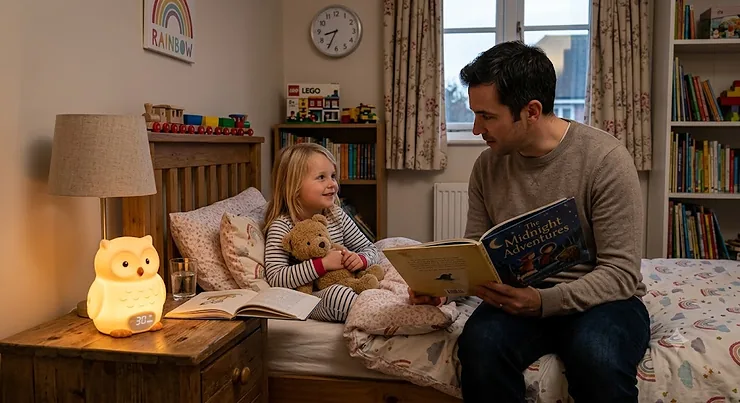
Somewhere around 5:47am, a small person appears at the side of your bed asking if it’s “morning time yet.” If that sentence gave you a full-body flinch, you are not alone, and you are exactly who this guide is for. A good night light with timer for kids does two jobs most parents don’t expect from a bit of plastic and LEDs: it soothes the 2am wake-up, and it quietly negotiates a more civilised wake-up hour without you saying a single word. That’s the whole appeal of a night light with timer for kids — it removes you from the argument entirely, letting the light do the talking.
We’re going to walk through seven real, currently available products spanning budget, mid-range and premium price points, so whether you’ve got a tenner or ninety quid to spend, there’s something here that fits. Along the way we’ll dig into how these devices actually work, where the marketing oversells them, and which one suits which kind of family. What is a night light with timer for kids? In short, it’s a bedside light — sometimes paired with a clock, sound machine or colour-change display — that switches on, off, or between colours on a pre-set schedule, so a toddler or young child gets a visual cue for “still sleep time” versus “OK to get up.” It’s a small object with an outsized effect on the whole household’s sleep.
We’ve researched real product specifications, gathered aggregated customer-review sentiment from verified retail listings, and cross-checked safety guidance from the NHS, so you’re getting an honest, decision-ready comparison rather than a rehashed spec sheet.
Quick Comparison Table
| Product | Price Range | Standout Feature | Best For |
|---|---|---|---|
| Tommee Tippee Groclock | £20-£30 | Classic star-to-sun visual cue | First-time sleep trainers, ages 2-6 |
| PurFlo Snoozee | £22-£32 | Rechargeable, 7 brightness levels | Travel and portability |
| Munchkin Light My Way | under £15 | Grab-and-go handle nightlight | Loo trips and toddler comfort |
| LittleHippo Mella | £35-£50 | All-in-one alarm, sounds and nightlight | Families wanting one gadget for everything |
| Hatch Rest 2nd Gen | £60-£80 | App-controlled, grows with the child | Tech-comfortable households |
| Yoto Player 3rd Gen | £90-£110 | Screen-free audio player with colour timer | Story-loving kids and screen-time reduction |
| Lumie Bodyclock Spark 100 | £70-£85 | Sunrise/sunset simulation | Older children and dark-winter mornings |
Looking at the spread above, there’s a clear pattern: cheaper devices like the Munchkin Light My Way and PurFlo Snoozee nail one job well (portability, simple colour cues), while pricier options like the Hatch Rest 2nd Gen and Yoto Player 3rd Gen bundle in app control, audio content and multi-stage routines. The Tommee Tippee Groclock sits in the sweet spot as the most recognised entry point for sleep training specifically, while the Lumie Bodyclock Spark 100 is really in a category of its own, aimed more at older children and light-sensitive mornings than toddler bedtime battles.
💬 Just one click — help other tired parents make better buying decisions too! 😊
Top 7 Night Lights With Timer for Kids: Expert Analysis
Reaching for any night light with timer for kids on a whim rarely ends well — we’ve picked these seven because each earns its spot for a genuinely different reason, not just because it showed up first in a search result. Every entry below blends real specifications with honest, sourced analysis of who it actually suits.
1. Tommee Tippee Groclock — best-known sleep trainer for beginners
The Tommee Tippee Groclock (made by the Gro Company, now under the Tommee Tippee umbrella) is the clock most UK parents have either owned or borrowed from a friend, and there’s a reason it’s stuck around this long.
At bedtime, the display fills with softly glowing stars around a sleeping moon; when the pre-set wake time arrives, those stars are replaced by a smiling sun. In practice, this means a toddler doesn’t need to read a clock face or understand “seven o’clock” — they just need to remember one rule: stars mean stay put, sun means go. The Groclock also includes a printed storybook, which does more heavy lifting than you’d expect, since walking a two- or three-year-old through the “why” before you ever switch the thing on tends to make the visual cue click faster once it’s actually in use.
Based on the spec comparison with other clocks in this list, the Groclock‘s biggest strength is also its simplicity — there’s no app, no Bluetooth pairing, and nothing to update. Reviewers consistently report that it’s straightforward enough for young toddlers to grasp within a week or two of consistent use, and several buyers specifically call out the two-alarm feature (useful for separating weekday wake times from weekend lie-ins) as a genuine time-saver for parents.
Pros:
- ✅ Simple star-and-sun visual system toddlers grasp quickly
- ✅ Two adjustable wake settings for weekday and weekend
- ✅ Included storybook helps explain the concept beforehand
Cons:
- ❌ No dimming schedule for the overnight glow itself
- ❌ Mains-powered only, so it’s less travel-friendly
At around £20-£30, the Groclock remains one of the best-value entry points into sleep training if your priority is simplicity over smart features — check current price on Amazon UK before buying, as availability shifts between colour options.
2. PurFlo Snoozee — best rechargeable option for travel
The PurFlo Snoozee, from British safe-sleep brand Purflo, takes the “sun means wake, moon means sleep” formula and strips out the mains cable entirely, which turns out to matter more than it sounds.
Specifically, the Snoozee runs on a rechargeable internal battery said to last several days on a single charge, with seven adjustable brightness levels controlled by simple plus/minus buttons on the back. What that means in practice: no trailing cable near a curious toddler’s cot, and a device you can genuinely throw in an overnight bag for a grandparents’ stay without hunting for a spare plug adaptor. What most buyers overlook about clocks in this category is how much friction a cable adds — one less cord by the bed is one less thing to trip over during a 3am nappy change.
The Snoozee also includes a child lock, a feature that comes up again and again in aggregated review sentiment as a genuine relief for parents whose toddlers had previously “fixed” the settings themselves at 4am. It functions as a basic 12-hour digital clock too, which is a nice bonus once your child is old enough to start learning numbers alongside colours.
Pros:
- ✅ Cordless and rechargeable for up to several days
- ✅ Seven brightness levels via simple button controls
- ✅ Child lock prevents accidental setting changes
Cons:
- ❌ Smaller display than some mains-powered rivals
- ❌ No sound machine or music functions included
Priced in the £22-£32 range depending on retailer, the PurFlo Snoozee earns its place as the practical mid-budget pick, particularly for families who move between houses or travel regularly.
3. Munchkin Light My Way — best grab-and-go comfort light
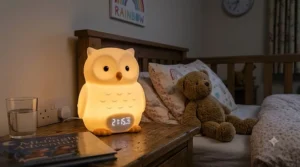
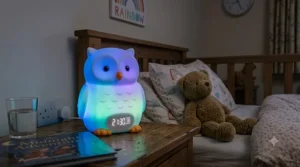
Not every family needs (or wants) a full sleep-training system. The Munchkin Light My Way is a battery-powered, owl-shaped portable nightlight designed for exactly the situations a fixed bedside clock can’t cover — the 2am corridor walk to the loo, the sudden thunderstorm, the unfamiliar spare room at a relative’s house.
Reviewers consistently highlight the moulded handle as the standout feature, since it’s genuinely designed for small hands rather than being an afterthought. The Light My Way uses cool-touch LED technology and automatically shuts off after roughly twenty minutes, which is a sensible built-in timer for a device that’s meant to be a comfort object rather than an all-night fixture. On paper this means it won’t run down its batteries if a child falls asleep clutching it, which happens more often than you’d think.
This isn’t a colour-change wake light or an OK-to-wake clock — it’s simply a reassuring, portable glow, and it should be judged on that basis rather than compared feature-for-feature against the app-controlled options further down this list.
Pros:
- ✅ Portable handle designed for small hands
- ✅ Automatic 20-minute timer conserves battery
- ✅ Cool-touch LED is safe for close contact
Cons:
- ❌ No colour-change or wake-time function
- ❌ Runs on AAA batteries rather than USB charging
At under £15, the Munchkin Light My Way is best treated as a comfort accessory alongside one of the sleep-trainer clocks on this list, not a replacement for one.
4. LittleHippo Mella — best all-in-one nursery timer light
The LittleHippo Mella is the device most likely to actually replace three or four separate gadgets on a nightstand. Shaped like a friendly round character with an animated face, it combines an OK-to-wake clock, sound machine, night light and nap timer into a single unit that started life as a crowdfunded project before becoming one of the most talked-about sleep trainers on the market.
Here’s what to weigh: the Mella‘s face changes expression alongside its colour — closed eyes and a moon during sleep time, open eyes and a smile at wake time — which gives younger children a second cue beyond colour alone, useful for kids who aren’t fully confident distinguishing shades yet. It offers a genuine colour change wake light function across a broad palette, alongside six ambient sleep sounds (white noise, rain, ocean, lullaby, rainforest and birdsong) and a configurable nap or activity timer.
Aggregated customer-review sentiment is largely positive on functionality, though a recurring theme across independent reviews is that even the dimmest brightness setting can feel too bright for very light-sleeping toddlers or shared rooms — worth bearing in mind if your child already sleeps with minimal ambient light. On the plus side, several parents specifically praise its “grows with the child” design, since older kids can repurpose it as a straightforward timer for homework or screen-time limits once sleep training is no longer the priority.
Pros:
- ✅ Combines clock, sounds, timer and nightlight in one
- ✅ Facial expressions reinforce the colour-based cues
- ✅ Doubles as a general-purpose kids’ timer as they grow
Cons:
- ❌ Lowest brightness setting still fairly bright for some
- ❌ No app control, so all settings are done manually
In the £35-£50 range, the LittleHippo Mella offers strong value for families who’d rather consolidate gadgets than juggle several.
5. Hatch Rest 2nd Gen — best for app-controlled routines
The Hatch Rest 2nd Gen takes a different approach entirely: instead of physical buttons doing most of the work, it’s controlled via a companion smartphone app over Wi-Fi, which unlocks a level of customisation the button-based clocks on this list can’t match.
Reviewers consistently note the sound quality and colour range as particular strengths, with one common thread across independent retailer reviews being how “non-jarring” the white noise and nature sounds feel compared with cheaper sound machines. Based on the spec comparison, the Hatch Rest‘s “Time-to-Rise” feature functions much like the Groclock‘s star-to-sun system, but with far more granular control — you can programme different colours, brightness curves and sound pairings for nap time versus overnight, and adjust everything remotely without walking into the room and risking a wake-up.
What the spec sheet won’t tell you, but user reports suggest, is that Wi-Fi dependency is a genuine double-edged sword: several reviewers mention that losing an internet connection can interrupt playback, which is a fair trade-off to weigh if your household Wi-Fi is patchy. The device also offers an optional content subscription for guided wind-down routines and stories, though the core night-light and Time-to-Rise functions work perfectly well without it.
Pros:
- ✅ App control allows remote, granular customisation
- ✅ Wide colour range with genuinely soothing sound options
- ✅ Designed to scale features from infancy through to the tween years
Cons:
- ❌ Some functions rely on a stable Wi-Fi connection
- ❌ Optional content subscription adds an ongoing cost
At £60-£80, the Hatch Rest 2nd Gen suits tech-comfortable households who want to fine-tune settings without physically handling the unit each time.
6. Yoto Player 3rd Gen — best for story-loving kids
The Yoto Player 3rd Gen isn’t marketed primarily as a sleep trainer, but its programmable OK-to-wake nightlight and clock function have made it a genuine dual-purpose pick for families who also want a screen-free audio player for stories, music and podcasts.
Here’s the clever bit: via the free app, parents can set the nightlight to glow one colour during the day and switch automatically to another at bedtime, effectively building a colour change wake light system on top of a device your child will also use to listen to audiobooks, white noise or a bedtime story before lights-out. Reviewers consistently describe the wind-down routine this creates as genuinely useful — children pick a physical card, slot it in, and the story plays without a screen in sight, which sidesteps the usual pre-bed tablet battle entirely.
What most buyers overlook about the Yoto Player is that it’s really two products in one: a children’s audio platform first, and a capable OK-to-wake clock second. That’s exactly why it earns its spot here rather than in a pure audio-device roundup — the nightlight and colour-scheduling features are functional enough to replace a dedicated sleep-trainer clock for many families, and the addition of a room thermometer is a small but genuinely handy extra.
Pros:
- ✅ Screen-free audio player doubles as a colour-change wake light
- ✅ Up to 16 hours of playback per charge
- ✅ No cameras, microphones or ads built in
Cons:
- ❌ Pricier than dedicated sleep-trainer clocks
- ❌ Nightlight customisation requires the companion app
Sitting around the £90-£110 mark, the Yoto Player 3rd Gen is the best pick if you want the sleep-training function bundled with genuine day-to-day entertainment value.
7. Lumie Bodyclock Spark 100 — best wake-up light for older children
The Lumie Bodyclock Spark 100 is the odd one out on this list in a good way: it’s a proper wake-up light for children rather than a toddler sleep trainer, aimed at school-age kids (and honestly, plenty of adults) who struggle with dark winter mornings.
From British light-therapy specialist Lumie, the Spark 100 simulates a 30-minute sunrise that gradually brightens the room before an alarm sound kicks in, rather than jolting a child awake with a sudden noise. On paper this means a gentler cortisol response at wake time — the light gradually signals the body to reduce melatonin production, working with natural circadian rhythms rather than against them, similar in principle to devices used for seasonal affective disorder in adults. At night, it works in reverse, fading down to a warm glow or a dedicated nightlight setting to support winding down.
Independent reviewers have generally rated the Spark 100 highly for its simplicity and build quality, though the same coverage notes that the physical button interface can feel slightly fiddly compared with touchscreen rivals. This is genuinely not the right pick for a two-year-old who can’t yet understand “wait for the light” — it comes into its own with children aged roughly six and up who are already managing an independent wake-up routine but need a nudge that isn’t a blaring alarm.
Pros:
- ✅ Gentle sunrise simulation over 30 minutes
- ✅ Sunset/wind-down mode supports bedtime routine too
- ✅ Backed by a UK light-therapy specialist brand
Cons:
- ❌ Better suited to school-age kids than toddlers
- ❌ Button controls feel fiddly next to app-based rivals
At £70-£85, the Lumie Bodyclock Spark 100 is a smart step-up purchase once a child has outgrown a basic OK-to-wake clock.
Getting Started: Your First 30 Days With a Night Light Timer
Buying the device is the easy part. What actually determines whether a night light with timer for kids works is what happens in the first month of using it, and this is where a lot of well-meaning parents trip themselves up.
Start before bedtime, not at bedtime. Show your child the device switched off during the daytime, explain the colours calmly, and if the product comes with a storybook (like the Tommee Tippee Groclock), read it together at least once before the first “live” night. On night one, set the wake time realistically — if your child currently wakes at 5:30am, jumping straight to a 7am target is setting everyone up to fail. A common mistake in the first 30 days is setting the wake window too ambitious too fast; shift it in 15-minute increments every few nights instead.
Keep the overnight brightness low enough that it doesn’t interfere with melatonin production, and if your chosen device (such as the LittleHippo Mella or Hatch Rest 2nd Gen) offers a red or amber overnight tone, use it — cooler blue-toned light in the small hours can actually work against you. A maintenance note worth flagging early: rechargeable models like the PurFlo Snoozee should be topped up on a regular schedule (weekly is a sensible habit) rather than waiting for a flat battery at an inconvenient moment.
Expect some inconsistency in weeks one and two. Reviewers and sleep consultants alike note that most children need repeated, calm reinforcement of the “rule” before the visual cue truly sinks in — celebrate small wins (an extra ten minutes in bed counts) rather than expecting an overnight transformation.
✨ Don’t Miss These Exclusive Deals!
🔍 Take your family’s bedtime routine to the next level with these carefully selected night lights. Click through to check current pricing and availability, and finally reclaim your early mornings.
Real-Life Scenarios: Matching the Light to Your Family
Every family’s bedtime chaos looks a little different, so here’s how three common situations map onto the products above.
If you’re a parent of a two-year-old who’s just moved from a cot to a bed and keeps wandering into your room at 5am, the Tommee Tippee Groclock or PurFlo Snoozee are the sensible starting point — simple, low-cost, and built around the exact “stay in bed until you see X” concept that’s driving the problem. Budget around £25-£30, expect two to three weeks of consistent reinforcement, and pair it with the storybook or a similar bedtime explanation.
If you’re managing two children sharing a room, one of whom is more light-sensitive than the other, the LittleHippo Mella‘s dimmer range and facial-expression cues tend to work better than a single-brightness device, since you can find a lower setting that still reads clearly across the room. Budget £35-£50, and consider positioning the unit closer to the more sensitive sleeper’s side of the room.
If you’re a household juggling shift work or inconsistent schedules, the app-controlled Hatch Rest 2nd Gen earns its higher £60-£80 price tag by letting a parent adjust wake times or colours remotely without walking into the room — genuinely useful if one parent is doing an early shift and needs the settings changed without disturbing anyone. For school-age children resisting dark winter mornings specifically, the Lumie Bodyclock Spark 100 solves a different, related problem: not “stay in bed,” but “wake up without dread.”
How to Choose a Night Light With Timer for Kids
Picking the right device comes down to a handful of genuinely important criteria, rather than the longest feature list. Here’s how to work through it:
- Match the device to your child’s age and understanding. Under-threes generally respond best to simple two-colour systems (stay/go) like the Groclock; children aged four-plus can usually handle multi-stage cues or even digital clock faces.
- Decide how much control you actually want. If you’re happy setting it once and leaving it, a button-based clock is fine. If your routine changes often, app control (as on the Hatch Rest) pays for itself in convenience.
- Check the overnight light colour, not just brightness. Warm reds and ambers are generally considered less disruptive to melatonin production overnight than cool blues or whites.
- Think about portability if you travel often. Rechargeable, battery-powered options like the PurFlo Snoozee or Munchkin Light My Way hold up better for sleepovers and holidays than mains-only units.
- Factor in whether you want extra functions. Sound machines, story audio, or a room thermometer (as bundled into the Yoto Player and Hatch Rest) can add genuine value, but only if you’ll actually use them.
- Set a realistic budget band. Expect roughly £15-£30 for a basic timer light, £35-£60 for an all-in-one sleep trainer, and £70 and above for app-controlled or wake-up-light-style devices.
- Read the safety marking, not just the reviews. UK-sold electrical children’s products should carry a UKCA or accepted CE mark under the Toys (Safety) Regulations — a legal minimum, not a bonus feature.
Common Mistakes When Buying a Night Light With Timer for Kids
Even well-researched parents fall into a handful of predictable traps. First, buying based on brightness alone: a dazzling multi-colour display looks impressive in a product photo but can genuinely work against sleep if the overnight setting can’t be dimmed low enough — this was one of the most consistent complaints across independent Mella reviews.
Second, ignoring power source until after purchase. A gorgeous app-controlled clock is a poor fit for a nursery with no nearby socket, just as a battery-only light is a hassle if you’re constantly replacing cells. Third, expecting instant results. A device is a tool, not a magic switch — reviewers across every product on this list agree that consistency over two to three weeks matters more than which specific gadget you choose. Finally, some parents skip the “explain it first” step entirely and simply switch the device on cold, which tends to extend the learning curve unnecessarily. A five-minute conversation beforehand saves days of confusion later.
Wake-Up Light vs Traditional Night Light
It’s worth being clear-eyed about the difference between a wake-up light for children and a standard plug-in night light, because they solve genuinely different problems and buyers sometimes expect one to do the other’s job.
A traditional night light — think a simple plug-in glow or the Munchkin Light My Way — exists purely to reduce fear of the dark and provide enough illumination for safe movement around a room. It has no bearing on when a child wakes up. A wake-up light, by contrast, such as the Lumie Bodyclock Spark 100, is built around simulating natural daylight transitions to influence the body’s circadian rhythm, gently signalling “time to wake” through gradually increasing brightness rather than colour alone.
OK-to-wake clocks like the Groclock, PurFlo Snoozee and LittleHippo Mella sit somewhere in between: they combine a basic night light function with a scheduled colour or icon change that acts as a behavioural cue rather than a physiological one. In practice, younger children respond better to the behavioural cue (a colour they’ve been taught to associate with a rule), while older children and those specifically struggling with dark-morning grogginess tend to benefit more from the genuine light-based wake-up simulation. Choosing the wrong category for your child’s age is a common reason parents feel a device “didn’t work,” when in fact it was simply solving a different problem.
Night Light With Timer for Kids by Age Group
Age matters more than almost any other factor here. For babies and infants under 18 months, the NHS advises keeping sleep environments dark and consistent rather than introducing complex visual systems — a simple, dimmable comfort light is usually more appropriate than a full sleep-trainer clock at this stage.
For toddlers roughly aged two to four, colour-based OK-to-wake clocks come into their own, since toddlers generally need around 11-14 hours of sleep across 24 hours and simple visual rules (stars mean stay, sun means go) map neatly onto their developing understanding of routine, even before they grasp clock time. The Groclock, PurFlo Snoozee and Munchkin Light My Way are best suited to this age band.
For children aged five to eight, more sophisticated all-in-one devices like the LittleHippo Mella or Hatch Rest 2nd Gen tend to hold their interest longer, particularly once digital clock faces and sound options become genuinely useful rather than decorative. For nine and up, a dedicated wake-up light for children such as the Lumie Bodyclock Spark 100, or a hybrid audio device like the Yoto Player, better matches a child managing more of their own independent routine.
Long-Term Cost & Maintenance
The sticker price is only part of the total cost of ownership here, and it’s worth thinking a little further ahead than the initial purchase.
Battery-powered devices like the Munchkin Light My Way carry an ongoing (if modest) cost in replacement AAAs, which adds up over a year of regular use — budget a few pounds every couple of months depending on usage. Rechargeable units such as the PurFlo Snoozee avoid that recurring spend entirely but do rely on a USB cable and port staying in good condition; a cheap replacement lead is a sensible thing to keep spare.
App-connected devices carry a different kind of long-term consideration: the Hatch Rest 2nd Gen‘s core functions work without a subscription, but its optional content library is a recurring monthly cost worth factoring in if you know you’ll want it, rather than being surprised by it later. Mains-powered clocks like the Tommee Tippee Groclock have effectively zero ongoing running cost beyond negligible electricity use, which is worth weighing against their higher initial simplicity if budget certainty matters to you. Across the board, reviewers rarely report hardware failures within the first year or two on any of these products, though as with any electronic device, keeping charging contacts clean and avoiding submersion (particularly relevant for bathroom-adjacent nurseries) extends lifespan meaningfully.
Features That Actually Matter (And Those That Don’t)
Marketing copy on night lights loves to list features, but not all of them move the needle for actual sleep outcomes. Features that genuinely matter: a properly dimmable overnight setting (not just “low, medium, high” presets that are still too bright), a clear and consistent visual cue your child can learn quickly, and reliable power (whether that’s a good battery life or a stable mains connection).
Features that matter far less than the packaging suggests: an enormous colour palette. Reviewers across multiple products note that children typically settle into using two or three colours consistently rather than exploring the full spectrum, which makes a 16-colour unit functionally similar to a 4-colour one for most families. Similarly, elaborate app dashboards sound impressive but, based on aggregated review sentiment, many parents set the schedule once and rarely open the app again. If you’re choosing between two similarly priced devices and one simply has a longer feature list, don’t assume that automatically translates to better sleep — check that the core dimming, timing and cue-clarity fundamentals are solid first.
Safety, Regulations & Compliance Guide
Because these devices are electrical products intended for children’s bedrooms, safety compliance isn’t optional box-ticking — it’s a genuine legal requirement worth checking before you buy. In Great Britain, electrical children’s products must meet the Toys (Safety) Regulations 2011, and should carry either a UKCA mark or an accepted CE mark as proof of conformity assessment, covering everything from flammability to safe voltage limits for anything a child might handle directly.
Beyond the legal marking, a few practical checks are worth making regardless of which product you choose: keep any mains cable well out of reach of the cot or bed, avoid positioning the unit somewhere a child could pull it down onto themselves, and if a device is rechargeable, only use the cable and adaptor supplied by the manufacturer rather than a generic replacement. The NHS also notes that a nightlight can genuinely help children who are afraid of the dark settle more easily, provided the room stays dim rather than fully lit — a useful reminder that “night light” should mean a gentle glow, not a substitute for the main light.
Buyer’s Decision Framework
If you’d rather skip the full read and jump to a decision, use this quick framework. If your child is under three and this is your first sleep-trainer purchase, choose a simple two-colour clock like the Tommee Tippee Groclock because it’s the lowest-risk, lowest-cost way to test whether the concept works for your family. If your child needs a portable comfort light for occasional dark-corridor trips rather than a full training system, choose the Munchkin Light My Way because it solves that specific, narrower problem without unnecessary extras.
If you want one device to replace several nursery gadgets, choose the LittleHippo Mella or Hatch Rest 2nd Gen because the combined sound machine, timer and nightlight functions genuinely reduce nightstand clutter. If your child is school-age and struggles specifically with dark winter mornings rather than “staying in bed,” choose the Lumie Bodyclock Spark 100 because it addresses light-based grogginess directly rather than behavioural cueing. And if bedtime stories are already a nightly ritual you’d like to formalise, choose the Yoto Player 3rd Gen because it bundles the wake-light function into a device your child will use for entertainment value long after sleep training is done.
FAQ
❓ What is the best night light with timer for kids?
❓ What age should a child start using an OK-to-wake clock night light?
❓ Does a colour change wake light actually help toddlers sleep longer?
❓ Is a wake-up light for children better than a normal alarm?
❓ What's the difference between a sleep training lamp for a child and a nursery timer light?
Conclusion
There’s no universal “best” night light with timer for kids — only the best one for the child and household in front of you. If you’re just starting out and want the lowest-risk option, the Tommee Tippee Groclock remains a genuinely solid, well-tested entry point at a fair price. If you’d rather consolidate several nursery gadgets into one, the LittleHippo Mella and Hatch Rest 2nd Gen both deliver real value once you’re past the basics. And if your challenge is less about toddler bedtime battles and more about groggy, dark-morning wake-ups in an older child, the Lumie Bodyclock Spark 100 is worth the step up in price.
Whichever you choose, remember that the device is only half the equation — consistency, a calm explanation beforehand, and realistic expectations for the first few weeks matter just as much as the specs on the box. Give it time, keep the rule simple, and those 5:47am visits should, eventually, become a thing of the past.
✨ Don’t Miss These Exclusive Deals!
🔍 Ready to reclaim your mornings? Check current prices on any of the picks above and find the right fit for your family tonight.
Recommended for You
- Unicorn Night Light: 7 Best Picks for Kids in 2026
- Star Projector Night Light: 7 Best Picks for Kids in 2026
- Night Light for Kids: 7 Best Picks Parents Trust in 2026
Disclaimer: This article contains affiliate links. As an Amazon Associate, I earn from qualifying purchases. If you purchase products through these links, we may earn a small commission at no additional cost to you.
✨ Found this helpful? Share it with your friends! 💬🤗
