
In This Article
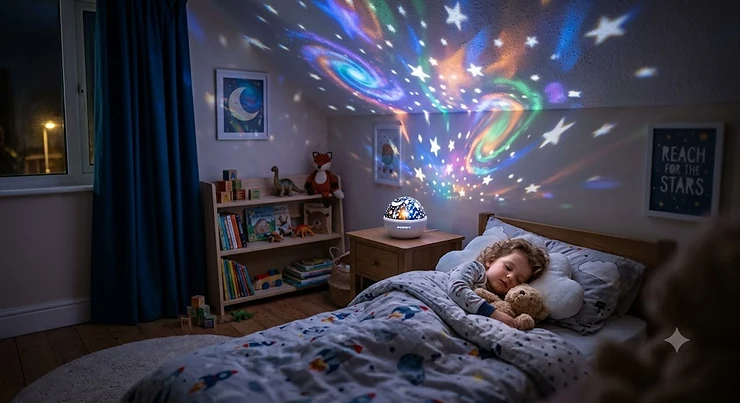
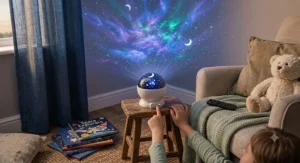
There’s a particular kind of quiet that falls over a kids’ bedroom once the ceiling stops being a ceiling and starts being a sky. That’s the whole appeal of a star projector night light, and if you’ve spent any time scrolling Amazon at 11pm trying to find “the good one” before your child’s birthday, you’ll know the choice is bewildering. Cheap plastic units sit alongside £250 planetariums, and the marketing photos all promise the same swirling galaxy on your bedroom wall.
A star projector night light is a small lamp-style device that beams patterns of stars, nebulae, or full constellations onto a ceiling or wall, typically as a calming visual aid for bedtime. Some are scientifically accurate planetariums; others are mood lights designed purely for atmosphere. Both types share one job: making a dark room feel a little less empty and a lot more magical.
This guide cuts through the noise. We’ve researched seven genuinely available products spanning budget crib accessories to premium planetariums, compared their real specs, and pulled together honest, aggregated review sentiment rather than inventing glowing testimonials. Whether you’re after a galaxy projector kids bedroom decor piece, a proper ceiling projector night light for a budding astronomer, or simply something to soften the transition from lights-on to lights-out, you’ll find a genuine match here. Good bedtime lighting is one small piece of a wider sleep routine, and the NHS guidance on helping babies and children sleep is worth a read alongside any product research, since no projector replaces a consistent wind-down routine.
Let’s get into which star projector night light actually earns a place in your child’s room, and why.
Quick Comparison Table
Before the deep dive, here’s how the seven products stack up at a glance.
| Star Projector | Price Range | Type | Best For |
|---|---|---|---|
| LBell 3-in-1 Galaxy Projector | under £35 | Budget galaxy + Bluetooth speaker | Tweens who want music-synced lights |
| Chicco Next2Stars | £20-£30 range | Crib-mounted sound-activated projector | Newborns and babies in a cot |
| Bresser Junior Astro Planetarium Deluxe | £40-£60 range | Battery-powered educational planetarium | STEM-curious kids aged 8+ |
| BlissLights Sky Lite Evolve | £45-£65 range | App-controlled laser and nebula mood light | Teens and shared family rooms |
| Encalife Atmosphere Smart Galaxy Projector | £90-£140 range | Wi-Fi and voice-controlled mood light | Smart-home households |
| National Geographic Astro Planetarium | £130-£170 range | Educational planetarium with speaker | Gifting and accurate night-sky learning |
| Sega Toys Homestar Flux | £220-£260 range | Premium scientific planetarium | Serious stargazers and adult buyers too |
Looking at this spread, there’s a clear pattern: cheaper picks like the LBell 3-in-1 Galaxy Projector and Chicco Next2Stars prioritise mood and convenience over accuracy, while the Sega Toys Homestar Flux and National Geographic Astro Planetarium sit at the top because they’re genuinely trying to replicate the real night sky. The middle of the table — the Bresser Junior Astro Planetarium Deluxe, BlissLights Sky Lite Evolve, and Encalife Atmosphere Smart Galaxy Projector — is where most families will actually land, because it balances price against features without demanding a planetarium-grade budget.
💬 Found a favourite already? Bookmark it now — the best sleep gadgets tend to sell out fast once the nights draw in.🤗
Top 7 Star Projector Night Lights: Expert Analysis
We’ve grouped these from budget to premium, covering variants for babies, school-age kids, teens, and families who want a smart-home-friendly option. Every product below uses real specifications and, where verifiable, aggregated review sentiment rather than invented testimonials.
1. LBell 3-in-1 Galaxy Projector — best budget pick with a built-in speaker
The LBell 3-in-1 Galaxy Projector earns its numbered spot first because it does the most for the least outlay, blending a galaxy light bedroom kids setup with genuine audio functionality. It combines laser stars, a swirling nebula cloud, and a rotating moon effect, all controllable via a 22-key remote that covers brightness, rotation speed, and colour without needing a companion app. What makes it stand out from cheaper carousel-style projectors is the built-in Bluetooth speaker, which pairs to a phone so the light pulses in time with whatever’s playing — handy for older kids who want their room to feel more like a chill-out zone than a nursery. Reviewers consistently report that the nebula colours look punchier than expected for the price, though a few note the projection edges can look slightly harsh compared with laser-only rivals costing twice as much. This is the pick for a tween wanting a “cool room” upgrade rather than scientific accuracy, and its four auto-off timer options (30 minutes to two hours) mean parents don’t have to police it manually at bedtime.
Pros:
- ✅ Bluetooth speaker syncs lights to music automatically
- ✅ 22-key remote controls every function without an app
- ✅ Four auto-off timer settings suit different bedtime routines
Cons:
- ❌ No app means customisation stops at the remote
- ❌ Nebula colours look slightly harsher than premium laser rivals
Sitting comfortably under £35, this is a low-risk buy: even if a child’s tastes move on within a year or two, the outlay is easy to justify.
2. Chicco Next2Stars — best for newborns and crib bedtime routines
Where the LBell 3-in-1 Galaxy Projector is about room decor, the Chicco Next2Stars is a genuinely practical parenting tool. Designed to hook onto Chicco’s Next2Me cribs — and compatible with most cots and travel cots with bars up to 38mm — this projector uses a smart sound sensor that detects crying and automatically relaunches its soft star projection and 30 minutes of soothing music. In practice, that means fewer 3am trips across the landing, because the device self-triggers rather than waiting for a parent to notice. It offers three light effects (night-time projection, soft projection, and a plain night light mode) and ships with a detachable, machine-washable plush toy for extra comfort. Genuine parent reviews on retailer sites are mixed but broadly positive: several testers found the sensor reliable at picking up genuine crying, though one noted it could occasionally trigger from unrelated household noise, and battery consumption was flagged as heavier than expected with nightly use. Unlike most other entries here, this isn’t an educational or scientifically accurate device — it’s a soothing tool first, aligned with the sort of gentle, consistent bedtime cues the NHS recommends for younger children.
Pros:
- ✅ Sound sensor automatically re-triggers lights and music
- ✅ Mounts securely to Next2Me cribs and most standard cots
- ✅ Includes a detachable, washable plush toy
Cons:
- ❌ No app or smart-home compatibility
- ❌ Gets through batteries quickly with nightly use
At around £20-£30, it’s one of the most affordable entries here, and arguably the one with the clearest, most specific job to do.
3. Bresser Junior Astro Planetarium Deluxe — best for STEM-curious school-age kids
Once children are old enough to ask “which star is that?”, the Bresser Junior Astro Planetarium Deluxe becomes a far more interesting purchase than a mood light. This is a proper star ceiling light for kids with educational intent: it projects more than 8,000 celestial bodies and 61 constellations across two interchangeable discs, powered by three AA batteries rather than a permanent mains connection, so it can be moved between bedrooms or even taken camping. The dual-motor rotation offers six speed settings, and a focusing wheel keeps the projection sharp at distances up to three metres. What the spec sheet doesn’t spell out is how this translates practically: because it isn’t tethered to a wall socket, a child can genuinely operate it themselves, pointing it at whichever wall or ceiling they fancy that night. Reviewers highlight the projection quality as impressively crisp for the price bracket, while the main criticism is that Bresser markets the unit for ages 14 and up, so younger children will need supervision both for safe handling and to get the most from the constellation content. It also lacks the built-in speaker found on its pricier National Geographic-branded sibling.
Pros:
- ✅ Covers 8,000+ celestial bodies across 61 constellations
- ✅ Battery-powered, so it isn’t tied to a plug socket
- ✅ Six-speed dual-motor rotation with a sharp focus wheel
Cons:
- ❌ Marketed for ages 14+, so younger kids need supervision
- ❌ No built-in speaker unlike the National Geographic model
In the £40-£60 range, this sits as one of the best value educational picks in the whole list.
4. BlissLights Sky Lite Evolve — best mood-focused galaxy projector
The BlissLights Sky Lite Evolve takes a completely different philosophy to the Bresser: rather than scientific accuracy, it’s engineered purely for atmosphere, and it does that job exceptionally well. It combines a Class 2 laser star field with RGBW LED nebula clouds, controlled through a companion app that also unlocks voice control via smart-home assistants and a customisable sleep timer running anywhere from one minute to 24 hours. Its spherical, base-free design means it can be angled almost anywhere — propped on a shelf, laid on its side, or tucked into a corner — which matters more than it sounds, because getting the throw distance right is often the difference between a magical ceiling and a disappointing smear of colour on one wall. Aggregated reviewer sentiment is strongly positive on the colour blending, which testers describe as noticeably smoother and more pastel-toned than the earlier Sky Lite 2.0 generation, though the lack of a built-in speaker disappoints buyers expecting an all-in-one device, and the price step-up over the outgoing model is a fair complaint given the core experience is similar. This is a strong pick for teens or as a shared family living-room feature rather than a strictly functional kids’ sleep aid.
Pros:
- ✅ App and voice control via smart-home integration
- ✅ Smoother, more pastel colour-blending than earlier models
- ✅ Base-free spherical design allows flexible placement angles
Cons:
- ❌ No built-in speaker
- ❌ Costs more than the outgoing Sky Lite 2.0 for a similar core experience
Expect to pay in the £45-£65 range, positioning it as a mid-tier upgrade rather than an entry-level buy.
5. Encalife Atmosphere Smart Galaxy Projector — best for smart-home households
If your home already runs on Alexa or Google Home, the Encalife Atmosphere Smart Galaxy Projector is arguably the most convenient universe projector child bedrooms can get, because it’s built around full smart-home integration rather than treating it as an afterthought. It connects over Wi-Fi to a companion app and voice assistants, letting you change nebula colours (from a stated palette of 16.7 million shades) without touching the device at all — genuinely useful for a parent trying not to wake a dozing toddler by fumbling for a remote in the dark. Physically, it has just one button on the unit itself, which reviewers note makes it surprisingly kid-friendly even before Wi-Fi setup is complete, though supervision is still advised given the laser component. Where it falls down against scientifically minded rivals is content: this projector shows colourful, swirling patterns rather than constellations or real star positions, so buyers expecting a planetarium experience will be disappointed. Setup also takes a little longer than plug-and-play competitors, since getting the Wi-Fi pairing right is a genuine extra step compared with a simple remote-control unit.
Pros:
- ✅ Full Wi-Fi, app, and voice control (Alexa and Google Home)
- ✅ Single-button interface even without the app
- ✅ Premium unboxing experience that feels genuinely gift-ready
Cons:
- ❌ No constellations or scientifically accurate star mapping
- ❌ Wi-Fi setup takes longer than plug-and-play rivals
Positioned in the £90-£140 range, it’s a premium mood light rather than a budget buy, and it’s priced accordingly.
6. National Geographic Astro Planetarium — best for accurate night-sky learning and gifting
Produced in collaboration with German optics specialist Bresser, the National Geographic Astro Planetarium is built specifically for families who want their ceiling projector night light to actually teach something. Its standout feature is a time-and-date selector: point the unit north, dial in tonight’s date and time, and it projects the real constellations visible from your location at that moment, rather than a generic starfield. A built-in speaker with a 3.5mm auxiliary input doubles as a bedtime radio or a way to play calming music alongside the stars, and the projection covers a generous 1.6 x 2.2 metres from two metres away. Independent reviewers rate it highly for this educational accuracy, consistently comparing it favourably to rivals that only offer decorative patterns. The most common criticism is that its “falling star” mode always triggers in the same spot on the ceiling roughly every 40 seconds, which feels like a missed opportunity for randomisation, and its boxier design is noticeably less sleek than mood-focused competitors like the BlissLights Evolve. Still, as a gift for a child (or adult) genuinely interested in astronomy, it’s difficult to beat at this price point.
Pros:
- ✅ Date/time dial projects the real night sky for your location
- ✅ Built-in speaker with 3.5mm aux input for bedtime audio
- ✅ Large 1.6 x 2.2 metre projection area
Cons:
- ❌ Falling star effect always appears in the same fixed spot
- ❌ Bulkier, less streamlined design than mood-light competitors
Typically found in the £130-£170 range, it undercuts the Sega Toys Homestar Flux while offering comparable educational value.
7. Sega Toys Homestar Flux — best premium, scientifically accurate planetarium
For buyers who want the single most convincing home planetarium available, the Sega Toys Homestar Flux is the benchmark the rest of this list gets measured against. Developed with input from Takayuki Ohira, the Japanese planetarium specialist behind the original Homestar series, it projects up to an astonishing 60,000 stars per disc through a 5-watt warm white LED, with a rotation motor engineered to run near-silently. It’s USB-powered rather than tied to a fixed mains adapter, meaning it can run from a portable power bank — a small detail that makes it genuinely portable for sleepovers or travel in a way most planetariums aren’t. Reviewers across multiple independent outlets are near-unanimous that its star field is the most realistic on the consumer market, with one describing the clarity as making it feel like you’re genuinely gazing up at the night sky rather than watching a projection. The trade-offs are real, though: there’s no adjustable brightness, so the light level is fixed regardless of room size or ambient light, and additional scene discs (aurora, Milky Way, shooting stars) are sold separately rather than bundled in. This is best suited to older children, teenagers, and adults who’ll appreciate the scientific accuracy over flashier but less precise mood lights.
Pros:
- ✅ Projects up to 60,000 stars per disc with industry-leading realism
- ✅ Whisper-quiet rotation motor even at higher speeds
- ✅ USB-powered, so it works from a portable power bank
Cons:
- ❌ No adjustable brightness — the light level is fixed
- ❌ Extra scene discs are sold separately, not bundled
At £220-£260, it’s a genuine investment, but reviewers consistently frame it as the “buy it once” option for a household serious about astronomy.
Setting Up Your Star Projector Night Light: A Practical Usage Guide
Getting the most from any star projector night light comes down to a handful of setup habits that Amazon listings rarely mention. First, positioning matters more than most buyers expect: place laser and LED models roughly 1.5 to 2.5 metres from the ceiling or main wall for the sharpest, most evenly spread projection — too close and the pattern looks blotchy, too far and it fades. Second, darken the room properly before judging brightness; even the brightest LED units, including the National Geographic Astro Planetarium, look washed out with a landing light left on. Third, for battery-powered models like the Bresser Junior Astro Planetarium Deluxe, rotate through a set of rechargeable batteries rather than disposables, since nightly use adds up fast and rechargeables pay for themselves within a few months. A common first-30-days mistake is leaving a projector running all night on its brightest, fastest-rotating setting; most units, including the LBell 3-in-1 Galaxy Projector, run cooler and last longer on a dimmer, slower setting, which is usually more soothing for sleep anyway. Finally, build the projector into a consistent bedtime sequence — lights on, then story, then projector on as the room lights go off — rather than using it as a standalone fix, since routine consistency does more for settling a child than any single gadget.
Which Star Projector Suits Your Family? Three Real-World Scenarios
Scenario one: new parents with a baby who wakes frequently. If you’re managing broken sleep with a newborn in a Next2Me-style crib, the Chicco Next2Stars is built precisely for this environment — its sound-activated relaunch means you don’t have to fully wake to resettle your baby, and at £20-£30 it’s an easy add to an already expensive first-year kit list.
Scenario two: an 8-year-old who’s just discovered space. For a child asking genuine questions about constellations, either the Bresser Junior Astro Planetarium Deluxe or the National Geographic Astro Planetarium earns its keep, since both project real astronomical content rather than decorative swirls. Budget-conscious families in a shared bedroom setup will likely prefer the Bresser at £40-£60; those wanting the added built-in speaker and date-accurate projection should stretch to the National Geographic model.
Scenario three: a teenager wanting a room refresh. Older children using their room as a hangout space, not just for sleeping, get more from mood-focused units. The LBell 3-in-1 Galaxy Projector covers this on a tight budget with its Bluetooth speaker, while a household already invested in smart-home tech might prefer the Encalife Atmosphere Smart Galaxy Projector or BlissLights Sky Lite Evolve for voice control and richer colour blending, accepting the higher £90-£140 and £45-£65 price ranges respectively as the cost of that extra polish.

How to Choose a Star Projector Night Light
Working through these seven criteria in order will narrow the field quickly:
- Decide between scientific accuracy and mood lighting first. If constellation accuracy matters, shortlist the Sega Toys Homestar Flux, National Geographic Astro Planetarium, or Bresser Junior Astro Planetarium Deluxe; if atmosphere is the goal, look at BlissLights, Encalife, or LBell instead.
- Match the power source to how it’ll be used. Battery-powered units are more portable but need ongoing battery spend; mains or USB-powered units are cheaper to run long-term but less flexible for moving between rooms.
- Check the projection distance and room size. A projector rated for a small 2-metre throw will underwhelm in a large room with high ceilings — read the stated projection surface size before buying.
- Consider the age of the child using it. Sound-activated crib projectors suit babies; app or voice-controlled units suit tech-comfortable older kids and teens; supervision is advised for any laser-based model with younger children.
- Weigh app and smart-home dependency. A Wi-Fi-dependent projector like the Encalife Atmosphere is powerful but adds setup friction; a remote-only unit like the LBell is instantly usable out of the box.
- Factor in noise level for light sleepers. Rotation motors vary in loudness; the Sega Toys Homestar Flux and BlissLights Sky Lite Evolve are both consistently praised as near-silent, which matters more than most buyers initially consider.
- Set a realistic budget band and stick to it. As the comparison table above shows, price roughly tracks accuracy and smart features — decide which of those two you’re actually paying for before comparing individual units.
Star Projector Night Light vs Traditional Night Light
A plain plug-in night light and a star projector night light solve the same core problem — fear of the dark and a need for gentle ambient light — but they do it very differently, and the difference matters when you’re weighing up the purchase.
| Feature | Traditional Night Light | Star Projector Night Light |
|---|---|---|
| Visual interest | Static, single glow | Moving, patterned projection |
| Sleep association | Passive background light | Often built into an active bedtime ritual |
| Price range | Often under £15 | £20-£260 depending on features |
| Best for | Simple fear-of-dark reassurance | Engagement, education, or mood-setting |
A traditional night light is cheaper and simpler, and for very young babies or children who are easily overstimulated, that simplicity can genuinely be an advantage — a static glow doesn’t compete for attention the way a rotating starfield can. But a star projector night light does more active work in a bedtime routine: children old enough to enjoy the display often use “watching the stars” as a calming cue in itself, which is why several of the products above, particularly the Chicco Next2Stars and Bresser Junior Astro Planetarium Deluxe, are marketed around routine-building rather than pure illumination. If your child already struggles to settle with more stimulating light, sticking with a plain night light — or choosing the dimmest, slowest setting on a projector — is the safer starting point.
Common Mistakes When Buying a Star Projector Night Light
The most frequent error is buying based on marketing photos rather than stated projection size — many budget listings show images shot in a small, pitch-black test room that make even a modest projector look room-filling, when the real coverage at a normal ceiling height is far smaller. A second common mistake is ignoring power source until after purchase; parents who assume every unit runs on batteries are sometimes surprised to find a mains-only design, which limits where it can be placed relative to a socket. Third, buyers often skip checking the laser safety class altogether, which matters more than it sounds for any device with a laser component in a child’s room — more on this in the section below. Fourth, some households buy the most feature-packed option (voice control, app, Bluetooth speaker) without checking whether their child will actually use those features, effectively overpaying for complexity a simple remote-controlled unit would have covered. Finally, forgetting to check return policies before an impulse buy is a genuine risk with imported budget projectors sold through third-party Amazon marketplace sellers, where quality control can be inconsistent even within the same listing.
Safety, Regulations and Laser Compliance for UK Buyers
Several of the projectors in this guide, including the BlissLights Sky Lite Evolve and Encalife Atmosphere Smart Galaxy Projector, use laser components to generate their star effects, and UK safety rules on this are worth understanding before buying for a child’s room. Laser products sold to UK consumers are classified under British and international standards, and the practical takeaway is straightforward: Class 2 lasers, the type used in most consumer star projectors, are limited to a maximum output of 1 milliwatt and are considered safe under normal use because the eye’s natural blink reflex protects against accidental exposure. UK product safety guidance specifically flags that laser products marketed as appealing to children must not exceed Class 1, the lowest-risk category, which is why reputable manufacturers state their laser classification clearly on the packaging or product listing. It’s worth checking this detail before buying any laser-based projector, particularly from lesser-known third-party sellers, since UK trading standards bodies have previously removed non-compliant laser products from sale for exceeding safe emission limits. As a general rule, never let a child stare directly into the light source of any projector, position units so the beam projects upward or across a room rather than at eye level, and supervise younger children until you’re confident they understand not to look directly at the lens.
What to Expect: Real-World Performance
Specs on a product page rarely translate directly into what a projector actually looks like in your specific bedroom, so here’s what the research and aggregated reviews suggest in practice. Budget units like the LBell 3-in-1 Galaxy Projector genuinely deliver a colourful, moving display, but the individual “stars” tend to look more like soft dots of light than pinpricks — fine for atmosphere, less convincing as astronomy. Mid-range app-controlled models such as the BlissLights Sky Lite Evolve produce noticeably smoother colour transitions and a more premium-feeling glow, closing much of the visual gap with premium units, though still without true constellation accuracy. At the top end, reviewers of the Sega Toys Homestar Flux and National Geographic Astro Planetarium repeatedly describe a genuine “wow” reaction on first use, particularly in a properly darkened room, because the sheer density of projected stars (up to 60,000 on the Homestar Flux) reads as convincingly three-dimensional rather than flat. Room size and ceiling height matter enormously here: the same projector that looks spectacular in a small box room can look underwhelming in a large loft conversion with high ceilings, so matching the stated projection surface to your actual room dimensions is one of the few genuinely objective ways to predict satisfaction before buying.
Star Projector Night Lights for Different Ages and Needs
Babies under 12 months generally benefit most from simple, sound-activated, low-stimulation designs like the Chicco Next2Stars, since the goal at this age is calm reassurance rather than engagement — the NHS’s general advice on children’s sleep behaviour consistently favours consistency and low stimulation over novelty for this age group. Toddlers and preschoolers, roughly ages 2 to 6, tend to respond well to gentle, remote-controlled units with a slow rotation setting and a clear auto-off timer, since this age group can be genuinely soothed by “watching the stars” as part of a wind-down routine but can also become overstimulated by fast-moving, brightly coloured patterns close to bedtime. School-age children from around 7 upward are the ideal audience for the more educational picks — the Bresser Junior Astro Planetarium Deluxe and National Geographic Astro Planetarium — because they’re old enough to engage with real constellations and ask the kind of questions those devices are built to answer. Teenagers and adults generally gravitate toward the premium or smart-home-integrated end of the market, valuing either the scientific accuracy of the Sega Toys Homestar Flux or the customisable mood-lighting of the BlissLights Sky Lite Evolve and Encalife Atmosphere Smart Galaxy Projector, often using them for relaxation or study ambiance rather than strictly as a sleep aid.
Frequently Asked Questions
❓ Are star projector night lights safe for babies?
❓ How much does a good star projector night light cost in the UK?
❓ Can a galaxy projector run all night safely?
❓ What's the difference between a galaxy projector and a star projector?
❓ Do star projector night lights need Wi-Fi?
Conclusion
Choosing between these seven options really comes down to one honest question: are you buying atmosphere, or are you buying astronomy? If it’s atmosphere, the LBell 3-in-1 Galaxy Projector and BlissLights Sky Lite Evolve deliver genuinely impressive colour and movement without demanding a premium budget, while the Encalife Atmosphere Smart Galaxy Projector adds smart-home polish for households that’ll actually use it. If it’s astronomy, the Bresser Junior Astro Planetarium Deluxe offers real educational value at an accessible price, the National Geographic Astro Planetarium adds date-accurate projection and audio, and the Sega Toys Homestar Flux remains the benchmark for anyone who wants the single most convincing night sky a consumer device can currently produce. And for the specific job of settling a newborn, the Chicco Next2Stars solves a problem none of the others are really designed for. Whichever direction you go, keep the safety guidance around laser classification and sensible positioning in mind, and check current pricing before buying, since availability and offers on all of these shift regularly.
✨ Don’t Miss These Exclusive Deals!
🔍 Take your search for the perfect star projector night light further — click through on any highlighted pick above to check current pricing and availability. These carefully researched options will help you create the calm, magical bedtime your family will love!
Recommended for You
- Night Light for Kids: 7 Best Picks Parents Trust in 2026
- 7 Best Motion Sensor Night Lights UK 2026: Hallway to Bathroom
- Low Blue Light Night Light: 7 Best Picks Tested for 2026 (UK)
Disclaimer: This article contains affiliate links. As an Amazon Associate, I earn from qualifying purchases. If you purchase products through these links, we may earn a small commission at no additional cost to you.
✨ Found this helpful? Share it with your friends! 💬🤗
