
In This Article
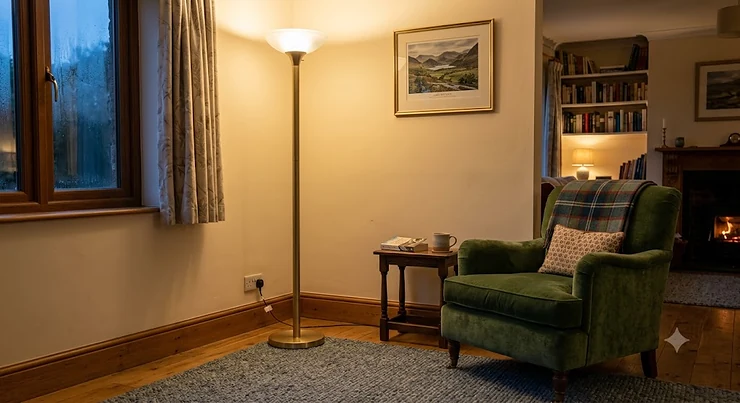
There’s a particular kind of evening ritual most of us don’t think twice about: you walk in, flick the big overhead light, and the room goes from cosy to clinical in half a second. That’s the tragedy of relying on a single ceiling fitting. An uplighter for living room use solves this the old-fashioned way — by bouncing light off the ceiling and walls instead of firing it straight down at your face. In thirty seconds: an uplighter is a lamp designed to throw light upward rather than downward, using the ceiling as a giant, soft reflector so the room fills with an even, glare-free glow rather than one harsh pool of brightness. Under UK energy labelling rules, every uplighter sold must now display clear efficiency information, which is genuinely useful when you’re comparing an old-style halogen torchiere against a modern LED one.
We’ve spent time digging through real product listings, verified specifications and genuine aggregated review sentiment to put together this guide — not a rehash of an Amazon listing, but honest analysis of what actually works in a British living room. Whether you’re after a floor uplighter for a reading nook, a standing uplighter lamp to soften a rented flat with no dimmer switches, or a corner uplighter living room fix for that one gloomy spot behind the sofa, there’s a real product below that fits. We’ll cover seven genuine options across every budget, then get into the details that actually change how a room feels: placement, colour temperature, running costs, and the mistakes that turn a good lamp into an expensive disappointment.
Quick Comparison Table
| Product | Type | Best For | Price Range |
|---|---|---|---|
| MiniSun Modern Silver Uplighter Floor Lamp | Classic torchiere | Budget-friendly ambient glow | around £35-£45 |
| HUAEU LED Floor Uplighter & Spot Lights (2 Pack) | Accent uplighter | Corner and plant lighting | under £30 |
| VASAGLE Floor Lamp with 3 Shelves | Tilting shade + storage | Small rooms needing function | £45-£60 range |
| LUCKEA LED Uplighter Floor Lamp (42W) | Dimmable remote uplighter | Whole-room ambient control | £50-£65 range |
| SIBRILLE Floor Lamp with Linen Shade | Scandi corner lamp | Soft diffused everyday light | £45-£60 range |
| OUTON Parent & Child Uplighter/Reading Lamp | Dual-light design | Reading plus ambience | £40-£55 range |
| Govee Uplighter Floor Lamp | Smart ceiling-wash lamp | Tech-lovers and mood lighting | mid-£100s |
Looking at this spread, the price gap tells its own story: cheap uplighters like the MiniSun and HUAEU buy you a warm glow and not much else, while paying more for the LUCKEA or Govee buys you control — dimming, colour temperature, and in the Govee’s case, an entire lighting “scene” system. The middle ground, occupied by VASAGLE, SIBRILLE and OUTON, is where most living rooms actually land, because they solve a second problem (storage, reading, dual lighting) alongside the ambient glow. If you’re renting and might move house in a year, the sub-£45 options make more financial sense than committing to a smart lamp you can’t take the ceiling reflections with you.
💬 Just one click — help others make better buying decisions too!😊
Top 7 Uplighters for Living Rooms: Expert Analysis
1. MiniSun Modern Silver Uplighter Floor Lamp — best classic budget torchiere
The MiniSun Modern Silver Uplighter Floor Lamp is about as close as you get to the platonic ideal of a floor uplighter: a simple pole, a bowl-shaped shade, and a job description that begins and ends with “point light at ceiling.” At 1800mm tall with a 220mm diameter shade, it’s built for average UK ceiling heights of around 2.3-2.4m, leaving enough clearance that the shade doesn’t scorch the plaster. The in-line switch and E27 fitting (rated up to 60W, though it ships with a 6W LED GLS bulb) mean you can swap in a warmer or dimmable smart bulb later without buying a new lamp entirely. Based on the spec comparison with pricier rivals, what you’re sacrificing here is control — there’s no remote, no dimming, no colour-changing gimmick — but for a spare room, a rental, or a first flat, that simplicity is arguably the selling point rather than the flaw. Reviewers consistently note that the silver finish reads more expensive than the price suggests, and that assembly takes minutes rather than an evening with an Allen key. Two recurring gripes in aggregated feedback: the bowl shade shows dust and fingerprints more visibly than a matte finish would, and the in-line switch cable can be fiddly to reach once the lamp is tucked behind furniture.
Pros:
- ✅ Genuinely simple setup — no manuals needed
- ✅ Silver finish looks pricier than its category
- ✅ Standard E27 fitting works with any smart bulb
Cons:
- ❌ No dimming or remote control included
- ❌ Bowl shade shows fingerprints and dust easily
At around £35-£45, the MiniSun earns its keep as the sensible default rather than the exciting pick — value here is about reliability, not features.
2. HUAEU LED Floor Uplighter & Spot Lights Indoor (2 Pack) — best for corner and plant accent lighting
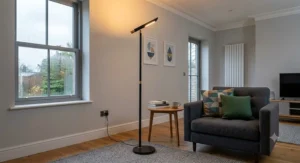
Where the MiniSun aims to light a whole room, the HUAEU LED Floor Uplighter & Spot Lights Indoor set is built for something narrower: highlighting a specific corner, a tall plant, or a piece of wall art with a warm 3000K wash. Each of the two compact cylindrical units runs a GU10 bulb, plugs in with a 5.9ft cord, and switches on via a foot pedal rather than a wall switch — practical when your hands are full or the outlet is behind the sofa. What most buyers overlook about this model is that it isn’t trying to be your main ambient light source; it’s a layering tool, the kind interior designers use to create depth rather than flatness. Aggregated review sentiment repeatedly praises the build quality relative to the price and describes the beam as “cosy” rather than “bright,” which lines up with its 3000K warm-white spec. Buyers looking for a genuine corner uplighter living room solution — say, either side of a media unit or flanking a bookshelf — get two fittings for the price of one uplighter elsewhere, which is a smart way to add symmetry to a room.
Pros:
- ✅ Two units for layered, symmetrical corner lighting
- ✅ Foot switch control frees up your hands
- ✅ Warm 3000K tone suits cosy living spaces
Cons:
- ❌ Not bright enough as a sole light source
- ❌ Bulbs aren’t dimmable out of the box
At under £30 for the pair, this is one of the cheapest ways to introduce genuine indirect ambient light into a dark corner without rewiring anything.
3. VASAGLE Floor Lamp with 3 Shelves (LFL001BD03) — best functional tilt-shade lamp for small rooms
The VASAGLE Floor Lamp with 3 Shelves takes a different approach entirely: rather than a fixed upward-facing shade, its fabric shade tilts up to 90 degrees, meaning it can act as a soft uplighter bouncing light off the ceiling or angle down for reading, all from the same fitting. At 160.5cm tall with a 29.9 x 31.8cm footprint and three open shelves built from particleboard and steel, it’s aimed squarely at smaller living rooms and flats where a lamp needs to double as storage for books, a plant, or the TV remote you can never find. The foot switch cycles between three colour temperatures, and here’s what the spec sheet won’t spell out clearly: because the shade genuinely tilts rather than simply pointing one way, this is one of the few lamps on this list that functions as both a floor uplighter and a reading lamp without buying two separate fittings. Reviewers highlight the shelves as unexpectedly sturdy for the price and note that assembly, while requiring a screwdriver, takes under twenty minutes with the included anti-tip kit — a detail worth noting if you have curious pets or toddlers, since the anti-tip fixing genuinely reduces wobble risk.
Pros:
- ✅ Shade tilts 90° for uplight or reading light
- ✅ Three shelves add real storage value
- ✅ Anti-tip kit included for safety
Cons:
- ❌ Fabric shade diffuses less light than open bowl designs
- ❌ Footprint needs a dedicated corner to work well
Priced in the £45-£60 range, this is the pick for anyone who needs their lighting to also solve a storage problem.
4. LUCKEA LED Uplighter Floor Lamp Living Room (42W) — best dimmable remote-controlled uplighter
Step up to the LUCKEA LED Uplighter Floor Lamp, and the 42W integrated LED array with a 2700K-6500K adjustable range starts to explain why it costs more than the simpler torchieres above. The wattage figure alone doesn’t mean much until you translate it: this is bright enough to genuinely replace a ceiling pendant as the room’s main light source, not just supplement it, while the tunable colour temperature lets you swing from warm evening amber to a crisper daylight tone for cleaning or video calls. Both remote and touch controls are included, and the remote magnetically attaches to the lamp’s pole, which sounds like a small thing until you’ve spent six months finding a lost remote down the side of the sofa. Genuine UK buyer reviews describe the uplight effect as excellent for “reflecting off the ceiling to give a pool of light underneath,” and multiple reviewers specifically compare it favourably to the halogen uplighters it’s replacing, citing lower running costs and a noticeably wider range of brightness levels. A minority of reviews mention the matte black finish as their only reservation, wishing for a brushed metal alternative — a fair point if your décor leans toward brass and warm tones rather than matte black.
Pros:
- ✅ Genuinely bright enough to be a main light
- ✅ Stepless dimming plus 2700K-6500K range
- ✅ Magnetic remote attaches to the lamp pole
Cons:
- ❌ Only available in matte black finish
- ❌ Touch controls can be less precise than remote
At around £50-£65, the LUCKEA represents the sweet spot between the barebones budget lamps and the smart-home premium tier — full control without the app-pairing faff.
5. SIBRILLE Floor Lamp with Linen Shade — best Scandi-style corner lamp with dual control
If the LUCKEA is about raw brightness and control, the SIBRILLE Floor Lamp with Linen Shade is about atmosphere. Its matte metal base and linen fabric shade diffuse the included 9W LED bulb (roughly 900 lumens) into a soft, even glow rather than a directional beam, and the compact footprint is specifically designed to slot into corners without dominating the room the way a wider tripod base would. Dual controls — a foot pedal for colour temperature and a magnetic remote for brightness — mean you’re not fumbling for a switch in the dark, and the dimming range runs a genuinely usable 10% to 100% rather than jumping between a handful of fixed steps. What most buyers overlook about linen-shade lamps generally is that the fabric itself changes the character of the light: it’s warmer and softer than an open metal shade, at the cost of slightly less total brightness. Aggregated reviewer feedback describes the dimming as smooth rather than stepped, and several reviewers specifically mention using the adjustable colour temperature to switch between a calming warm glow at night and a brighter, cooler setting for daytime tasks like cleaning or working from the sofa.
Pros:
- ✅ Linen shade gives an especially soft, warm glow
- ✅ Smooth 10-100% stepless dimming
- ✅ Compact footprint fits tight corners easily
Cons:
- ❌ Lower total brightness than metal-shade rivals
- ❌ Linen shade can mark if knocked or handled roughly
In the £45-£60 range, this is the lamp to choose if the goal is “cosy Scandinavian evening” rather than “replace the big light.”
6. OUTON LED Floor Lamp with Reading Lamp (Parent & Child Design) — best two-in-one uplighter and reading lamp
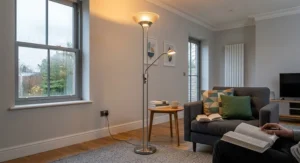
The OUTON LED Floor Lamp with Reading Lamp takes the “mother and child” design approach — one larger uplighter head paired with a smaller, independently adjustable reading light — and turns it into a genuinely practical solution for shared living rooms where one person wants ambient wash and another wants focused light for a book. Touch and remote controls operate the two lights either together or separately, and the dimmable range covers both the wide uplight and the narrower reading spotlight. Here’s what the spec sheet won’t tell you outright: the real value of a parent-and-child design isn’t the novelty, it’s avoiding the classic living-room compromise where one person sacrifices reading light so the other can watch a film in a dim, atmospheric room. Reviewers frequently mention buying this specifically to replace two separate lamps, and the aggregated sentiment suggests satisfaction with the flexibility, though a handful of buyers note the second reading arm has a shorter reach than expected for very deep armchairs.
Pros:
- ✅ Two independently controlled light zones
- ✅ Replaces the need for a separate reading lamp
- ✅ Touch and remote control both included
Cons:
- ❌ Reading arm has limited reach for deep chairs
- ❌ Two light heads mean a slightly bulkier base
At £40-£55, this earns its place for households where “ambience” and “I just want to read my book” are in constant, gentle conflict.
7. Govee Uplighter Floor Lamp — best premium smart ceiling-wash lamp
At the top of this list sits the Govee Uplighter Floor Lamp, which does something none of the others attempt: it splits into genuinely independent lighting zones on a single 170cm pole. The upper section casts a rotating, colour-shifting ripple effect onto the ceiling for decorative ambience, a middle RGBIC ring adds customisable colour glow, and a lower 1000-lumen white section handles proper task lighting for reading or working — all controllable via app, voice assistant, or the physical unit itself, with 2700K-6500K adjustable white light and Matter, Alexa and SmartThings compatibility built in. On paper this means one lamp is doing the job of three separate fixtures, which is precisely why the price sits well above everything else on this list. Reviewers who’ve tested it extensively describe the ceiling ripple effect as genuinely mesmerising rather than gimmicky, and praise how easy the companion app makes scheduling and scene-building; the most common criticism is that the clear plastic dome of the lampshade scuffs relatively easily if it brushes against a sloped ceiling, so measuring your room’s height before ordering is worth the two minutes it takes. For anyone who’s already invested in a smart home ecosystem, this is less a lamp and more a lighting installation that happens to stand in the corner.
Pros:
- ✅ Three independent lighting zones in one lamp
- ✅ Full smart home and voice assistant integration
- ✅ Ripple ceiling effect is a genuine talking point
Cons:
- ❌ Premium price relative to simpler uplighters
- ❌ Clear dome can scuff if it touches sloped ceilings
Sitting in the mid-£100s, the Govee is the one to budget for if you want your uplighting home setup to double as entertainment.
Practical Usage Guide: Getting the Best Indirect Ambient Light From Your Uplighter
Getting an uplighter right isn’t just about buying one — it’s about where you put it and how you run it in. Position matters more than almost any spec sheet figure: place the lamp roughly 15-20cm from a wall or corner so the light has somewhere to bounce, because pushing it flush against the wall crushes the reflection and pulling it too far into open floor space wastes most of the upward throw. In the first week, resist the temptation to run it on maximum brightness constantly; most integrated LED uplighters have a genuine lifespan rated in tens of thousands of hours, but consistently running at full output in a small room generates more heat and glare than the space needs. A common early mistake is forgetting to check ceiling colour and texture — a bright white flat ceiling reflects beautifully, while a textured Artex finish or a dark accent colour absorbs a surprising amount of light, sometimes 30-40% less effective reflection according to lighting industry estimates. For maintenance, dust the shade or lens monthly (a build-up of dust measurably dims LED output over time), and if your model has a fabric shade, spot-clean rather than machine-washing, since linen and cotton blends can shrink or discolour under standard cycles.
Real-World Scenarios: Matching an Uplighter to Your Living Room
Picture three different households, each with the same basic problem — a living room that feels flat under the main light — solved three different ways. First, a young professional renting a one-bed flat with low ceilings and no permission to alter fixed wiring: a plug-in floor uplighter like the MiniSun or HUAEU set solves this instantly, adding softness without a single tool or landlord conversation required. Second, a family with school-age children sharing one living room for homework, television and downtime: the OUTON parent-and-child design or the VASAGLE shelf lamp earns its keep here, because the household genuinely needs two lighting modes running simultaneously rather than one compromise setting. Third, a couple who’ve just moved into a first home with higher ceilings and a genuine appetite for smart-home tech: the Govee justifies its price precisely because taller rooms give its ceiling-ripple effect room to breathe, and the app-based scheduling suits people who already control their heating and speakers from a phone. The through-line across all three: budget and features should follow the room and the routine, not the other way round.
Common Uplighting Problems (And How to Fix Them)
Even a well-chosen uplighter can underwhelm if a handful of predictable issues go unaddressed. First, the “why does this look dim” complaint usually traces back to ceiling colour or a bulb that’s too low in lumens for the room size — swapping to a brighter LED bulb (check the E27 or GU10 fitting first) often fixes this without buying a new lamp. Second, flickering or buzzing, particularly with older halogen-style uplighters, is frequently a sign of an incompatible dimmer switch rather than a faulty lamp; LED-specific dimmers solve this in most cases. Third, a lamp that tips over easily is almost always a base-weight problem, and the practical solution is either choosing a model with a genuinely weighted base (like the Govee’s) or positioning the lamp somewhere it won’t get knocked, rather than assuming all floor lamps are equally stable. Fourth, colour temperature that feels “off” — too clinical or too orange — is a matter of matching Kelvin rating to purpose: 2700-3000K for relaxing evening ambience, 4000K-plus for anything closer to daytime focus. Finally, remote controls that stop responding are commonly a battery or line-of-sight issue rather than a defect, so before assuming the worst, check the batteries and make sure nothing is blocking the infrared sensor.
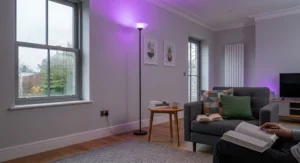
How to Choose an Uplighter for Your Living Room
- Measure your ceiling height first. Uplighters need genuine clearance to work — anything under 2.2m makes tall pole lamps impractical.
- Decide if you need dimming. A fixed-brightness lamp is fine for a rarely-used room; a main living space benefits enormously from stepless dimming.
- Check the bulb type and wattage cap. E27 and GU10 fittings are the most replaceable and future-proof if you want to upgrade later.
- Think about colour temperature range. A single fixed 3000K bulb suits a cosy reading nook; an adjustable 2700-6500K range suits a multi-use living room.
- Match control method to your habits. Remote and touch controls matter more in households where someone’s always mid-task with full hands.
- Factor in base stability. Homes with pets, kids, or open-plan traffic flow need a genuinely weighted base, not just a tall pole.
- Set a realistic price range. Budget lamps handle ambience well; paying more buys control, smart features, or dual-zone lighting — decide which you actually need before comparing prices.
Floor Uplighter vs Ceiling Wash Lighting: Which Wins for Ambience?
A floor uplighter and built-in ceiling wash lighting (recessed fittings angled to graze the ceiling or cove lighting hidden in a pelmet) both aim for the same effect — a softly lit ceiling rather than a single glaring point — but they get there very differently. Ceiling wash lighting is typically installed once, wired permanently, and controlled from a wall dimmer, which makes it elegant and invisible but expensive and disruptive to retrofit, especially in a rented property or a room without existing wiring for it. A floor uplighter, by contrast, plugs into any socket, can be repositioned in minutes, and costs a fraction of an electrician’s day rate — but it occupies floor space, needs a nearby socket, and can’t always match the perfectly even wash that a well-designed recessed system achieves. For most UK living rooms, particularly rentals or homes without a lighting refit budgeted in, a good uplighter closes perhaps 80% of the gap to proper ceiling wash lighting at a fraction of the cost and effort, which is exactly why it remains the more popular choice for anyone not planning major renovation work.
| Floor Uplighter | Ceiling Wash Lighting | |
|---|---|---|
| Installation | Plug-in, instant | Professional electrician needed |
| Flexibility | Fully portable | Fixed once installed |
| Typical Cost | £30-£150+ | Several hundred pounds plus labour |
| Best For | Renters, flexible rooms | Permanent home renovations |
The table makes the trade-off obvious: a floor uplighter wins on flexibility and upfront cost every time, while ceiling wash lighting wins only if you’re already committed to a full room renovation and want a completely invisible light source.
What Is a Standing Uplighter Lamp? (Plus Corner Uplighter Placement Tips)
A standing uplighter lamp is simply a free-standing floor lamp built specifically to direct its light upward, usually via an open or bowl-shaped shade at the top of a pole, rather than downward or sideways like a conventional reading lamp. The design traces back to the torchiere, a lamp style whose entire purpose has always been reflecting light off a ceiling to fill a room evenly. What makes a standing uplighter distinct from a table lamp doing a similar job is height and stability: because it stands on the floor rather than a surface, it can be positioned precisely where the ceiling reflection will be strongest, typically in a corner.
Corner uplighter placement in a living room isn’t arbitrary — corners work because two walls meet, doubling the reflective surface the light bounces off compared with a lamp standing in open floor space. As a rule of thumb, position the lamp 15-30cm out from each wall in the corner, angle the shade opening fully upward rather than tilted, and avoid corners with dark paint, heavy curtains, or low box shelving directly above, all of which absorb light that should be bouncing back into the room.
Common Mistakes When Buying an Uplighter for Living Room
The single most common mistake is buying on looks alone and ignoring the lumen output entirely — a beautiful lamp that only pushes out 400 lumens will disappoint in anything bigger than a small snug. A close second is assuming every uplighter is dimmable by default; plenty of budget models are fixed-brightness, which is fine if you know that going in but frustrating if you assumed otherwise. Buyers also frequently overlook bulb replaceability, purchasing a sealed integrated-LED unit and then discovering years later that when it eventually dims with age, the whole lamp needs replacing rather than just a bulb. Another recurring error is ignoring the base footprint relative to the room — a wide tripod base that looks striking in product photos can be a genuine trip hazard in a narrow living room. Finally, shoppers sometimes skip checking the cable length and plug position, only to find the lamp they’ve chosen for a specific corner is a metre short of the nearest socket.
Long-Term Cost & Maintenance of an Uplighting Home Setup
Running costs for LED uplighters are genuinely low: a 40W-equivalent LED uplighter used for roughly four hours an evening costs only a few pence per day at typical UK electricity rates, and integrated LED arrays commonly carry lifespans in the 20,000-50,000 hour range — which, at four hours nightly, works out to well over a decade of use before any noticeable dimming. The maintenance burden is similarly light: dusting the shade monthly, occasionally checking cable and plug condition, and, for models with replaceable bulbs, budgeting for an occasional bulb swap every few years. Where costs do creep in is with premium smart lamps like the Govee, which rely on continued app support and Wi-Fi connectivity — not a running cost as such, but a dependency worth being aware of if you dislike relying on an app to turn a light on. Research on the broader relationship between artificial lighting and wellbeing also suggests that adjustable, warmer evening lighting supports better sleep patterns than harsh, high-Kelvin lighting late at night — a genuine long-term “cost” worth factoring in beyond pounds and pence, since the cheapest lamp that keeps you on a bright cool setting all evening may not be the best value choice for your health.
✨ Don’t Miss These Exclusive Deals!
🔍 Take your living room lighting to the next level with these carefully selected uplighters. Click on any highlighted pick to check current pricing and availability — the right glow could be one click away!
Features That Actually Matter (And Those That Don’t)
Genuinely worth paying for: stepless dimming, adjustable colour temperature, and a stable, weighted base — all three change daily usability far more than any cosmetic detail. Also worth it if your household actually needs it: dual-zone lighting (ambient plus task) and app or voice control, provided you’ll actually use the app rather than defaulting to a physical switch anyway. Largely marketing hype for most living rooms: elaborate colour-changing RGB modes beyond a simple warm-to-cool range, since most people settle on one or two favourite settings within the first month regardless of how many “scenes” are technically available. Similarly, ultra-high maximum brightness figures matter far less than the quality of dimming at the lower end — a lamp that goes blindingly bright but can’t dim below 20% is less useful night to night than one with a smooth, genuinely low minimum setting for late-evening winding down.
Safety, Regulations & Energy Labelling for UK Uplighters
Every lighting product sold in the UK, uplighters included, must display the correct rescaled energy efficiency label at the point of sale, a requirement that’s been fully in force since 2021 and is designed to stop old, inflated efficiency ratings misleading buyers. Beyond energy labelling, standard electrical safety basics apply: check for an IP rating suited to the room (IP20 is standard and fine for a dry living room, but avoid anything not rated for indoor domestic use near bathrooms or damp areas), keep cables tidy and away from foot traffic, and never exceed the maximum wattage bulb stated for the fitting. The Energy Saving Trust’s lighting guidance is a genuinely useful independent reference if you want to understand how LED efficiency ratings translate into real running costs, and it’s worth a skim before assuming all “LED” labelling means identical performance across brands.
What to Expect: Real-World Performance
On paper, lumen figures and wattage ratings are straightforward, but in practice a living room uplighter’s performance depends heavily on room size, ceiling colour, and what else is competing for light in the space. A 900-1000 lumen uplighter, like the SIBRILLE, comfortably fills a small-to-medium living room (say, up to around 15 square metres) with soft ambient light when paired with a light-coloured ceiling, but the same lamp in a large open-plan space with a dark feature wall will feel noticeably dimmer than its spec sheet suggests. Higher-output models in the 1400-4200 lumen range, like the Govee or LUCKEA, genuinely can replace a room’s main light source, particularly useful in older properties where the only ceiling fitting is a single, unflattering pendant. The honest takeaway from aggregated reviewer experience: buy slightly more lumen capacity than you think you need, since dimming down an overly bright lamp is trivial, while a dim lamp in a large room has no fix beyond buying a second one.
FAQ
❓ What is the best type of light for uplighting a living room?
❓ Do uplighters use a lot of electricity?
❓ Can I use an uplighter as my only living room light?
❓ Where should I place a floor uplighter in a living room?
❓ Are dimmable uplighters worth the extra cost?
Conclusion
Choosing the right uplighter for living room use really comes down to matching three things honestly: your room’s size and ceiling height, how much control you actually want day to day, and how much you’re comfortable spending for that control. The MiniSun and HUAEU prove that a genuinely warm, ambient glow doesn’t require a big budget, while the VASAGLE and OUTON show how a single fitting can solve two problems — storage or reading light — alongside ambience. Step up to the LUCKEA or SIBRILLE for meaningfully better dimming and colour control, or go all-in with the Govee if smart-home integration and genuine “wow factor” ceiling effects matter to you. None of these are the “wrong” choice; they’re simply built for different rooms, routines and budgets, and the honest analysis above should make it far easier to pick the one that actually suits yours rather than the one with the flashiest listing photos.
Recommended for You
- Up and Down Wall Lights Indoor: 7 Brilliant Picks for 2026
- Plug-In Wall Lights UK 2026: 7 Best No-Electrician Picks
- 7 Best Wall Lights Living Room Picks for 2026 (Honest UK Guide)
Disclaimer: This article contains affiliate links. As an Amazon Associate, I earn from qualifying purchases. If you purchase products through these links, we may earn a small commission at no additional cost to you.
✨ Found this helpful? Share it with your friends! 💬🤗
