
In This Article
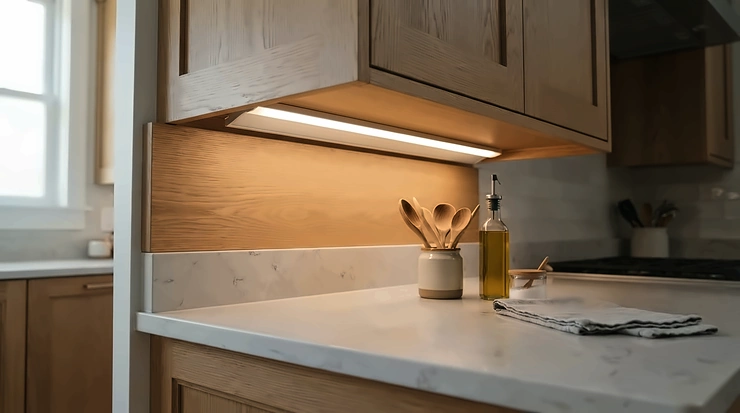
There’s a particular kind of kitchen gloom that no ceiling pendant ever quite fixes — the shadow your own head casts over the chopping board at six o’clock on a January evening. LED strip lights for kitchen worktops solve exactly that problem, and they do it without an electrician, a chunk of your weekend, or a bill that makes you wince. Stick a strip under the wall units, plug it in, and suddenly the counter where you actually do things — dicing onions, reading recipes, finding the corkscrew — gets its own dedicated light instead of borrowed scraps from across the room.
This guide walks through seven real, currently available strips spanning budget peel-and-stick tape through to smart, app-controlled systems and proper mains-wired kitchen fittings. Every product here has been chosen for genuine fit-for-kitchen use — moisture tolerance, brightness, colour accuracy — rather than just decorative appeal. We’ll cover what actually matters when you’re choosing (colour temperature, lumens per metre, IP rating, and how the strip gets its power), where each option earns its place, and the practical side nobody puts on the box: how to fit one without it peeling off in a year, and what to do when it does. If you’re comparing kitchen LED strip lights against traditional under-cabinet fittings, or you’ve landed here after searching for LED strip under cabinet kitchen ideas specifically, you’re in the right spot — this is a shopping guide, not a spec sheet.
Quick Comparison Table
| Product | Best For | Power Type | Colour Temp / RGB | Price Range |
|---|---|---|---|---|
| Lepro 5M LED Strip Light | Budget task lighting | 12V plug-in | 6000K daylight white | Under £20 |
| WOBANE Under Cabinet Kit | No-cut, pre-sized fitting | 12V plug-in, RF remote | 6500K white | £25-£30 range |
| Aigostar 5m WiFi Smart Strip | Budget smart lighting | 12V plug-in, WiFi | RGBW, tunable | Under £20 |
| Govee RGBIC H619Z | Colour zones & music sync | 12V plug-in, Bluetooth/WiFi | RGBIC, tunable white | £25-£35 range |
| Sensio Connex TriTone | Permanent, hardwired kitchens | Mains, hardwired driver | 3-in-1 CCT | £35-£50 range |
| Philips Hue Lightstrip Plus v4 | Full smart-home integration | Mains, Bluetooth/Hue Bridge | 16m colours + white | £65-£75 range |
| Govee Strip Light 2 Pro | Dot-free premium glow | Mains, WiFi/Matter | RGBIC, COB | £40-£60 range |
Looking at the spread above, the pattern is fairly predictable once you see it laid out: budget picks like the Lepro 5M LED Strip Light and Aigostar 5m WiFi Smart Strip compete on price and basic function, mid-range options such as the WOBANE Under Cabinet Kit and Govee RGBIC H619Z add convenience features like remotes and app control, and the premium tier — Sensio Connex TriTone, Philips Hue Lightstrip Plus v4, and Govee Strip Light 2 Pro — trades a higher price for either professional-grade hardwiring or genuinely smart-home-native control. Notice that mains-wired kitchen fittings (Sensio, Hue, Govee 2 Pro) tend to sit at the top of the price table, which reflects the extra components (drivers, transformers, proper connectors) baked into a permanent installation rather than a slap-and-stick tape.
💬 Found the right one already? A single click helps you compare current prices before you commit.
Top 7 LED Strip Lights for Kitchen: Expert Analysis
1. Lepro 5M LED Strip Light — budget daylight-white workhorse
The Lepro 5M LED Strip Light is the strip most people picture when they think “kitchen LED tape,” and there’s a reason it keeps turning up in under-cabinet shortlists: it does one job — bright, even, white light — without asking you to download an app to get it. It runs 300 LEDs across five metres, putting out around 1,650 lumens at a crisp 6000K daylight white, which is the colour temperature that makes chopping boards easiest to read and food colours look closest to true.
On paper, 12V low-voltage operation means the strip itself stays cool to the touch even after hours on, and the included dimmer switch is a genuinely useful inclusion at this price point — plenty of budget strips skip it entirely. Cut points every three LEDs let you trim it to an odd-shaped run of cabinets without waste. This is the strip for anyone who wants function over flair: students, renters, or anyone kitting out a rental kitchen where a smart ecosystem would be overkill.
Reviewers consistently note the self-adhesive backing holds well on a properly cleaned, dry surface, though several flag that greasy or dusty cabinet undersides cause early peeling — a preparation issue rather than a product fault. The main recurring complaint in user reviews concerns the separate 12V power supply, which some buyers feel should be clearer about being required at checkout.
Pros:
- ✅ Genuinely bright 1,650 lumens for the price bracket
- ✅ Simple dimmer switch included, no app needed
- ✅ Cuttable every three LEDs for awkward cabinet runs
Cons:
- ❌ Single colour temperature only, no tuning
- ❌ Adhesive needs a properly degreased surface to last
Sitting comfortably under £20, the Lepro 5M LED Strip Light is the safest first purchase if you’ve never fitted a strip before — solid value, and little to go wrong.
2. WOBANE Under Cabinet Kit — best pre-cut kit for no-fuss fitting
Where the Lepro strip is one continuous run you cut to length, the WOBANE Under Cabinet Kit takes the opposite approach: eight separate 20-inch bars, already sized, that you position individually under each section of cabinet and link with short connector cables. What most buyers overlook about this design is that it sidesteps the single trickiest part of strip-light installation — cutting cleanly at the marked point without damaging the circuit board underneath.
Each bar packs 30 LEDs for roughly 1,900 lumens combined across the full 13-foot kit at 6500K, and the whole system runs from a single 17-key RF remote with dimming and a built-in timer — handy for an automatic glow that switches on at dusk without you touching a switch. Based on the spec comparison with strip-format alternatives, the segmented bars also mean a single damaged section doesn’t take out your whole run of lighting, which is a real practical advantage over one continuous five-metre strip.
Aggregated review sentiment describes the RF remote as reliable well beyond typical infrared range, useful in a kitchen where you’re rarely stood directly in front of the light. A recurring theme in the feedback is that the segmented format works best on cabinets of fairly uniform depth; very shallow or unusually deep units can leave visible gaps between bars.
Pros:
- ✅ No cutting required — bars arrive pre-sized
- ✅ RF remote works from genuine distance, unlike IR
- ✅ Built-in timer for automatic dusk-to-dark lighting
Cons:
- ❌ Gaps possible on non-standard cabinet depths
- ❌ Eight separate bars means more cables to hide
In the £25-£30 range, the WOBANE Under Cabinet Kit earns its place for anyone who wants the reassurance of a pre-measured system over a raw metre-length tape.
3. Aigostar 5m WiFi Smart RGBW Strip — best budget smart entry point
Smart lighting has a reputation for costing more than it’s worth, and the Aigostar 5m WiFi Smart RGBW Strip is one of the clearer counterexamples — it connects directly to WiFi (no separate hub required), works with both Alexa and Google Assistant, and still lands comfortably under £20. The RGBW designation matters here: unlike pure RGB strips that fake white light by mixing red, green and blue LEDs, this strip has a dedicated warm-white LED alongside the colour ones, which is what stops “white” mode looking slightly lilac or green under close inspection.
Here’s what to weigh: control comes via app and infrared remote, letting you switch between warm white for evening cooking and full colour for parties or accent lighting along a kitchen island. The 5-metre length and standard cut points make it comparable in coverage to the Lepro strip, but with the added flexibility of scheduling and voice control layered on top for a modest premium.
Reviewers highlight the WiFi setup as usefully quick compared with rival budget-smart strips that demand a clunky separate hub, though a consistent theme in feedback is that the smartphone app’s interface feels less polished than premium competitors — functional, not elegant.
Pros:
- ✅ Works with Alexa and Google Assistant out of the box
- ✅ True warm-white LED, not just colour-mixed white
- ✅ No separate hub needed for WiFi connection
Cons:
- ❌ App interface less refined than premium rivals
- ❌ Colour accuracy softer than pricier RGBIC strips
For under £20, the Aigostar 5m WiFi Smart RGBW Strip is the pick for anyone curious about smart lighting who doesn’t want to commit serious money to find out if they’ll actually use it.
4. Govee RGBIC LED Strip Light H619Z — best for colour zones and music sync
The step up from ordinary RGB to RGBIC is genuinely worth understanding before you buy, and the Govee RGBIC LED Strip Light H619Z is a strong demonstration of why. Where standard RGB strips show one colour along their entire length at once, RGBIC uses individually addressable segments — so a single 5-metre run can show a gradient shifting from blue to purple to orange simultaneously, rather than one flat wash of colour.
What most buyers overlook about this model is the local microphone in the controller box, which lets music sync work without needing your phone anywhere nearby — genuinely useful in a kitchen where your phone is more likely covered in flour than propped up listening. Reviewers consistently report the primary colours as vivid and well saturated, and the Govee Home app’s scene library (sunrise, candlelight, and several dozen presets) gives more day-to-day variety than most rivals bother offering.
The trade-off, based on the spec comparison, is that this is accent and ambience lighting first and task lighting second — vivid colour strips aren’t necessarily what you want directly over a chopping board, so it suits kitchen islands, plinths, or open shelving better than the primary worktop run. A common complaint in user reviews is that quiet background music produces a fairly subtle music-sync effect; it comes alive properly only at higher volumes.
Pros:
- ✅ True RGBIC — multiple colours displayed simultaneously
- ✅ Local mic means music sync works without your phone
- ✅ Strong scene library via the Govee Home app
Cons:
- ❌ Less suited to direct task lighting than white strips
- ❌ Music sync underwhelms at low playback volumes
Priced in the £25-£35 range, the Govee RGBIC LED Strip Light H619Z makes the most sense as a second strip for atmosphere, paired with a white strip doing the actual work lighting your worktop.
5. Sensio Connex TriTone LED Cabinet Strip Light — best hardwired kitchen fitting
If you want lighting that behaves like it was built for kitchens specifically — because it was — the Sensio Connex TriTone LED Cabinet Strip Light is where the category shifts from consumer gadget to proper kitchen fitting. Sensio is a UK lighting manufacturer that supplies trade and retail kitchen lighting rather than general-purpose LED tape repurposed for cabinets, and the Connex range is hardwired via a low-voltage driver rather than plugged into a wall socket.
The TriTone feature lets you switch the colour temperature between 3000K, 4000K and a cooler tone at the fitting itself, which solves a real design headache: a strip that reads warm and cosy in the evening but switches to a crisper white for daytime food prep, without buying two separate products. Based on the spec comparison with plug-in strips, the daisy-chain wiring between multiple Connex bars gives a cleaner, cable-free finish along a run of cabinets — there’s no visible plug, transformer, or trailing wire, because it’s wired into the kitchen’s own electrics.
Reviewers and trade buyers consistently describe the diffused cover as effective at hiding individual LED dots, which is the visible flaw that separates cheap strips from professional-grade ones when you look directly along the run rather than down at the worktop.
Pros:
- ✅ TriTone lets you switch colour temperature at the fitting
- ✅ No visible cables or wall plug once installed
- ✅ Diffused cover eliminates visible LED dots
Cons:
- ❌ Hardwiring may need an electrician for a first fit
- ❌ Considerably pricier than plug-in alternatives
Sitting in the £35-£50 range per strip section, the Sensio Connex TriTone LED Cabinet Strip Light is the pick for a kitchen renovation where lighting is being planned in from the start, not retrofitted after the units are hung.

6. Philips Hue Lightstrip Plus v4 — best for full smart-home integration
The Philips Hue Lightstrip Plus v4 carries a premium price tag, and the honest answer to “is it worth it” depends entirely on whether you already own other Hue products or Alexa/Google/Apple Home devices you want this to talk to. On its own, out of the box, it connects via Bluetooth directly from your phone — no bridge required — offering 16 million colours and tunable white light across a 2-metre base strip extendable to 10 metres.
What most buyers overlook about the Hue ecosystem is that the real value unlocks once you add the separate Hue Bridge: routines, automations tied to sunset times, integration with motion sensors, and genuinely instant, lag-free control that Bluetooth-only smart strips often can’t match. The manufacturer specifies LEDs rated for around 15,000 hours of use, in line with the broader connected-lighting category, and the strip works well tucked under kitchen cabinets, along a kitchen island’s toe-kick, or behind a plinth.
Reviewers are consistently positive about build quality and colour range, though a genuine limitation flagged across independent reviews is that the whole strip changes as one colour zone rather than displaying a gradient — Hue’s separate Gradient Lightstrip line handles that instead, at a further premium.
Pros:
- ✅ Works instantly via Bluetooth, no bridge required
- ✅ Extendable to 10 metres for larger kitchens
- ✅ Deep automation and voice control once bridged
Cons:
- ❌ Whole strip shows one colour, not a gradient
- ❌ Full value only unlocks with a separate Hue Bridge
At around £65-£75 for the 2-metre starter, the Philips Hue Lightstrip Plus v4 suits households already committed to — or actively building — a Hue or wider smart-home setup.
7. Govee Strip Light 2 Pro — best for a dot-free premium glow
Govee’s regular strips use individual LED points, which — however good the diffuser — can still show up as small bright dots on a glossy cabinet underside. The Govee Strip Light 2 Pro solves this with COB (chip-on-board) construction, packing LEDs so densely together that the result reads as one continuous, seamless line of light rather than a string of tiny bulbs, which is a genuinely noticeable upgrade in a kitchen where the strip is visible from below.
The spec sheet won’t tell you this, but user reports suggest the COB build also runs slightly warmer to the touch than standard strips due to LED density, so ventilation around the mounting channel is worth considering on longer runs. Matter compatibility future-proofs the strip against whichever smart-home standard your other devices eventually settle on, sidestepping the walled-garden problem some competing ecosystems create.
Aggregated feedback highlights the neat, disc-coiled packaging and genuinely straightforward setup, whether mounted behind a kitchen island or under wall cabinets. A consistent theme in reviews of Govee’s connected devices generally is that Matter support, while present, has occasionally been patchy during firmware updates — worth checking current compatibility notes before committing to it as your primary smart-home bridge.
Pros:
- ✅ COB construction gives a genuinely dot-free glow
- ✅ Matter compatibility for cross-platform smart control
- ✅ Neat, well-organised unboxing and setup
Cons:
- ❌ Runs slightly warmer than standard LED strips
- ❌ Matter support has had reported firmware hiccups
In the £40-£60 range, the Govee Strip Light 2 Pro is worth the step up from the standard H619Z specifically for kitchens where the strip itself will be visible and dot-free finish genuinely matters.
How to Fit and Maintain Your Kitchen LED Strip
Getting a strip light to look genuinely good in a kitchen — rather than just present — comes down to three things most people skip: surface prep, power planning, and a maintenance rhythm. Before sticking anything down, clean the underside of the cabinet with isopropyl alcohol rather than a standard kitchen spray; grease and silicone-based polish residues are the single biggest cause of adhesive failure reported in reviews across every brand in this guide. Let the surface dry fully — even five extra minutes matters, particularly in a humid kitchen environment.
Plan your power point before you buy. Plug-in strips like the Lepro 5M LED Strip Light or Aigostar 5m WiFi Smart RGBW Strip need a nearby socket, ideally routed up and over the cabinet edge rather than dangling visibly down the wall — a cable clip channel, sold separately for a couple of pounds, tidies this instantly. Hardwired options such as the Sensio Connex TriTone LED Cabinet Strip Light need this planned at first-fix electrical stage if you’re mid-renovation, since retrofitting means lifting cabinets later.
For the first 30 days, the most common mistake is over-tensioning the strip around corners — bending a flexible LED strip under cabinet kitchen runs at a sharp 90-degree angle, rather than using a corner connector, stresses the copper traces and is a leading cause of early dead sections. Wipe the strip’s outer surface monthly with a barely damp cloth; kitchen grease settles on light strips just as readily as on cabinet doors, and a greasy film measurably dims output over time. If a self-adhesive LED strip kitchen fitting starts lifting at the edges after a year or two — entirely normal as 3M-style adhesive ages — a run of clear mounting clips, screwed rather than stuck, gives a permanent fix without replacing the whole strip.
Real-World Scenarios: Which Strip Suits Your Kitchen
The renter refreshing a rented kitchen wants brightness and reversibility above all else — no drilling, no hardwiring, and something that comes off cleanly at the end of a tenancy. The Lepro 5M LED Strip Light or WOBANE Under Cabinet Kit both fit this brief: plug-in power, no professional installation, and adhesive residue that lifts cleanly from painted cabinet undersides with a little warmth from a hairdryer.
The family kitchen used for six hours a day needs reliability over novelty — a strip that’s switched on constantly during breakfast, homework, and dinner prep won’t benefit much from RGB colour-cycling but will benefit hugely from genuine daylight-white brightness and a dimmer for evenings. This points toward the Lepro or the WOBANE kit again, potentially paired with the Sensio Connex TriTone LED Cabinet Strip Light if the kitchen is being renovated and hardwiring is on the table anyway.
The design-led kitchen with an island as its centrepiece is where the smart and RGBIC options genuinely justify their price: the Govee RGBIC LED Strip Light H619Z or Govee Strip Light 2 Pro under a floating island shelf creates the kind of ambient glow that turns a kitchen into an evening entertaining space, while the Philips Hue Lightstrip Plus v4 slots into an existing smart-home routine that already dims the living room at sunset.
What Is LED Strip Lights for Kitchen?
LED strip lights for kitchen use are flexible circuit boards studded with small LEDs, self-adhesive or clip-mounted under wall cabinets, along plinths, or around kitchen islands, run from either a 12V/24V plug-in transformer or hardwired mains driver…
The category spans everything from a basic single-colour strip to full RGB and app-controlled systems, but the shared purpose across all of them is the same: filling the shadow gap that overhead ceiling lighting always leaves directly over a worktop.
How to Choose LED Strip Lights for Kitchen
- Check the colour temperature first. Anything between 4000K and 6500K (natural to cool white) suits food prep best; warm white below 3000K looks cosy but makes ingredients harder to judge accurately by eye.
- Look at lumens per metre, not just total lumens. A five-metre strip advertising 1,650 lumens spreads that across the whole run — roughly 330 lumens per metre — which matters more for actual worktop brightness than the headline figure.
- Confirm the power type suits your kitchen. Plug-in 12V strips are the easiest retrofit; hardwired mains options need planning before cabinets go up, ideally during a renovation.
- Decide if you need colour, or just good white light. RGB and RGBIC strips look striking but rarely beat a dedicated daylight-white strip for actually seeing what you’re chopping.
- Check the IP rating for splash exposure. A strip mounted directly above a hob or sink benefit from at least IP44 splash resistance; strips tucked well under a wall cabinet can usually get away with a basic IP20 rating.
- Factor in cut points and connectors. Strips that can be cut every few centimetres and rejoined with clip connectors handle awkward, non-standard cabinet runs far better than fixed-length kits.
- Weigh smart features against actual need. App control and voice assistants add cost and complexity; they’re worth it for ambience lighting on show, less so for a strip tucked out of sight doing pure task-lighting duty.
| Feature | Budget Strips | Mid-Range Strips | Premium Strips |
|---|---|---|---|
| Colour options | Single white | RGB / RGBW | RGBIC / tunable |
| Power | 12V plug-in | 12V/WiFi | Mains hardwired / app |
| Best For | Lepro, WOBANE | Aigostar, Govee H619Z | Sensio, Hue, Govee 2 Pro |
The pattern across this table is consistent with the product breakdown above: budget strips optimise for brightness-per-pound, mid-range strips add convenience layers like remotes and app control, and premium strips either integrate properly into a smart-home ecosystem or, in the Sensio Connex TriTone LED Cabinet Strip Light‘s case, into the kitchen’s actual electrics.
LED Strip Lights vs Traditional Kitchen Lighting
Traditional under-cabinet kitchen lighting historically meant strip fluorescent tubes or small halogen pucks, both of which run considerably hotter and less efficiently than an LED equivalent. According to guidance summarising Energy Saving Trust research, lighting makes up around 11% of the average UK household’s electricity consumption, and switching from older lighting technology to LEDs can meaningfully reduce that share since LED fittings use a fraction of the energy of incandescent or halogen equivalents.
Beyond running costs, the practical differences stack up quickly. Halogen pucks generate real heat directly under a cabinet — uncomfortable in summer and a genuine safety concern near flammable surfaces — while LED strips run cool enough to touch after hours of continuous use. Fluorescent tubes, meanwhile, are rigid and fixed-length, meaning awkward cabinet runs are stuck with visible gaps; a flexible LED tape simply gets cut to fit. The one place traditional fittings still hold an edge is total light output from a single small fixture — a bright halogen puck throws more light from one point than the equivalent length of budget LED strip — but that gap has narrowed substantially as LED lumens-per-watt figures have improved year on year.
Features That Actually Matter (And Those That Don’t)
Genuinely worth paying for: a proper diffuser cover (the difference between visible dots and a smooth glow), a real dimmer rather than fixed brightness, and — if the strip sits near a hob or sink — a splash-rated IP44 casing. These affect daily usability every single time the light’s switched on.
Genuinely skippable for most kitchens: elaborate colour-cycling modes, since kitchen strips overwhelmingly get used in one or two settings (bright white for prep, dimmed warm for evenings) rather than cycled through dozens of scenes; and ultra-high colour counts like “16 million colours,” which sound impressive on packaging but are functionally indistinguishable from a strip offering a few hundred once installed under a cabinet you glance at rather than stare into.
Kitchen Accent Lighting for Small Kitchens and Rentals
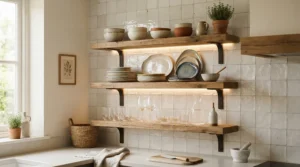
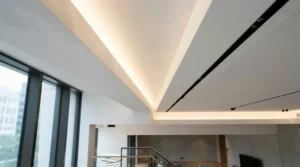
A kitchen accent lighting strip does a different job to task lighting, and it’s worth separating the two in your head before you buy. Task lighting sits directly over the worktop, aimed at what you’re doing; accent lighting sits somewhere more decorative — inside a glass-fronted cabinet, along a toe-kick, under a floating shelf — and its job is atmosphere rather than visibility. In a small kitchen, a single well-placed accent strip along the top of wall units, washing light up toward the ceiling, can make the room feel taller and less boxed-in without adding any extra fixtures.
For rentals specifically, self-adhesive LED strip kitchen fittings with a plug-in power supply — rather than anything hardwired — remain the only sensible option, since they leave zero permanent marks when removed at the end of a tenancy. The Aigostar 5m WiFi Smart RGBW Strip works well here, doubling as both accent lighting on the colour setting and reasonable task lighting on warm white, useful when one budget has to cover two jobs in a compact space.
Safety, Regulations and Compliance for Kitchen LED Strips
Any LED strip light for sale in Great Britain needs to meet the UK’s product safety regulations, formerly covered under CE marking and now increasingly under the UKCA scheme. Government guidance confirms that businesses currently have flexibility to use either the UKCA or CE marking to sell electrical products in Great Britain, so checking for either mark on the packaging is a reasonable first safety check before buying from an unfamiliar seller.
Beyond marking, a few practical rules matter specifically for kitchens. Never mount an unrated strip directly above a hob or within likely splash range of a sink without confirming an appropriate IP rating — IP20 strips are for dry areas only. Always use the power supply that came with the strip rather than a generic substitute; voltage or current mismatches are a genuine fire risk with low-voltage LED systems. And when a strip eventually reaches the end of its life, it shouldn’t go in general household rubbish — as with any electrical item, WEEE (Waste Electrical and Electronic Equipment) rules mean it needs to go to a recycling point rather than a bin, since electrical components contain materials better recovered than landfilled.
Long-Term Cost and Maintenance of Kitchen LED Strips
Upfront price only tells half the story with LED strips, and it’s worth running the numbers before assuming the cheapest option is automatically the best value. A budget strip like the Lepro 5M LED Strip Light costs less initially but typically carries a shorter rated lifespan and a less robust adhesive, meaning a genuine possibility of replacement within three to five years of daily kitchen use. A hardwired option like the Sensio Connex TriTone LED Cabinet Strip Light costs considerably more upfront but is built to trade specifications with a stated multi-year guarantee, spreading that higher cost over a much longer service life.
Running costs, meanwhile, are low across the board — LED strips draw only a handful of watts per metre, so even leaving one on for several hours daily adds a genuinely modest amount to an electricity bill compared with older halogen or fluorescent fittings. The real long-term cost driver is less about electricity and more about replacement frequency: buying once, buying a genuinely rated product, and fitting it correctly the first time consistently beats repeatedly replacing a failed budget strip every couple of years.
Frequently Asked Questions
❓ Can LED strip lights go under kitchen cabinets safely?
❓ Do LED strip lights use a lot of electricity?
❓ How long do LED strip lights last in a kitchen?
❓ What colour temperature is best for kitchen LED strips?
❓ Can I cut LED strip lights to fit my kitchen cabinets?
Conclusion
Choosing between these seven options really comes down to one honest question: are you lighting a worktop, or lighting a mood? For pure function on a tight budget, the Lepro 5M LED Strip Light and WOBANE Under Cabinet Kit deliver dependable daylight-white brightness without asking much of your wallet or your patience. For those who want a foot in the smart-home door without overcommitting, the Aigostar 5m WiFi Smart RGBW Strip and Govee RGBIC LED Strip Light H619Z offer genuine app and voice control at accessible prices. And for a kitchen renovation where lighting is being properly designed in — not retrofitted as an afterthought — the Sensio Connex TriTone LED Cabinet Strip Light, Philips Hue Lightstrip Plus v4, and Govee Strip Light 2 Pro each bring a different flavour of premium finish, whether that’s hardwired permanence, deep smart-home integration, or a seamless dot-free glow.
Whichever you land on, the underlying advice holds across the board: prep the surface properly, plan your power source before you buy, and match the colour temperature to how the space actually gets used. Get those three things right, and even the most modest budget strip will transform how a kitchen feels after dark.
✨ Ready to brighten up your worktop? Browse the picks above and check current availability before prices shift — your evening cooking sessions will thank you! 🔆
Recommended for You
- LED Light Bar Worktop Kitchen: 7 Best Picks For UK Homes (2026)
- Worktop Lighting: 7 Brilliant Picks For UK Kitchens (2026)
- Pendant Lights Over Kitchen Island: 7 Best Picks for 2026
Disclaimer: This article contains affiliate links. As an Amazon Associate, I earn from qualifying purchases. If you purchase products through these links, we may earn a small commission at no additional cost to you.
✨ Found this helpful? Share it with your friends! 💬🤗
