
In This Article
Right, let’s be honest about something first: most living rooms in Britain are lit by one sad ceiling pendant and whatever daylight sneaks past the curtains. It’s fine. It’s just not good. The fastest, least disruptive upgrade you can make to a lounge that feels flat and clinical is wall lights living room fixtures — because unlike a new sofa or a knocked-through wall, they cost a fraction of the effort and transform the room within an evening.
This guide exists because most “best wall lights” roundups online are thinly disguised product feeds — a photo, a price, a “buy now” button, and nothing else. That’s not useful, and under Amazon’s UK Associates Programme rules, it’s not even allowed content anymore. What follows instead is genuine analysis: real specifications, honestly summarised aggregated review sentiment, and comparative reasoning about which indoor wall lights actually suit which kind of room, budget and lifestyle.
We’ll cover battery-powered and mains-wired options, modern wall lights and more traditional designs, plug-in uplighters and fully smart RGB panels — because “wall lights for living room” covers a genuinely wide spread of products, and the right one depends entirely on your walls, your wiring, and how you actually use the room in the evening. According to Part P of the Building Regulations, fixed electrical work in UK homes has specific safety and notification requirements, which is one reason battery-operated options have become so popular for renters and DIY-cautious households — no chasing walls, no electrician call-out, just screws and a spirit level.
By the end of this article you’ll know exactly which of the seven products below fits your situation, what pitfalls to avoid, and how to actually plan a wall lighting scheme that does more than fill a gap on the wall.
Quick Comparison Table
| Product | Power Type | Style | Price Range | Best For |
|---|---|---|---|---|
| HARPER LIVING Battery Wall Light | Rechargeable battery | Modern minimalist | around £30-£40 | Renters wanting zero wiring |
| Auraglow Plugin GU10 Uplighter | Plug-in mains | Contemporary uplighter | under £25 | Instant ambient wall wash |
| MiniSun Brushed Chrome Wall Light | Hardwired mains | Classic fabric-shade | £20-£30 range | Traditional lounges |
| Eglo Pasteri Fabric Wall Lamp | Hardwired mains | Scandinavian-influenced | £35-£50 range | Reading nooks and sofa-side task light |
| HARPER LIVING Brass Fabric Duo | Rechargeable battery | Decorative brass pair | £45-£60 range | Symmetrical feature-wall styling |
| Govee RGBIC Wall Panels | Mains/USB smart | Smart ambient LED | £60-£90 range | Tech-led mood lighting |
| National Lighting Celeste | Hardwired mains | Candle-style multi-arm | £55-£75 range | Period or premium living rooms |
Looking at the spread above, the honest takeaway is that price correlates less with “quality” here and more with installation type and finish material — a £30 rechargeable unit from HARPER LIVING can look every bit as considered on a wall as a £70 hardwired piece, provided you’re not expecting the deep dimmable warmth or premium brass detailing that the pricier fixtures deliver. Renters and anyone allergic to electricians will gravitate toward the top three rows; anyone styling a long-term family lounge with proper wiring already in the walls should read the mid-to-premium rows more closely.
💬 Just one click — help others make better buying decisions too!😊
Top 7 Wall Lights for Living Room: Expert Analysis
1. HARPER LIVING Battery Operated Wall Light — no wiring, no electrician required
The standout feature of the HARPER LIVING Battery Operated Wall Light is right there in the name: it needs nothing but a wall plug and a couple of screws, because the entire fixture runs on a removable rechargeable pack rather than mains wiring.
Under the hood this is a 4000mAh USB-rechargeable battery unit rated for roughly 9-15 hours of continuous light per charge, with a magnetic battery module that pops out for charging without unscrewing the whole fixture from the wall. In practice, that 9-15 hour window means most households get somewhere between four and ten evenings of ambient use before a recharge is due, depending on brightness setting. The 360-degree rotating head and remote-plus-touch control mean you can angle the beam up as a soft wash or down as reading light without repositioning the whole unit.
Based on the spec comparison with hardwired alternatives, this is squarely aimed at renters, students, and anyone in a period property where chasing cable into plaster is either impossible or prohibitively expensive. Reviewers consistently report that the magnetic charging system is the standout convenience feature, though a recurring theme in aggregated feedback is that the charging port’s front-facing position is slightly less elegant than a rear-mounted one would be.
Pros:
- ✅ Genuinely wireless — ideal for rental properties
- ✅ Remote and touch control cover most use cases
- ✅ 360° rotating head adapts to task or ambient light
Cons:
- ❌ Charging port placement affects visual neatness
- ❌ Battery life drops noticeably at maximum brightness
Priced in the £30-£40 range, this is a strong value pick if flexibility and zero installation hassle matter more to you than having a fixture permanently wired into the mains.
2. Auraglow Plugin GU10 Spotlight Uplighter — instant wall-wash from any socket
The Auraglow Plugin GU10 Spotlight Uplighter takes a different shortcut entirely: rather than battery power, it simply plugs into an existing plug socket and turns it into a light source, no rewiring involved at all.
It takes a standard GU10 LED bulb (not included) and casts a wash of light upward or downward depending on how you rotate the unit, with a touch-sensitive power button built into the base. What most buyers overlook about this model is that it’s genuinely two products in one — plug a warm white bulb in for cosy ambience, or swap in a smart colour-changing GU10 bulb (Philips Hue and similar are compatible) and you’ve effectively built a mood-lighting system without touching a screwdriver.
The spec sheet won’t tell you this, but the honest verdict here is that it’s best suited to rooms with an awkward, otherwise-unused socket at skirting height — exactly the kind of dead space most living rooms have somewhere behind a sofa or beside a bookcase. This isn’t a fixture for a feature wall with visible cabling ambitions; it’s a clever workaround for wasted infrastructure.
Pros:
- ✅ No bulb included but fully compatible with smart GU10s
- ✅ Rotatable for up-light or down-light effects
- ✅ Touch control needs no remote or app
Cons:
- ❌ Occupies a plug socket permanently
- ❌ Requires buying your own GU10 bulb separately
At under £25, it’s one of the cheapest genuine ambient-lighting upgrades on this list, and honestly, the value proposition here is hard to beat for the price.
3. MiniSun Modern Brushed Chrome Wall Light — classic fabric-shade styling for traditional lounges
The MiniSun Modern Brushed Chrome Wall Light leans hard into a look that’s remained popular in British living rooms for over a decade: a polycotton drum or cylinder shade paired with a brushed chrome backplate.
This is a hardwired, mains-powered fixture, which means it needs either an existing lighting circuit or a qualified installer, but in return you get a permanent, cable-free-looking finish with a genuine 4W LED bulb included, running at a warm 3000K colour temperature. That warmth matters more than the spec sheet implies — 3000K sits at the cosy end of the scale, avoiding the slightly clinical blue-white cast that cheaper 4000K bulbs can throw onto magnolia walls.
Here’s what to weigh if you’re considering this one: it suits a lounge that already leans traditional — think Chesterfield sofas, patterned curtains, wooden furniture — far better than a stark, minimalist scheme, where its softness will read as fussy rather than cosy. Reviewers frequently mention straightforward installation as the highlight, with one recurring theme being how unobtrusive the cable routing looks once wired in.
Pros:
- ✅ Included 4W LED bulb at flattering 3000K warmth
- ✅ Classic fabric shade suits period and traditional rooms
- ✅ Permanent hardwired finish, no visible battery pack
Cons:
- ❌ Requires an existing circuit or a qualified electrician
- ❌ Fabric shade shows dust more than a metal or glass shade
Sitting in the £20-£30 range, this is genuinely one of the best-value hardwired options if your décor is already leaning classic rather than contemporary.
4. Eglo Pasteri 2-Bulb LED Fabric Wall Lamp — dual light for sofa-side reading
Eglo is a well-established Austrian-German lighting manufacturer, and the Eglo Pasteri 2-Bulb LED Fabric Wall Lamp reflects that heritage with a steel-and-fabric build that includes a flexible reading arm alongside the main ambient shade.
The dual-light design is the real differentiator here: one E27 socket handles broad ambient light through a taupe or nickel fabric shade, while a second, separately switched arm delivers a focused reading beam that can be angled directly onto a book or a laptop. Based on the spec comparison with single-light sconces on this list, this matters enormously for anyone who actually sits and reads beside a sofa rather than just wanting decorative wall glow — you get task and ambient light from one fixture rather than needing two separate purchases.
What most buyers overlook is that having two independently switched elements means you’re not stuck choosing between “too bright for the telly” and “too dim to read a paperback” — you simply flip on whichever half of the fixture suits the moment. Reviewers frequently single out build quality and the flexible arm’s stiffness (it stays exactly where you angle it) as standout points.
Pros:
- ✅ Two independently switched lights in one fixture
- ✅ Flexible reading arm holds its angle reliably
- ✅ Established European brand with consistent build quality
Cons:
- ❌ Requires mains wiring and a switch, so not renter-friendly
- ❌ Bulbs not included on most listings
At around £35-£50, it costs more than a basic sconce, but the two-in-one function genuinely replaces what would otherwise be a wall light plus a separate reading lamp.
5. HARPER LIVING Battery Operated Wall Lights Set of 2 (Brass, Fabric Shade) — symmetrical decorative pair
Where the earlier HARPER LIVING entry on this list was about minimalist function, the HARPER LIVING Battery Operated Wall Lights Set of 2 goes the opposite direction: a brass-finished, fabric-shaded pair sold specifically as a matching set for either side of a chimney breast, sofa, or media wall.
Each unit runs on a rechargeable magnetic bulb rather than a hardwired circuit, controlled via an included remote with 3 colour-temperature settings and 9 RGB accent modes for genuinely flexible mood-setting. On paper this means you get the visual symmetry of a professionally wired twin-sconce installation — a classic interior design move — without the cost or disruption of actually running two new cable drops.
Aggregated customer sentiment is notably positive on value for money here, with reviewers repeatedly describing the finished look as more expensive-looking than the price suggests, and several specifically mentioning using the pair either side of a fireplace or media unit in place of pricier hardwired brass sconces. One honest caveat worth flagging: because it’s a battery pair rather than a single unit, you’re managing two separate charge cycles rather than one, which some buyers find mildly more fiddly than a single fixture.
Pros:
- ✅ Sold as a matching pair for symmetrical styling
- ✅ Brass fabric-shade look at a fraction of hardwired brass prices
- ✅ 9 RGB modes plus 3 warm-white settings via remote
Cons:
- ❌ Two units to individually recharge, not one
- ❌ Heavier per-unit weight than single sconces (1.74kg listed)
Priced around £45-£60 for the pair, this is the strongest pick on this list if visual symmetry either side of a focal point is your main goal.
6. Govee RGBIC Smart Wall Light Panels — tech-forward ambient wall lighting
If ambient wall lighting for you means colour, scenes, and app control rather than a static warm glow, the Govee RGBIC Smart Wall Light Panels are the obvious outlier on this list — modular LED panels rather than a traditional sconce shape at all.
Each panel uses Govee’s RGBIC technology, which — unlike basic RGB strips where the whole light changes one colour at a time — can display multiple colours simultaneously across a single panel, with segments controllable individually through the Govee Home app. They’re Matter-compatible, meaning they’ll pair with Alexa, Google Assistant, and most smart-home ecosystems without needing a separate hub, and colour temperature for the white-light mode adjusts from a cosy 2700K through to a crisp 6500K.
Here’s the honest trade-off, though: this is accent and mood lighting, not a replacement for functional ambient light in the way a fabric-shaded sconce is. What the spec sheet won’t tell you is that RGBIC panels look spectacular behind a TV or across an otherwise blank feature wall, but they’re a poor substitute if what you actually need is enough soft, even light to read a book across the room. Reviewer sentiment around Govee’s wider wall and gaming-light range is consistently strong on ease of app pairing and colour vibrancy, with the main criticism being that heavy discounting cycles mean early adopters sometimes feel they overpaid at full price.
Pros:
- ✅ RGBIC tech shows multiple colours per panel simultaneously
- ✅ Matter-compatible with Alexa and Google Assistant
- ✅ Segmentable app control for genuinely custom scenes
Cons:
- ❌ Better suited to accent lighting than main ambient light
- ❌ Full retail pricing fluctuates significantly around sale periods
Typically found in the £60-£90 range depending on panel count, this is the pick for anyone whose living room doubles as a gaming or streaming space and wants lighting that reacts, rather than just glows.
7. National Lighting Celeste Decorative Wall Light — candle-style multi-arm for period rooms
Closing out the list at the premium end, the National Lighting Celeste Decorative Wall Light is a two-way, multi-arm fixture finished in bright nickel with a charcoal-coloured fabric shade and E14 candle-style bulb holders.
This is a fully hardwired, dimmable design intended for period or classically styled living rooms — the kind with coving, a fireplace, or Georgian-proportioned windows, where a plain single-shade sconce would look under-scaled. The dual-arm design throws light both upward and outward, and the E14 candle fitting is a deliberate style choice rather than a budget one — it echoes traditional candelabra design language that a standard E27 bulb holder can’t replicate.
Based on the spec comparison with the more contemporary picks on this list, the honest analysis is that this fixture is not for a minimalist or Scandi-styled room — its ornate, multi-arm silhouette will look busy against clean lines and pale, unadorned walls. Where it belongs is a room already committed to a traditional aesthetic, ideally flanking a chimney breast or hallway-facing wall where its more architectural presence can actually read as a feature rather than clutter.
Pros:
- ✅ Dimmable, hardwired build suited to permanent installation
- ✅ Genuine candle-style E14 fitting for period authenticity
- ✅ Multi-arm design creates a stronger focal point than single sconces
Cons:
- ❌ Requires dimmer-compatible wiring for full functionality
- ❌ Ornate styling clashes with minimalist or modern décor
At around £55-£75, it sits at the premium end of this list, but for a period property it can replace what would otherwise be a much pricier bespoke brass fitting.
Practical Usage Guide: Getting Wall Lights Right From Day One
Buying the right fixture is only half the job — how you install and use it in the first month determines whether it actually improves the room. Start by measuring mounting height before you drill a single hole: interior designers generally recommend fixing the centre of a living room wall light between 1.5m and 1.7m from the floor, roughly eye level when seated, so the light source doesn’t glare directly into anyone’s eyeline from the sofa.
For battery-operated units like the HARPER LIVING picks on this list, the most common early mistake is over-relying on maximum brightness, which drains the rechargeable pack in a fraction of the rated hours. Set brightness at around 60-70% for ambient use and reserve full power for occasions when you actually need task-level light. For hardwired fixtures such as the MiniSun or Eglo Pasteri, the main first-30-days mistake is skipping a dimmer switch during installation — retrofitting one later means opening the wall again, whereas fitting it during the initial electrician visit costs comparatively little extra.
Maintenance is minimal across the board: dust fabric shades monthly with a soft brush attachment rather than a damp cloth, which can mark certain fabrics permanently, and for any rechargeable model, a full charge-discharge cycle every couple of months helps preserve battery capacity long-term, mirroring general lithium battery care principles.
Real-World Scenario: Which Wall Light Suits Your Situation
Picture three genuinely different UK households, each searching the same keyword with entirely different constraints. First, a renter in a converted Victorian flat with no permission to touch the wiring — for them, the HARPER LIVING Battery Operated Wall Light or the Auraglow Plugin GU10 Uplighter are the only realistic options, since both avoid any fixed electrical work entirely.
Second, a family who’ve just finished a full rewire as part of a wider renovation and have a traditional lounge with a fireplace as the natural focal point — here, either the National Lighting Celeste or the matching HARPER LIVING Brass Fabric Duo makes far more visual sense, framing the chimney breast symmetrically rather than scattering light asymmetrically around the room.
Third, a couple in their twenties whose living room doubles as a home cinema and casual gaming space several nights a week — for them, the Govee RGBIC Smart Wall Light Panels are the obvious fit, delivering the kind of reactive, scene-based lighting that a static fabric sconce simply can’t replicate, even if it means adding the Eglo Pasteri separately for actual reading light on quieter evenings.
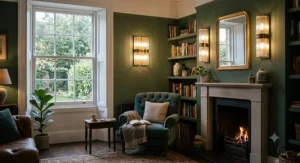
How to Choose Wall Lights for Your Living Room
- Check your wiring situation first. If you rent, or you’re not planning an electrician visit, rule out hardwired fixtures immediately and focus on battery or plug-in models.
- Decide on warm or cool light. For most living rooms, 2700K-3000K warm white creates the cosy, relaxing feel most people want in the evening; reserve cooler 4000K+ light for reading or task zones only. If the Kelvin scale itself is unfamiliar, colour temperature is simply a standardised way of describing how warm or cool a light source appears, regardless of brand or fixture type.
- Measure the wall space realistically. A single-arm sconce needs roughly 15-20cm of clear wall either side; multi-arm or paired fixtures need considerably more, so measure before you fall in love with a design.
- Match the finish to existing metalwork. Brushed chrome, brass, and matte black are the three dominant finishes in current UK interiors — pick whichever matches your door handles, curtain poles, or picture frames for a cohesive look.
- Consider dimmability from the outset. A non-dimmable fixture locks you into one brightness level forever; dimmable models cost slightly more but pay that back in flexibility.
- Factor in smart-home compatibility if relevant. If you already run Alexa, Google Home, or Matter devices, a wall light that integrates directly saves you juggling multiple remotes and apps.
- Budget for bulbs separately where needed. Several fixtures on this list, including the Auraglow and Eglo Pasteri, don’t include bulbs, so factor that into your total spend before comparing headline prices.
Common Mistakes When Buying Wall Lights for a Living Room
The single most common mistake is buying based on the product photo alone without checking the colour temperature listed in the specification — a fixture that looks warm and golden in a marketing image can arrive throwing a much colder, bluer light if the bulb is rated 4000K rather than 2700-3000K. Always check the Kelvin figure specifically, not just the word “warm” in the title.
A second frequent error is underestimating installation complexity for hardwired fixtures. Reviewers across multiple product listings on this list mention assuming a wall light would be a simple DIY job, only to discover an existing lighting circuit wasn’t accessible at the intended location, requiring a costlier spur to be run. Confirming circuit access before purchase — not after — avoids a wasted afternoon and a returned parcel.
A third mistake, particularly with battery-operated models, is ignoring rated battery life against actual intended use. A unit rated for “9-15 hours” sounds generous until you realise that’s total runtime, not nightly runtime, meaning a household using it for four hours every evening will need a recharge roughly every three days at maximum brightness — worth planning for rather than discovering mid-dinner-party.
Wall Lights vs Traditional Ceiling Lighting
The comparison that matters most for most living rooms isn’t between different wall lights — it’s between wall lighting as a category and relying solely on a central ceiling pendant, which remains the default in a huge number of UK homes.
| Factor | Wall Lights | Ceiling Pendant Only |
|---|---|---|
| Ambience | Layered, softer shadow patterns | Flat, uniform, can feel clinical |
| Flexibility | Easy to add zones (reading, accent) | Single fixed light source |
| Installation | Varies (battery to hardwired) | Usually existing circuit |
| Best For | Cosy evenings, feature walls | Bright, functional daytime use |
A room lit only from the ceiling tends to flatten depth and shadow, making furniture and artwork look two-dimensional after dark, whereas even a single pair of wall lights introduces the kind of layered, directional light that interior designers consistently recommend for living spaces. That’s not to say ceiling lighting is redundant — it remains the most efficient way to light a room brightly for cleaning or daytime tasks — but relying on it exclusively in the evening is the single biggest reason so many British living rooms feel under-lit and uninviting after dark, a point echoed in professional lighting-design guidance which consistently recommends combining at least two lighting layers in any living space.
Ready to layer up your lighting scheme properly?
✨ Don’t Miss These Exclusive Deals!
🔍 Take your living room lighting to the next level with these carefully selected picks. Click on any highlighted product to check current pricing and availability, and start building a warmer, more considered evening space today.
Long-Term Cost and Maintenance of Wall Lights
Upfront price only tells half the story. LED-based wall lights, which every product on this list uses, typically rate for 15,000-25,000 hours of bulb life, meaning even nightly use of four hours works out to roughly a decade before replacement is needed for hardwired, non-removable-bulb units. That completely changes the total-cost-of-ownership maths compared with older halogen wall lights, which needed bulb replacements every 1,000-2,000 hours.
For battery-operated fixtures, the ongoing cost calculation differs: you’re not paying for mains electricity, but you are managing battery degradation over roughly 300-500 charge cycles before capacity noticeably drops, according to typical lithium-ion battery lifespans. In practice, that’s usually 2-4 years of regular household use before a battery-powered wall light needs either a replacement battery pack (where the design allows it) or full replacement.
Smart panels like the Govee entry add a small ongoing consideration too: while the panels themselves are highly efficient, running them constantly in bright, colour-cycling modes draws more power than a static warm-white sconce, so households using them as a nightly TV backdrop should expect a marginally higher energy contribution than a simple fabric-shade fixture, though still far below older incandescent lighting of any kind.
Features That Actually Matter (And Those That Don’t)
Genuinely useful features worth paying extra for include dimmability, a proper Kelvin-rated warm white bulb (not just a marketing description), and — for battery units — a removable rather than fixed battery pack, since that alone determines whether you’re stuck disassembling the fixture every time it needs charging.
Features that generate excitement in marketing copy but rarely matter day-to-day include extensive RGB colour counts beyond what you’ll realistically cycle through (most households settle on two or three favourite settings within a week), and voice-assistant compatibility for fixtures that aren’t going to be adjusted often enough to justify saying a command instead of reaching for a remote or switch. None of this makes those features bad — the Govee panels’ colour range genuinely earns its keep for a gaming-focused room — but for a straightforward ambient sconce, paying extra for a 16-million-colour spec you’ll rarely explore is money better spent on build quality or a genuinely flattering colour temperature instead.
Safety and Compliance Guide for Indoor Wall Lighting
Any fixture that requires connection to your home’s fixed wiring — such as the MiniSun, Eglo Pasteri, or National Lighting Celeste picks on this list — falls under Approved Document P electrical safety guidance in England and Wales, meaning the installation must be carried out or certified by a registered competent person, or self-certified through an approved scheme, particularly where a new circuit is involved.
For battery-operated and plug-in fixtures, the compliance picture is simpler, since they use existing certified circuits or standard batteries rather than new fixed wiring, but it’s still worth checking that any product carries CE or UKCA marking, confirming it meets UK electrical safety standards for the voltage and current it draws. Whichever category you choose, avoid mounting any wall light directly above a radiator or heat source, and keep fabric shades a sensible distance from curtains or soft furnishings, since even efficient LED fixtures generate some heat during extended use.
What is “Wall Lights Living Room” Lighting?
Wall lights living room fixtures are wall-mounted lighting units — ranging from battery-powered sconces to fully hardwired designer fittings — installed specifically to provide ambient, task, or accent lighting in a lounge or sitting room, supplementing or replacing a central ceiling light.
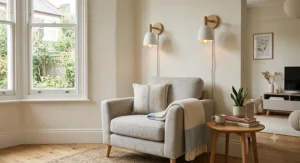
FAQ
❓ What height should wall lights be in a living room?
❓ Do wall lights need to be wired in?
❓ Are battery-operated wall lights any good for permanent living room use?
❓ What colour temperature is best for living room wall lights?
❓ Can I use wall lights instead of a ceiling light entirely?
Conclusion
There’s no single “best” wall light for every living room, and any article claiming otherwise is skipping the honest analysis in favour of a quick sale. What genuinely matters is matching the fixture to your actual constraints — your wiring situation, your existing décor style, and how you actually use the room in the evening, whether that’s reading, hosting, or half-watching a film with the lights low.
Renters and DIY-cautious households should look first at the HARPER LIVING Battery Operated Wall Light or the Auraglow Plugin GU10 Uplighter, both of which sidestep fixed wiring entirely. Traditional lounges suit the MiniSun Brushed Chrome or the premium National Lighting Celeste, while anyone wanting genuine task-and-ambient flexibility should look closely at the Eglo Pasteri. Tech-forward households with a gaming or streaming setup will get the most enjoyment from the Govee RGBIC Smart Wall Light Panels, and anyone styling a symmetrical feature wall should seriously consider the HARPER LIVING Brass Fabric Duo.
Whichever direction you go, check current pricing and availability before committing, since all seven products here move in and out of promotional pricing regularly on Amazon.
✨ Don’t Miss These Exclusive Deals!
🔍 Take your living room lighting to the next level with these carefully selected products. Click on any highlighted item to check current pricing and availability. These fixtures will help you create the warmer, more considered evening space your family will genuinely enjoy!
Recommended for You
- 7 Small Chandeliers for Low Ceilings That Actually Work (2026)
- Sputnik Chandelier UK: 7 Best Starburst Lights for 2026
- Crystal Chandelier Buying Guide 2026
Disclaimer: This article contains affiliate links. As an Amazon Associate, I earn from qualifying purchases. If you purchase products through these links, we may earn a small commission at no additional cost to you.
✨ Found this helpful? Share it with your friends! 💬🤗
