
In This Article
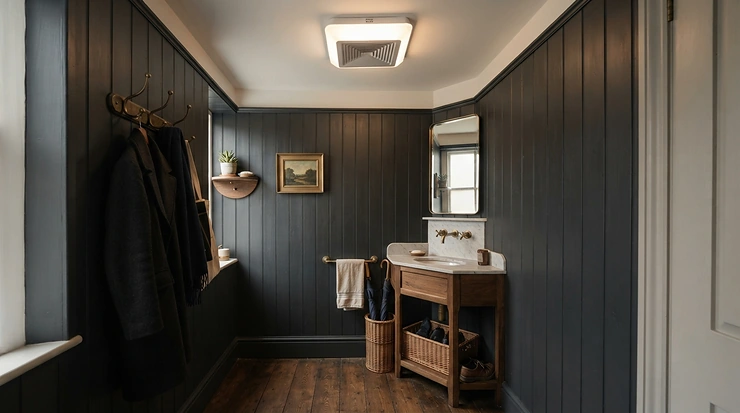
An extractor fan with light combo is a single bathroom fitting, or a fascia-plus-loft-fan kit, that pairs a moisture-clearing fan with a built-in lamp on one switch. Flick the light on and the fan starts. Flick it off and an overrun timer keeps extracting, so steam and odours are dragged outside before they settle.
Picture the usual morning scene. The shower finishes, the mirror vanishes, and the ceiling starts to glisten. That moisture has to go somewhere, and left alone it ends up as black speckles on the grout. In England, the ventilation rules in Approved Document F on gov.uk treat a bathroom as a place where moisture must be extracted at source. A good extractor fan with light combo does that job while also replacing a tired downlight.
One reality check before we start. Most “combos” are shower-light fascia kits, with a small LED in a slim ceiling disc and the fan itself tucked into the loft or ceiling void. The lamp is a pleasant downlight, not your main bathroom lighting.
I haven’t tested any of these products. This guide rests on manufacturer and retailer specifications, plus aggregated review ratings where I could verify them. Specs were gathered in October 2026 and can change, so always check current price and availability before buying.
Quick Comparison: 7 Extractor Fan With Light Combo Kits at a Glance
| Product | Free-air extraction | Noise (quoted) | Timer | Light | Price range | Best For |
|---|---|---|---|---|---|---|
| Manrose LEDSLKTC | ~24 l/s | 41 dB(A) at 3 m | 1–20 min | 3W LED | £65–£110 | Small en-suites on a budget |
| Xpelair Airline ALL100T | ~24 l/s | 40 dBA at 3 m | 2–30 min | MR16 LED | Check current price | Shower cubicles (Zone 1) |
| HiB Turbo | ~38 l/s | 37 dB | 2–30 min | 3W MR16 LED | £85–£170 | Medium family bathrooms |
| HiB Cyclone | ~58 l/s | 32 dB | 2–30 min | Cool white LED | Around £150s | Large bathrooms, wet rooms |
| Airflow Aventa 100T+L | 40 / 52 l/s | 27 / 36 dB(A) | 2–30 min* | 4W LED | £110–£220 | Long duct runs |
| AirTech-UK FlowMax Elite | Up to ~55 l/s | 34 dB | Adjustable | 3W LED | £80–£100 | Maximum airflow for the money |
| Blauberg Ducto 100 | ~31 l/s | 25 dBA | Adjustable | MR16 LED | Check current price | Quiet en-suites off bedrooms |
*Some retailer listings give 1–20 minutes for the Airflow Aventa 100T+L, so confirm before ordering.
Every kit clears the 15 l/s bathroom benchmark on paper, but headroom varies a lot. The Manrose LEDSLKTC and Xpelair Airline ALL100T sit at roughly 1.6 times the benchmark, which is fine for compact rooms and tight once you add ducting. The HiB Cyclone and AirTech-UK FlowMax Elite offer nearly four times the benchmark, which suits big wet rooms and long duct runs. If silence matters most, the Blauberg Ducto 100 claims the lowest figure here, though noise numbers are not always quoted at the same distance.
💬 Just one click — help others make better buying decisions too!😊
Top 7 Extractor Fan With Light Combo Kits: Expert Analysis
These seven span budget, mid-range and premium, and they cover axial and mixed-flow fans. Prices are ranges only and move constantly. Review comments are aggregated sentiment from retailer pages, not my own experience.
1. Manrose LEDSLKTC — budget kit that nails the basics
One hole in the ceiling and one switch on the wall: that’s the appeal. The Manrose LEDSLKTC swaps a tired downlight for a light-and-fan pairing without much fuss.
The loft-mounted axial fan moves around 24 litres per second (about 85 m³/h) at 41 dB(A) at 3 m. The warm white 3W lamp gives roughly 200 lumens through a 12V SELV driver, and the timer adjusts from 1 to 20 minutes. That’s enough air to clear the 15 l/s guideline on paper, but a long duct run or a couple of bends will eat the margin quickly. Based on the spec comparison, it’s a small en-suite kit rather than a family-bathroom workhorse. The 20-minute timer ceiling comfortably covers the 15-minute run-on guidance.
Independent reviews were thin on the retailer pages I checked, so this verdict leans on the spec sheet rather than crowd feedback.
Pros:
- ✅ Complete kit with ducting, grille and driver
- ✅ Timer range beats the 15-minute guidance
- ✅ Retailers list it for shower zones 1 and 2
Cons:
- ❌ 41 dB(A) at 3 m is clearly audible
- ❌ Modest airflow for larger rooms
Expect roughly £65–£110 depending on retailer and finish (check current price). It’s good value for compact rooms.

2. Xpelair Airline ALL100T — Zone 1 suitability with a generous timer
The headline here is placement. Retailer specs describe the Xpelair Airline ALL100T as suitable for Zone 1, meaning right above the shower tray.
It’s a single-speed inline axial fan moving about 86 m³/h (roughly 24 l/s) at 40 dBA at 3 m. The overrun is adjustable from 2 to 30 minutes, and the kit includes a cool white MR16 LED on a SELV transformer, 3 m of ducting and interchangeable chrome and white trims. A 30-minute ceiling is useful because you can set 15–20 minutes for normal showers and stretch it for long family soaks. The cool white tint can feel clinical against warm bathroom lighting, though the standard GU5.3 lamp format suggests a swap is possible. Check lamp wattage and driver compatibility first.
I couldn’t verify a meaningful pool of independent reviews, so treat this as a spec-led recommendation.
Pros:
- ✅ Listed as suitable for Zone 1 installation
- ✅ 2–30 minute adjustable overrun timer
- ✅ White and chrome trims included
Cons:
- ❌ Single speed, so no boost for steamy sessions
- ❌ Mid-pack noise at 40 dBA
I couldn’t confirm a reliable current price range, so check current price. Comparable 100 mm kits generally sit in the £60–£150 band, which makes this a sensible mid-range pick.
3. HiB Turbo — slim flush fascia with healthy headroom
The HiB Turbo is the all-rounder of this group. The fascia sits just 15 mm proud of the ceiling, with a 145 mm diameter.
It’s rated at 137 m³/h (about 38 l/s) and 37 dB, with a 2–30 minute timer and a 3W MR16 LED. It’s available in white or chrome, and in cool or warm tint. Roughly 38 l/s of free-air flow gives around 2.5 times the 15 l/s benchmark, enough to absorb the losses from 3 m of flexible duct in a medium bathroom. The lamp is gentle, around 120 lumens on the cool version, so think mood glow rather than task lighting. Power draw is about 16W for the fan plus 3W for the lamp. It’s IPX4 rated and carries a two-year warranty.
Retailer pages show ratings of roughly 4.4–4.5 out of 5 across about 90–100 reviews. One buyer who’d feared noisy night-time fans said the neat flush finish won them over. A warm-white variant scored lower, around 3.6 from about a dozen ratings at one stockist.
Pros:
- ✅ About 38 l/s free-air flow with ducting headroom
- ✅ Slim 15 mm fascia sits flush
- ✅ 2–30 minute timer and IPX4 rating
Cons:
- ❌ Lamp output is only around 120 lumens
- ❌ Flexible ducting needs careful routing
Expect roughly £85–£170 depending on stockist and finish (check current price). Strong value for medium bathrooms.
4. HiB Cyclone — big airflow for wet rooms
Where the HiB Turbo is the all-rounder, the HiB Cyclone is the heavy hitter. It looks identical on the ceiling but moves much more air.
It’s quoted at 210 m³/h (about 58 l/s) and 32 dB, with a 2–30 minute timer, cool white LED and a two-year warranty. The maker positions it for large bathrooms and wet rooms. That matters because the 2026 edition of the Part F guidance says an internal wet room with no external walls should extract at four air changes per hour. A 3 m × 2.5 m × 2.4 m room is 18 m³, so four changes means 72 m³/h (about 20 l/s). That’s already above the standard 15 l/s rate, and the HiB Cyclone leaves plenty of room for duct losses.
Reviews I found were older, some dating to 2015, but they describe strong extraction that isn’t intrusive and a crisp blue-white light.
Pros:
- ✅ About 58 l/s free-air extraction
- ✅ Quoted 32 dB is lowest-in-class for this airflow
- ✅ Same slim flush fascia as its sibling
Cons:
- ❌ Cool white tint on the version I found
- ❌ Costs more than entry-level kits
It sits around the £150s at the stockist I found (check current price). It’s worth it if your bathroom is big or windowless.
5. Airflow Aventa 100T+L — mixed-flow muscle for long duct runs
This is the one to consider when the loft route is awkward. The Airflow Aventa 100T+L (part code 9041408) is a mixed-flow fan, which copes with duct resistance better than a simple axial unit.
It runs on two speeds, 40 l/s and 52 l/s (145 and 187 m³/h) at free discharge, at 27 dB(A) and 36 dB(A) at 3 m. The 4W cool white LED showerlight comes with both white and chrome bezels, and the timer is adjustable. The maker’s data says 2–30 minutes, though some retailer pages say 1–20, so check before ordering. It’s IPX4 rated with a three-year guarantee. The spec sheet allows ducting up to 3 m either side of the fan, which is a big plus. It’s also bulkier at 246 × 190 × 126 mm, so check your loft or ceiling space.
I found no verifiable pool of independent reviews, and it’s mostly sold through trade channels, so this is a spec-led pick.
Pros:
- ✅ Two speeds: quiet low, strong boost
- ✅ Designed for longer duct runs
- ✅ Three-year guarantee
Cons:
- ❌ Bulkier loft unit than axial rivals
- ❌ Priciest option in this round-up
Roughly £110–£220 depending on stockist (check current price). It’s premium money for a hard-to-ventilate bathroom.
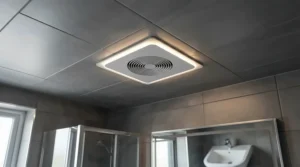
6. AirTech-UK FlowMax Elite — most airflow for the money
The AirTech-UK FlowMax Elite is the value surprise. Its listing claims dual-speed airflow up to 198 m³/h (about 55 l/s) at 34 dB.
The kit includes a 3W LED, an adjustable timer, ducting and a 100 mm connection, and one listing mentions an interchangeable white and chrome surround. Nearly four times the 15 l/s benchmark means this fan can cope with a longer or fiddlier duct route without dropping below target. Marketplace buyers describe a bright white lamp, simple wiring and shower steam disappearing. One said they noticed little difference in noise between speeds. The bright lamp is a double-edged sword, because a couple of buyers flagged that it may not match warmer existing lights.
Because it’s sold mainly through marketplace sellers, confirm warranty terms with the seller.
Pros:
- ✅ Up to ~55 l/s with two speeds
- ✅ Quoted 34 dB is modest for the airflow
- ✅ Reviewers praise easy wiring and strong extraction
Cons:
- ❌ Bright white lamp may clash with warm lighting
- ❌ Warranty details vary by seller
Around £80–£100 at the listing I saw (check current price). It’s excellent value if you can live with the lamp tint.
7. Blauberg Ducto 100 — whisper-quiet claim at 25 dBA
Noise is the whole story here. The Blauberg Ducto 100 claims just 25 dBA, the lowest figure in this round-up.
Airflow is up to 110 m³/h (about 31 l/s), roughly double the 15 l/s benchmark, which is ample for a typical en-suite. The kit has an MR16 LED, an adjustable run-on timer and rubber anti-vibration mounts. The timer needs standard three-wire connections, so check your cabling. For an en-suite off a bedroom, where a 40 dB fan can wake a light sleeper, that quoted figure is the draw. Manufacturers quote noise at different distances and conditions, so look for the “at 3 m” qualifier. The listing doesn’t state lamp lumens or colour temperature.
I couldn’t verify independent reviews or a reliable price, so this is the most spec-reliant entry here.
Pros:
- ✅ Lowest quoted noise level in this group
- ✅ Around 31 l/s extraction
- ✅ Anti-vibration mounts reduce rattle
Cons:
- ❌ Lamp brightness and tint not stated
- ❌ Few verifiable reviews and unclear pricing
Check current price before committing. It’s the one to shortlist if bedroom-adjacent quiet beats everything else.
How to Install and Set Up a Timer Extractor Fan With Light
Bathrooms are special locations for electrics, so use a registered electrician for the wiring. Here’s the practical sequence they’ll follow, and the things Amazon listings never tell you.
- Isolate and plan. Switch off at the consumer unit and decide whether the fan lives in the loft or the ceiling void. Keep the duct as short and straight as possible.
- Check the wiring. A timer extractor fan with light generally needs a permanent live, a switched live and a neutral. Without the permanent live the overrun timer simply won’t work. Read the wiring diagram supplied.
- Route the duct. Run it with a slight fall towards the outside so condensation drains away rather than back into the fan. Insulate flexible duct in a cold loft.
- Fit the outlet. Use a grille with a backdraught shutter and keep it clear of vegetation, gutters and soffit gaps.
- Set the overrun timer. Start at 15–20 minutes. The Part F guidance expects at least 15 minutes after the room is vacated where there’s no openable window.
Three first-30-day mistakes to avoid: leaving the timer on its factory minimum, kinking flexible duct around loft joists, and forgetting to test the fan with the door closed. The HiB Turbo and Xpelair Airline ALL100T both ship with enough ducting for a typical loft, but only if routed properly.

Real-World Scenarios: Matching Kits to Your Bathroom
The rental en-suite. A windowless 1.8 m × 1.5 m shower room, a landlord who wants a tidy swap and about £100. The Manrose LEDSLKTC covers it, with a timer long enough for the 15-minute guidance. The Xpelair Airline ALL100T is the alternative if the fan sits above the shower tray. Daily use means the fan runs about 20 minutes a day, so noise tolerance matters more than boost.
The family bathroom with a power shower. Roughly 3 m × 2.4 m, loft above, four people showering daily. This is where headroom pays off. The HiB Turbo at about 38 l/s suits it, and the AirTech-UK FlowMax Elite gives extra boost if the duct run is awkward. Budget around £85–£170.
The big wet room or long loft run. A walk-in wet room or a duct over 3 m needs muscle. The HiB Cyclone or the Airflow Aventa 100T+L, which is built for longer runs, are the logical choices.
The en-suite beside a light sleeper. Night-time noise is the issue, so the Blauberg Ducto 100 is worth a look, with its quoted 25 dBA.
✨ Ready to Clear the Steam for Good?
🔍 Take your bathroom ventilation to the next level with these carefully selected kits. Click on any highlighted product name to check current pricing and availability. The right fan will help you create the fresh, mould-resistant air your family deserves!
Common Problems and Fixes With Fan-and-Light Kits
The fan stops the second you flick the switch off. Almost always a missing permanent live. Ask your electrician to check the timer wiring.
The mirror still fogs. Check for kinked flexible duct, a blocked outlet grille or a duct that’s far longer than the 3 m supplied with the HiB Turbo. Fix the duct before blaming the fan.
The lamp feels dim or the wrong colour. These lamps are small. The HiB Turbo is around 120 lumens and the Manrose LEDSLKTC around 200, so keep a separate main light. If the tint clashes, as some AirTech-UK FlowMax Elite buyers noted, choose a warm-white variant where one exists.
Rattling or humming. Loose duct clamps and ceiling-joist contact are the usual culprits. The Blauberg Ducto 100 ships with rubber anti-vibration mounts for exactly this.
Water dripping back through the light. Condensation forming in cold loft ducting. Insulate the duct and keep it sloping outward.
How to Choose an Extractor Fan With Light Combo
- Measure your room. Length × width × height gives volume. For internal wet rooms, four air changes an hour is the Part F yardstick.
- Check extraction rate in litres per second. Aim for at least double the 15 l/s benchmark if ducting is longer than 2 m.
- Verify the overrun timer. Make sure it reaches at least 15–20 minutes.
- Confirm the zone and IP rating. IPX4 minimum for zones 1 and 2.
- Judge the light honestly. Lumens and colour temperature matter more than the word “LED”.
- Check noise at 3 m. Anything near 40 dB(A) is audible.
- Plan the duct route. Short, straight and insulated beats a powerful fan on a bad route.
Part F Ventilation: What the Rules Say About Bathroom Fans
Part F ventilation guidance applies in England, and Wales, Scotland and Northern Ireland have their own rules. The 2026 edition of Approved Document F, Volume 1 takes effect on 24 March 2027 for most building work. Until then the 2021 edition applies, and details may differ between editions, so check which your building control body is using.
From the 2026 text, the key bathroom points are:
- Extract rate: 15 l/s for intermittent fans (54 m³/h), or 8 l/s as a continuous high rate.
- Run-on: In a room without an openable window, the fan should run for at least 15 minutes after the room is vacated, and installers should check timers are set accordingly.
- Controls: Humidity-based control is acceptable in bathrooms, but not in toilets. Automatic controls need a manual override.
- Noise: The guidance suggests staying under 45 dB LAeq in bathrooms.
- Ducting: It recommends rigid ducting with a maximum length of 2.0 m. Flexible duct is limited to 200 mm for final connections, and longer runs need design calculations.
That last point is the one the spec sheet won’t tell you. Many kits, including the Manrose LEDSLKTC and HiB Turbo, ship with flexible duct. A free-air figure isn’t the same as installed performance, so ask your building control body or installer if in doubt. For a new dwelling, fan flow rates must be measured and reported. Replacing a fan on existing cabling doesn’t need notifying.
Extraction Rate in Litres per Second: Reading the Numbers
Manufacturers love cubic metres per hour, while Part F speaks litres per second. To convert, divide m³/h by 3.6. So 15 l/s equals 54 m³/h.
| Kit | Free-air l/s | Headroom over 15 l/s | Best For |
|---|---|---|---|
| Manrose LEDSLKTC | ~24 | ~1.6× | Small en-suites |
| Blauberg Ducto 100 | ~31 | ~2.0× | Quiet bedrooms-adjacent en-suites |
| HiB Turbo | ~38 | ~2.5× | Medium bathrooms |
| Airflow Aventa 100T+L | 40 / 52 | ~2.7× / ~3.5× | Long duct runs |
| HiB Cyclone | ~58 | ~3.9× | Large wet rooms |
Free-air numbers are measured with no ducting resistance, so real-world flow will be lower. A kit with around 1.6 times headroom has little margin for bends, while 2.5 times or more leaves room to breathe. If your duct is longer than 2 m, favour the higher end, such as the HiB Turbo, the Airflow Aventa 100T+L or the HiB Cyclone.

Timer Extractor Fan With Light: Why the Overrun Timer Matters
Steam doesn’t vanish when you step out of the shower. Moisture lingers in the air and on cold surfaces for a good quarter of an hour, and an overrun timer is what keeps the fan working through that window.
The ranges differ. The Manrose LEDSLKTC offers 1–20 minutes, while the Xpelair Airline ALL100T and HiB Turbo go 2–30. Both clear the 15-minute guidance, but 1–20 leaves little spare for long showers. For Part F purposes, set it to at least 15.
Running costs are trivial. A fan drawing 20–33 watts for 20 minutes uses roughly 7–11 watt-hours, which costs well under a penny at any plausible tariff. The real cost of too short a timer is mould, not electricity.
A light-switch-linked timer has one quirk. The fan only runs when the light is on, so if someone showers in the dark or switches off early, extraction stops.
Humidity Sensor Extractor Fan: When It Beats a Timer
A humidity sensor extractor fan switches itself on when relative humidity rises, then stops when the air dries. That removes the “did anyone remember the switch?” problem, which is why the Part F guidance accepts humidity controls in bathrooms (though not in toilets). It also requires a manual override.
Here’s the honest catch. None of the seven kits above offers humidity sensing at the time of research. If that matters, you’ll be pairing a separate humidity sensor extractor fan with a separate light. Options I found:
- Vent-Axia Lo-Carbon Silhouette 100HT: a slim 17 mm profile, humidistat plus adjustable timer, IPX4, and a five-year warranty on the range. Retailer listings vary between roughly 17 and 30 l/s, so check the manufacturer datasheet.
- Envirovent Silent Design 100: humidistat and timer at a quoted 26.5 dB(A).
- Knightsbridge EX005T: a backlit LED fan with an adjustable timer. Its humidistat sibling, the EX004H, is listed as discontinued. The maker notes the backlit LED is decorative, not a replacement light.
Humidity sensing shines in flats where a neighbour’s shower triggers the fan, and in rooms people use at odd hours. It suits busy homes, but a timer is simpler and cheaper.
Bathroom Extractor Fan With LED Light: Zones, IP Ratings and Brightness
A bathroom extractor fan with LED light has to satisfy two sets of rules: ventilation and electrical safety.
On safety, bathroom zones are measured from the bath or shower. Retailer guidance states that extractor fans in zones 1 and 2 need at least IPX4. The HiB Turbo and Airflow Aventa 100T+L both list IPX4, while listings for the Manrose LEDSLKTC quote IP24 and IP44, so check the datasheet. Electrical Safety First’s engineer advises in Ideal Home’s IP ratings guide that most ceiling lighting has no formal IP requirement, though IP44 is recommended. All of these kits use a low-voltage SELV driver for the lamp.
On brightness, expect 120–240 lumens: the HiB Turbo is about 120, the Manrose LEDSLKTC about 200, and some Manrose cool white variants about 240. That’s a downlight, not a main light. Choose the tint carefully, because cool white feels clinical beside warm bulbs.
Extractor Fan With Light Combo vs Separate Fan and Light
| Factor | Combo kit | Separate fan + light | Best For |
|---|---|---|---|
| Ceiling holes | One | Two | Combo for tidy ceilings |
| Brightness | ~120–240 lm | Whatever you choose | Separate for task lighting |
| Fan choice | Limited to the kit | Any fan, incl. humidity sensing | Separate for sensor controls |
| Install effort | One hole, one wiring plan | Two items to position | Combo for simple swaps |
| Cost | Single purchase | Often higher combined | Combo on tight budgets |
A combo wins on neatness and simplicity, especially replacing an old downlight. Separate items win when you want a humidity sensor, a brighter main light or a quieter fan. If you want both, choose a combo for the shower area and add proper main lighting elsewhere. Many people do exactly that with the HiB Turbo above the shower.
Long-Term Cost and Maintenance
Running costs are tiny, but longevity varies. Warranties differ: three years for the Manrose LEDSLKTC and Airflow Aventa 100T+L, two years for the HiB Turbo and HiB Cyclone, and five on the Vent-Axia Lo-Carbon Silhouette 100HT range. LED lamps should outlast the fan, and MR16 formats are generally replaceable.
Maintenance is minimal. Wipe the fascia every few months, check the outlet grille for blockages, and clear loft dust from the fan housing. Look for sagging flexible duct, which quietly kills airflow.
Ventilation also supports health. The gov.uk damp and mould guidance describes the serious respiratory risks of persistent mould and stresses fixing underlying causes. A fan helps, but it’s no substitute for repairing a leak. In total cost of ownership terms, a £100–£150 kit that clears steam properly is cheap insurance against redecorating.
FAQ
❓ Can I replace a bathroom extractor fan with light combo myself?
❓ How much does it cost to run a timer extractor fan with light?
❓ Does an extractor fan with light replace my main bathroom light?
❓ Can I use a combo kit in a windowless bathroom?
❓ Do these fans need a permanent live feed?
Conclusion
The best extractor fan with light combo for you depends on the room, the duct and your tolerance for noise. For compact en-suites on a budget, the Manrose LEDSLKTC and Xpelair Airline ALL100T do the job, with the Xpelair Airline ALL100T suiting shower-tray placement. For most family bathrooms, the HiB Turbo offers the best balance of airflow, slim styling and a 2–30 minute timer. The AirTech-UK FlowMax Elite squeezes in the most airflow for the money, while the HiB Cyclone and Airflow Aventa 100T+L handle wet rooms and long loft runs. If quiet is the priority, shortlist the Blauberg Ducto 100.
Three rules cut through the marketing. Choose headroom over the 15 l/s benchmark, make sure the overrun timer reaches at least 15 minutes, and plan a short, straight duct. If you need humidity sensing, accept that you’ll likely pair a separate sensor fan with a separate light.
Recommended for You
- IP65 Shower Lights: 7 Best Picks For UK Bathrooms (2026)
- Bathroom Wall Lights: 7 Best IP44 Picks For UK Homes (2026)
- Pendant Light Set Of 3 Kitchen: 7 Best Picks For UK Islands (2026)
Disclaimer: This article contains affiliate links. As an Amazon Associate, I earn from qualifying purchases. If you purchase products through these links, we may earn a small commission at no additional cost to you.
✨ Found this helpful? Share it with your friends! 💬🤗
