
In This Article
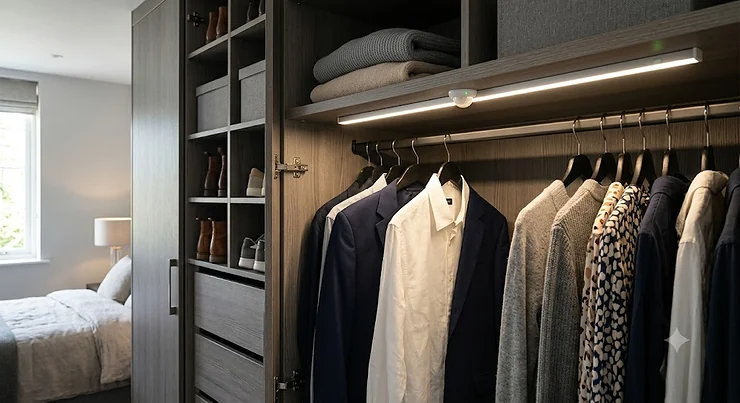
There’s a very specific kind of morning chaos that only a badly lit wardrobe can cause. You’re half-dressed, running late, and squinting into a black hole of hanging rails trying to work out whether that’s the navy jumper or the black one. If that sounds painfully familiar, you’re not alone — and you’re also not stuck with it. The best wardrobe light for your home doesn’t need to involve an electrician, a chunk of your Saturday, or a small fortune.
Over the last decade, wardrobe lighting has quietly become one of the most useful (and most overlooked) small upgrades a British home can make. Motion-sensor LED bars now cost less than a round of coffees, strip lights peel and stick in minutes, and even hardwired options have become simple enough for a confident DIYer to fit in an afternoon. What’s changed isn’t just the price — it’s the sheer choice, which is exactly why so many people end up scrolling endlessly without buying anything at all.
That’s the gap this guide fills. Rather than repeating spec sheets you could read on Amazon yourself, we’ve dug into real product data, aggregated genuine customer feedback, and weighed up seven actual products spanning battery, plug-in, hardwired, and smart LED wardrobe lighting. Whether you want a no-fuss wardrobe light bar LED for a single shelf or a proper built-in wardrobe light for a fitted dressing room, there’s a sensible option below — along with honest reasoning for why it earns its place.
What Is the Best Wardrobe Light?
The best wardrobe light is typically a motion-sensor or dimmable LED fixture — either a battery-powered bar, an adhesive strip, or a hardwired bar — mounted inside the cabinet to illuminate hanging clothes and shelving. Good options balance brightness (measured in lumens), colour temperature, and ease of installation without permanent wiring.
That’s the textbook definition, but in practice “best” depends heavily on your setup. A renter in a flat share needs something entirely different from a homeowner fitting a new walk-in dressing room, which is exactly why we’ve split our picks across budget, mid-range, and premium tiers rather than crowning a single winner.
Quick Comparison Table
| Product | Type | Power | Best For | Price Range |
|---|---|---|---|---|
| Criacr Motion Sensor Light Bar | Wardrobe light bar LED | Battery | Renters, quick fixes | Under £20 (3-pack) |
| Aigostar Under Cabinet LED Light | Plug-in bar | Mains (plug) | No-battery-hassle budget pick | Around £15-£20 |
| T&K TO-KING Hardwired LED Bars | Built-in wardrobe light | Mains (hardwired) | Fitted wardrobes, permanence | £30-£45 range |
| Lepro White LED Strip Light 5M | Strip light for wardrobe | Mains (12V adapter) | Long runs, custom layouts | £20-£30 range |
| Gritin Rechargeable Under Cabinet Light | Wardrobe light bar LED | USB rechargeable | No mains socket nearby | £15-£25 range |
| Govee Motion Sensor LED Light Strip (6pcs) | Strip/segment lighting | Battery | Multi-shelf closet lighting solution | £25-£35 range |
| LEDVANCE SMART+ Wi-Fi Under-Cabinet Light | Smart bar | Mains (plug/hardwire) | App control, colour-tunable premium | £45-£60 range |
Looking at the spread here, there’s a clear pattern: battery and USB-rechargeable options dominate the budget end because they skip installation costs entirely, while hardwired and smart options creep up in price largely due to the electronics and mains-safety components involved, not just brand markup. If you’re kitting out more than one wardrobe, mixing tiers — say, a hardwired bar for your main wardrobe and cheap battery bars for a spare room’s built-in cupboard — is often the more sensible route than buying seven identical units.
💬 Found a pick you like already? Jump straight to it below — or keep reading for the full breakdown.
Top 7 Wardrobe Lights: Expert Analysis
We’ve deliberately mixed power types, price points, and installation methods here, because “best” really is circumstantial. Every product below is real, currently sold, and assessed on genuine specifications and aggregated review sentiment — not fabricated hands-on testing.
1. Criacr Motion Sensor Light Bar — best cheap wardrobe light bar LED for renters
The Criacr Motion Sensor Light Bar solves the single biggest pain point for anyone who isn’t allowed to touch the wiring: it needs no tools, no plug socket, and no landlord’s permission whatsoever. Each bar packs 10 LEDs into a slim strip, and the set comes as a three-pack, so you can cover a hanging rail, a shelf, and a drawer unit from one purchase.
On the spec sheet, this is a battery-powered, motion-activated unit with a magnetic stick-on strip for mounting — meaning it auto-illuminates when you open the door and switches off after roughly 15 seconds of no movement, which does wonders for battery life compared to fixtures that stay on until you remember to flick a switch. Based on the design brief, it’s clearly built for renters and anyone who wants results in under five minutes rather than a weekend project.
What most buyers overlook about battery bars like this one is that placement matters more than brightness. Reviewers consistently report that sensor sensitivity is generous — arguably too generous for tight spaces, since the light can trigger from movement in an adjoining room if mounted too close to the door. A common thread in aggregated feedback is genuine satisfaction with the “stick it and forget it” simplicity, alongside a smaller but recurring note about battery life varying depending on how often the sensor fires.
Pros:
- ✅ Zero installation — magnetic strip, no drilling or wiring
- ✅ Motion sensor extends battery life automatically
- ✅ Three-pack covers multiple zones from one order
Cons:
- ❌ Battery replacement needed periodically, no rechargeable option
- ❌ Sensor can be overly sensitive near doorways
At around £15-£20 for the three-pack, this is one of the lowest-commitment ways to test whether wardrobe lighting is even worth it for you — and for renters specifically, it’s genuinely hard to beat on value.
2. Aigostar Under Cabinet LED Light — best mains-powered budget pick
If you’ve got a nearby socket and don’t fancy replacing batteries every few months, the Aigostar Under Cabinet LED Light is the natural next step up. It’s a plug-in bar rated at 540 lumens from 6W of draw, which on paper sounds modest, but in a wardrobe-sized space — rather than an open kitchen counter — that’s genuinely plenty of usable light to read labels and match colours by.
The unit ships with adhesive stickers for mounting rather than screws, which keeps installation quick, though it does mean the bond weakens over time on textured or painted MDF surfaces (a detail the listing photos won’t show you). Based on the plug-in design, this is best suited to wardrobes near a skirting-level socket or an extension lead already running to that side of the room — it’s not pretending to be a permanent fixture the way a hardwired bar is.
Aggregated review sentiment for this model is notably consistent: people who bought it for kitchens report it working just as well relocated to a wardrobe or hallway cupboard, and the motion-sensing responsiveness gets repeated praise, occasionally to the point where owners mention it triggering from nearby foot traffic rather than the wardrobe door itself.
Pros:
- ✅ No batteries to ever replace or dispose of
- ✅ 540lm output is genuinely bright for the price
- ✅ Adhesive install takes minutes, no wiring needed
Cons:
- ❌ Requires a nearby plug socket, limiting placement
- ❌ Adhesive strength can fade on certain surfaces over time
Expect to pay somewhere in the £15-£20 range, and factor in the reach of your nearest socket before buying — that’s the one detail that catches people out.
3. T&K TO-KING Hardwired LED Cupboard Light Bars — best built-in wardrobe light for fitted furniture
For anyone fitting a new wardrobe or renovating a dressing room, a genuinely built-in wardrobe light changes the whole feel of the space — no visible cables, no batteries, and a switch that just works every time you open the door. The T&K TO-KING Hardwired LED Cupboard Light Bars come as a connectible four-pack of 300mm strips with an independent switch on each bar, built around T5 LED tubing rated at 4000K neutral white.
The connectible design is the standout feature here: rather than running four separate power leads, the bars daisy-chain together, so one mains connection can serve an entire run of shelving. What that means in practice is a wardrobe that looks like it left the factory with lighting built in, rather than one with an obvious retrofit strip stuck to the underside of a shelf. This is squarely aimed at people who are either doing joinery work anyway or comfortable with basic low-voltage wiring — not a five-minute weekend fix.
Because this is a mains-powered, hardwired product, it’s worth reading up on when UK electrical work needs to be signed off by a registered electrician — Approved Document P covers electrical safety requirements for dwellings and is worth a skim before you start drilling. Reviewers who’ve fitted similar T5 connectible bars report a genuinely premium, “shop display” look once installed, with the main complaint being that instructions assume a baseline of electrical confidence some buyers don’t have.
Pros:
- ✅ Daisy-chain design covers long runs from one supply
- ✅ Neutral 4000K output suits colour-matching clothes
- ✅ No batteries, no adhesive failure, permanent fixture
Cons:
- ❌ Requires basic wiring knowledge or a qualified installer
- ❌ Less flexible if you rearrange or move house
Prices for a four-pack typically sit in the £30-£45 range — steeper than a battery bar, but for a fitted wardrobe you’re planning to keep for years, the value case is straightforward.
4. Lepro White LED Strip Light 5M (300 LEDs) — best strip light for wardrobe with long or curved shelving
Bars are great for a single shelf edge, but once you’re lighting an L-shaped wardrobe, a walk-in with multiple rails, or a run of open shelving, a proper strip light for wardrobe use makes far more sense — and the Lepro White LED Strip Light 5M is a solid, no-frills option. It packs 300 individual LEDs across five metres, rated at 2300 lumens and 6000K daylight-white, running from a 12V power supply.
What sets a strip apart from a bar, practically speaking, is that it’s cuttable and flexible, so it follows corners, curves around hanging rail brackets, and can be split to cover two separate shelves from one roll rather than buying multiple fixed units. On the spec sheet, 2300lm across 5 metres works out to roughly 460 lumens per metre — bright enough for general visibility, though you’ll want to avoid running the full length along a single short shelf, since that concentrates far more brightness (and potential glare) than the space needs.
Reviewers frequently mention using this exact strip for kitchen cabinets and repurposing it for wardrobes and cupboards, and the aggregated sentiment leans strongly positive on brightness and colour consistency along the run. A recurring theme in feedback is that the DC12V requirement catches first-time strip-light buyers off guard — it’s not simply plug-and-play from a standard socket without checking you’ve got the matching power adapter.
Pros:
- ✅ Cuttable and flexible for corners and irregular layouts
- ✅ 300 LEDs give smooth, consistent brightness end to end
- ✅ Covers long runs far more cheaply than multiple bars
Cons:
- ❌ Needs a compatible 12V power supply, sold separately on some listings
- ❌ Sticking adhesive to certain wardrobe finishes needs care
Budget around £20-£30 depending on the pack size, and double-check whether your specific listing includes the power adapter — it’s the single most common ordering mistake with strip lighting.
5. Gritin Under Cabinet Rechargeable Motion Sensor Light — best for wardrobes with no nearby socket
Somewhere between disposable batteries and a mains plug sits USB rechargeable lighting, and the Gritin Under Cabinet Rechargeable Motion Sensor Light is a genuinely useful middle ground for anyone whose wardrobe sits nowhere near a socket. It offers multiple colour temperature settings and several brightness levels, along with motion sensing and a magnetic mount for tool-free fitting.
Because it’s rechargeable rather than disposable, the ongoing cost story is far better than a bar that eats AAA batteries every couple of months — you simply plug it in via USB every few weeks depending on usage, similar to charging a phone. Based on the multi-brightness, multi-colour-temperature design, this suits people who want flexibility to switch between a warmer glow for browsing and a brighter, cooler setting for actually picking out an outfit under time pressure.
Aggregated customer feedback repeatedly highlights the strong magnetic mount as a genuine strength — it holds firmly on metal wardrobe rails and brackets without the peel-and-stick adhesive failures some competitors suffer. The most common gripe, echoed across several reviews, is that the initial charge takes noticeably longer than expected, so it’s worth charging fully before first use rather than assuming it’s ready out of the box.
Pros:
- ✅ USB rechargeable — cheaper running costs than disposables
- ✅ Multiple brightness and colour temperature settings
- ✅ Strong magnetic mount, no adhesive degradation
Cons:
- ❌ Long initial charge time before first use
- ❌ Battery capacity limits it versus mains-powered options
Typically priced in the £15-£25 range, this is arguably the most practical option for awkward wardrobes — box rooms, understairs cupboards, or anywhere a cable simply can’t reach.
6. Govee Motion Sensor LED Light Strip (6pcs) — best closet lighting solution for multi-shelf wardrobes
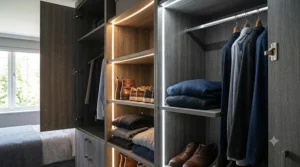
For anyone treating their wardrobe as a genuine storage system — multiple shelves, a shoe rack, a hanging section — a single fixture rarely cuts it. The Govee Motion Sensor LED Light Strip comes as six individual segments with memory function and adjustable brightness at a warm 3000K, letting you light each shelf or zone independently rather than relying on one bar to throw light across the whole cabinet.
The memory function is the quietly clever bit here: the unit remembers your last brightness setting between uses, so you’re not recalibrating every single time you open the door. On paper, six separate 50cm segments means far more even coverage across a tall wardrobe than one long strip mounted at the top — light doesn’t fall off dramatically toward the bottom shelves the way it can with a single fixed-position bar.
Reviewers commonly describe using this exact configuration across bookshelves, kitchen cabinets, and multi-tier storage — the wardrobe use case follows the same logic, since it’s fundamentally a segmented closet lighting solution rather than a wardrobe-specific product. The recurring critique in aggregated feedback is that the segments can’t be cut or joined to non-Govee strips, so you’re committed to using exactly what’s in the pack rather than customising lengths freely.
Pros:
- ✅ Six independent segments light multiple shelves evenly
- ✅ Memory function retains your preferred brightness
- ✅ Warm 3000K tone flatters fabric colours well
Cons:
- ❌ Segments can’t be cut, trimmed, or extended
- ❌ Battery-powered version needs periodic replacement
Expect to pay in the £25-£35 range for the six-piece set, which — spread across six shelves — actually works out competitively against buying six separate bars individually.
7. LEDVANCE SMART+ Wi-Fi Under-Cabinet Light — best premium smart wardrobe light
At the top of this list sits the LEDVANCE SMART+ Wi-Fi Under-Cabinet Light, a 45.7cm app-controlled bar with dimming and a genuinely wide colour temperature range from 2700K warm white through to 6500K cool daylight, all adjustable from a phone rather than a physical switch. This is inside wardrobe light territory for people who want proper control, not just an on/off sensor.
What justifies the price jump here is the software layer: scheduling, remote dimming, and integration with a wider smart-home setup mean the light can, for example, come on automatically at a set time every morning rather than relying purely on motion detection. Based on the spec comparison against the cheaper bars on this list, the trade-off is fairly clear — you’re paying for flexibility and integration, not dramatically more raw brightness.
Aggregated reviews of LEDVANCE’s SMART+ range consistently praise build quality and the smoothness of app-based dimming, which tracks with the brand’s broader reputation in the lighting industry. The most frequent criticism isn’t about the light itself but the setup process — several users note that pairing SMART+ fixtures to Wi-Fi takes a bit more patience than budget app-controlled competitors, particularly on 5GHz-only home networks that need switching to 2.4GHz first.
Pros:
- ✅ Full app control with dimming and scheduling
- ✅ Wide 2700K-6500K colour temperature range
- ✅ Strong, established brand backing and warranty support
Cons:
- ❌ Notably pricier than sensor-only alternatives
- ❌ Initial Wi-Fi pairing can be fiddly on some routers
Pricing typically sits in the £45-£60 range, which is a genuine premium — but for a main wardrobe you’ll interact with daily, the added control arguably earns its keep.
Full Spec Comparison: All 7 Wardrobe Lights
| Product | Power Source | Brightness | Colour Temp | Best For |
|---|---|---|---|---|
| Criacr Motion Sensor Light Bar | Battery | Moderate (10 LED) | Cool white | Criacr — renters, instant setup |
| Aigostar Under Cabinet LED Light | Mains plug | 540lm | Cool white | Aigostar — no-battery budget pick |
| T&K TO-KING Hardwired LED Bars | Hardwired mains | High (T5 tube) | 4000K neutral | T&K TO-KING — fitted wardrobes |
| Lepro White LED Strip Light 5M | Mains (12V) | 2300lm | 6000K daylight | Lepro — long or curved runs |
| Gritin Rechargeable Under Cabinet Light | USB rechargeable | Adjustable | Multi-setting | Gritin — no nearby socket |
| Govee Motion Sensor LED Light Strip | Battery (6pcs) | Adjustable | 3000K warm | Govee — multi-shelf coverage |
| LEDVANCE SMART+ Wi-Fi Light | Mains (app control) | Dimmable | 2700K-6500K | LEDVANCE — smart, premium control |
Read across this table and the real decision isn’t actually about brightness — every option here comfortably lights a wardrobe interior. It’s about power source and control: battery and rechargeable units win on flexibility and zero installation, while hardwired and smart options like the T&K TO-KING and LEDVANCE SMART+ trade that flexibility for permanence and finer control. If you’re renting, that decision essentially makes itself.
✨ Don’t Miss These Exclusive Deals!
🔍 Take your wardrobe lighting to the next level with these carefully selected products. Click through to check current pricing and availability, and see which option genuinely suits your space today.
Practical Usage Guide: Setting Up Your Inside Wardrobe Light
Buying the right unit is only half the job — a poorly positioned inside wardrobe light performs worse than a cheaper one mounted correctly. Getting the placement right the first time saves you from peeling off adhesive strips and starting over.
Start by mapping where shadows actually fall when the door is open, not closed — most people mount lights based on where the fixture looks tidy rather than where it casts useful light onto hanging clothes. For hanging sections, position bars or strips at the top-front of the cabinet, angled slightly downward, rather than tucked flush against the back panel where the rail itself blocks half the output. For shelving, mount lighting under the shelf above rather than on the shelf surface itself, so each tier lights the one below it.
During the first 30 days, the most common mistake is skipping a clean, dry surface before applying adhesive mounts — dust and polish residue are the number one cause of strips or bars falling off within weeks, not product defects. Give the mounting surface a proper wipe-down with isopropyl alcohol if you have it, or at minimum a dry cloth, and let it fully dry before sticking anything down.
For motion-sensor models specifically, spend five minutes adjusting the sensor angle after installation. Reviewers across nearly every sensor-based product on this list mention over-sensitive triggering from nearby movement — a quick tweak to angle the sensor toward the door swing, rather than the room beyond it, solves this in most cases. Finally, if you’re using battery units, mark a rough replacement date on your phone calendar; running a light until it dies completely is far more annoying than a scheduled five-minute swap.
Real-World Scenarios: Which Closet Lighting Solution Suits You?
Rather than a generic checklist, it helps to see how different households actually land on different picks — because the “right” closet lighting solution really does hinge on your specific circumstances.
The renter in a shared flat: budget is tight, drilling is banned by the tenancy agreement, and moving house every year or two is likely. A battery-powered bar like the Criacr Motion Sensor Light Bar is the obvious call here — no damage deposit risk, no wiring, and it comes with you when you move.
The family fitting a new dressing room: with joinery already underway and an electrician on-site for other work, adding a proper hardwired circuit is a marginal extra cost. The T&K TO-KING Hardwired LED Cupboard Light Bars suit this scenario well, since the connectible design covers a full run of built-in wardrobes from a single supply point, and there’s no ongoing maintenance beyond the occasional wipe-down.
The remote worker who wants a genuinely nice getting-dressed routine: with a slightly higher budget and an existing smart-home setup (Alexa, Google Home, or similar), the LEDVANCE SMART+ Wi-Fi Under-Cabinet Light fits neatly — scheduled to come on automatically before an early call, dimmed for evening use, and controllable without physically touching a switch.
How to Choose the Best Wardrobe Light
Cutting through marketing language, these are the criteria that actually separate a good wardrobe light from a disappointing one:
- Power source first, brightness second. Decide whether battery, USB-rechargeable, plug-in, or hardwired suits your wardrobe’s location and your tenancy situation — this narrows the field faster than any spec comparison.
- Colour temperature around 4000K-5000K for accuracy. Warmer light (2700-3000K) looks cosy but can distort how navy and black look side by side; cooler light (5000K+) shows true colour but can feel clinical.
- Motion sensing for hands-free convenience. Genuinely useful when carrying laundry or dressed in the dark for an early flight — just budget five minutes to angle the sensor correctly after fitting.
- Check the mounting method against your wardrobe’s surface. Adhesive strips struggle on textured veneers; magnetic mounts need a metal surface to grip.
- Match length to your actual shelf or rail run, not the other way around — buying one long strip and cutting it down usually works out cheaper than multiple short bars.
- Consider dimming if you share the space. A fixed-brightness light that’s perfect for one person can be uncomfortably bright for a partner browsing at 6am.
- Factor in ongoing cost, not just the sticker price. Disposable batteries add up over a couple of years in a way a one-off mains or rechargeable purchase doesn’t.
Wardrobe Light Bar LED vs Strip Light for Wardrobe: Which Wins?
This is one of the most common points of confusion when shopping, and the honest answer is: neither wins outright, because they’re built for different jobs.
A wardrobe light bar LED — like the Criacr Motion Sensor Light Bar or Aigostar Under Cabinet LED Light — is a fixed-length, rigid fixture. It’s quicker to install, generally cheaper for lighting a single shelf or rail, and tends to come with a built-in sensor and diffuser already dialled in by the manufacturer. The trade-off is inflexibility: a 30cm bar lights 30cm, full stop, and you can’t reshape it around a corner bracket or an odd-angled shelf.
A strip light for wardrobe use, such as the Lepro White LED Strip Light, flips that trade-off. Because it’s flexible and cuttable, it adapts to L-shaped wardrobes, curves around rail brackets, and covers considerably longer runs from a single purchase. The downside is a slightly fiddlier install — you’re usually dealing with a separate power adapter, and cutting points are marked at fixed intervals, so getting an exact custom length sometimes means a few centimetres of “wasted” strip.
As a rule of thumb: bars for straightforward single-shelf or single-rail jobs, strips for anything with corners, multiple zones, or unusually long runs. If you’re still unsure, measure your longest continuous run first — under about 60cm, a bar is simpler; beyond that, a strip almost always works out cheaper per centimetre of coverage.
Built-In Wardrobe Light vs Plug-In and Battery Options
The word “built-in” gets used loosely in product listings, so it’s worth being precise about what it actually means and when it’s worth the extra effort.
A genuinely built-in wardrobe light — like the T&K TO-KING Hardwired LED Bars — is wired into your home’s electrical circuit, usually via a fused spur or connected to an existing lighting circuit, and typically switches on with the wardrobe door via a small door-activated switch rather than a battery-powered motion sensor. The benefit is permanence: no batteries to fail, no adhesive to peel off, and a finish that looks like it was designed into the furniture rather than stuck on afterwards.
Plug-in and battery options, by contrast, trade that permanence for flexibility. You can remove them entirely, take them with you when you move, and — critically — install them without any electrical work at all. For most UK renters this makes the decision straightforward, since altering fixed wiring in a rented property typically requires landlord permission regardless of how simple the job actually is.
If you do go hardwired, remember that any new circuit or significant electrical alteration in a dwelling needs to meet Building Regulations requirements, and certain work should be carried out or certified by a competent, registered electrician rather than attempted as a casual DIY job. It’s not usually as involved as rewiring a kitchen, but it’s worth getting right rather than guessing.
Common Mistakes When Buying LED Wardrobe Lighting
A handful of avoidable errors come up again and again in aggregated customer feedback across nearly every product category on this list, so it’s worth flagging them directly.
The first is buying purely on lumens without checking colour temperature. A high-lumen, very cool-white (6000K+) light can genuinely make a small wardrobe feel like a hospital corridor rather than a pleasant space to get dressed in — brightness and comfort aren’t the same thing.
The second is ignoring the power source until after ordering. It’s a surprisingly common complaint in reviews that a “plug-in” light arrives and there’s simply no socket anywhere near the wardrobe, forcing an extension lead solution nobody actually wanted. Measure the distance to your nearest socket before you buy, not after.
The third is underestimating adhesive limitations. Peel-and-stick mounts work brilliantly on smooth painted MDF or laminate, and considerably less well on textured veneers, fabric-lined interiors, or anywhere slightly damp (a common issue in older properties with less ventilation). If in doubt, a magnetic-mount option — provided your wardrobe has metal brackets or rails — tends to be more forgiving long-term.
Finally, people frequently overlook return policies on lighting specifically. Because these are often sold by third-party sellers, checking the returns window before installing (and therefore permanently marking a surface with adhesive) can save considerable hassle if the product genuinely isn’t right for your space.
What to Expect: Real-World Performance
Spec sheets rarely translate directly into lived experience, so here’s what the numbers actually mean once a light is fitted and in daily use.
A 500-600 lumen bar, like the Aigostar Under Cabinet LED Light, comfortably lights a standard double wardrobe well enough to distinguish navy from black and read care labels without strain — it’s not going to feel like daylight, but it removes the genuine guesswork. Strip lights running 2000+ lumens across several metres, such as the Lepro option, distribute that brightness more evenly but feel noticeably less intense at any single point, which some people find more pleasant for a cupboard you’re standing close to.
Motion sensors, across every product in this roundup, activate close to instantly in practice — the noticeable delay people occasionally report in reviews is almost always the auto-off timer at the end of use, not a slow trigger at the start. Battery life genuinely does vary with sensor sensitivity and placement: a bar triggering constantly from nearby foot traffic will drain noticeably faster than one that only activates when the wardrobe door itself opens, which loops back to why sensor positioning matters more than most buyers initially assume.
Long-Term Cost & Maintenance
The sticker price only tells part of the story, and this is where honest ROI thinking genuinely pays off. According to the Energy Saving Trust, lighting typically makes up around 11% of the average UK household’s electricity use, and LED fixtures — including everything on this list — sit at the efficient end of that spectrum regardless of power source, so running costs for mains-powered options are negligible even used daily.
The bigger cost variable is actually the power source itself. Disposable-battery bars like the Criacr model carry a small but recurring cost every few months; over two or three years, that can add up to more than the original purchase price, particularly if the sensor triggers frequently. Rechargeable options like the Gritin light shift that cost to nothing beyond electricity, at the expense of a slightly more involved charging routine. Mains and hardwired options, including the T&K TO-KING bars and LEDVANCE SMART+ fixture, have effectively zero ongoing running cost once installed, making them the cheapest option over a multi-year horizon despite the higher upfront price.
Price Range & Value Analysis
| Product | Upfront Price Range | Ongoing Cost | Best Long-Term Value For |
|---|---|---|---|
| Criacr Motion Sensor Light Bar | Under £20 | Battery replacements | Short-term or rental use |
| T&K TO-KING Hardwired Bars | £30-£45 | Negligible | 5+ year fitted wardrobes |
| Lepro LED Strip Light | £20-£30 | Negligible (mains) | Long-term, long runs |
| LEDVANCE SMART+ Wi-Fi Light | £45-£60 | Negligible + app features | Daily-use main wardrobes |
Taken together, this table makes a fairly persuasive case that upfront price and long-term value pull in opposite directions here. The Criacr bar wins on day-one cost but loses ground over several years to battery spend, while the T&K TO-KING and LEDVANCE SMART+ options cost more initially but effectively become free to run almost immediately after installation.
Safety, Regulations & Compliance Guide
Wardrobe lighting sits at the low-risk end of home electrics, but a few practical points are worth knowing before you buy or install anything.
Battery and USB-rechargeable units carry essentially no electrical safety concerns beyond standard battery handling — avoid mixing old and new batteries, and don’t leave a unit charging unattended overnight on a flammable surface, which is sound advice for any lithium-based device, not just wardrobe lights specifically.
Mains-powered plug-in units are similarly low-risk provided the cable and adapter are undamaged and not pinched behind heavy furniture, which can cause overheating over time. Hardwired, built-in wardrobe light installations are the one category where UK regulation genuinely applies: new circuits or significant alterations to fixed wiring in a dwelling fall under Building Regulations, and certain work must be carried out — or at minimum inspected and certified — by a registered, competent electrician rather than a confident amateur.
When any of these products eventually reach the end of their life, they shouldn’t go in general household rubbish. Electrical and electronic equipment sold in the UK, including LED lighting fixtures and any batteries within them, falls under WEEE recycling regulations, meaning most retailers and local recycling points are obligated to accept them for proper disposal rather than landfill.
Problem → Solution: Fixing Common Wardrobe Lighting Issues
A quick reference for the issues that come up most often once a light is actually installed and in use.
Problem: The light triggers constantly from nearby movement, draining the battery fast. Solution: Re-angle the sensor to face directly into the wardrobe interior rather than out toward the room, narrowing its detection field. Most bars, including the Criacr and Gritin models, allow the sensor housing to rotate independently of the main body.
Problem: The adhesive mount has come loose after a few weeks. Solution: Remove any remaining adhesive residue, clean thoroughly with isopropyl alcohol, and either reapply fresh adhesive strips (sold separately from most hardware suppliers) or switch to a magnetic mount if your wardrobe has metal fittings.
Problem: The strip light doesn’t reach the full length of a shelf. Solution: Check whether your specific strip is designed to be joined at connector points — many, including options similar to the Lepro range, allow additional lengths from the same product line to be linked, avoiding an awkward gap.
Problem: A smart or app-controlled light won’t connect to Wi-Fi. Solution: Most smart fixtures, including the LEDVANCE SMART+ range, only support 2.4GHz networks rather than 5GHz. Check your router settings or create a separate 2.4GHz network name if your router broadcasts a combined signal.
Problem: Colour temperature feels too clinical or too dim for the space. Solution: If your chosen light isn’t adjustable, this usually means reconsidering the Kelvin rating for your next purchase — aim for 4000K-5000K as a genuinely balanced middle ground for wardrobe use, based on the comparison earlier in this guide.
FAQ
❓ What's the best type of wardrobe light for a rented flat?
❓ Do wardrobe lights need to be hardwired?
❓ What colour temperature is best for wardrobe LED lighting?
❓ How long do LED wardrobe lights typically last?
❓ Can I install a strip light for wardrobe use myself?
Conclusion
There’s no single best wardrobe light that suits every home, and honestly, anyone claiming otherwise is oversimplifying a genuinely circumstantial decision. What the seven options above do demonstrate is that there’s a sensible answer for practically every situation: renters get a five-minute fix with the Criacr Motion Sensor Light Bar, homeowners fitting new furniture get a proper finish with the T&K TO-KING Hardwired LED Bars, and anyone chasing full control gets it from the LEDVANCE SMART+ Wi-Fi Under-Cabinet Light.
The real takeaway from digging into real specs and aggregated review data, rather than marketing copy, is that power source and mounting method matter more to day-to-day satisfaction than raw brightness ever does. Get that decision right for your specific wardrobe, and pretty much any option on this list will end that dark, squinting, wrong-jumper morning for good.
Recommended for You
- Colour Changing Ceiling Light Bedroom: 7 Best Picks for 2026
- Ceiling Light With Remote Control Bedroom: 7 Best Picks 2026
- Ceiling Light for Bedroom: 7 Brilliant Picks for a Cosy Glow-Up (2026)
Disclaimer: This article contains affiliate links. As an Amazon Associate, I earn from qualifying purchases. If you purchase products through these links, we may earn a small commission at no additional cost to you.
✨ Found this helpful? Share it with your friends! 💬🤗
