
In This Article
It’s 11pm, you’re three chapters deep into a book you can’t put down, and your eyes are staring at you in protest. That gritty, dry, “I need to stop” feeling isn’t your imagination — it’s what happens when the wrong light forces your pupils to keep adjusting between a glaring bulb and a dim page. An eye care reading lamp is a light source engineered specifically to reduce that strain: typically flicker-free, glare-controlled, and tuned to a warmer colour temperature that’s gentler on tired eyes than a standard household bulb. It sounds like a small thing. It isn’t.
We’ve spent the last few weeks digging through spec sheets, manufacturer documentation, and genuine aggregated review sentiment for lamps sold on amazon.co.uk, covering everything from clip-on book lights you can throw in a rucksack to a genuinely clever desk lamp that changes its behaviour depending on whether you’re reading paper or a screen. According to consumer body Which?, screen use now amounts to 14-plus hours a day for almost a third of UK adults, with up to half potentially suffering from digital eye strain as a result — and while a lamp alone won’t undo a full working day of screen time, the right one takes a genuine chunk of the strain out of your evening reading.
This guide covers seven real, currently available products spanning budget clip lights through to a premium desk lamp with genuine smart-sensor tech, plus practical buying advice, real-world scenarios, and answers to the questions people actually type into Google before they buy. Prices below are given as ranges rather than fixed figures, since Amazon pricing shifts constantly — always check the current price on the product page before buying.
Quick Comparison Table
| Lamp | Light Type | Best For | Price Range |
|---|---|---|---|
| BenQ e-Reading Desk Lamp | Dual-mode paper/screen, 4000-5700K | Premium desk setup | £150-£220 |
| TaoTronics TT-DL13 | 5 colour temps, touch dimming | All-round flicker-free desk lamp | £25-£40 |
| Lepro LED Desk Lamp | 3 colour temps, diffused LED | Budget eye-caring desk lamp | £18-£30 |
| Suright Bedside Lamp | 3000K warm white, fabric shade | Warm white bedroom lamp | £22-£35 |
| Glocusent Clip-On Book Light | 5 amber tones, stepless dim | Low glare book lamp | £14-£22 |
| hooga Red Book Light | 625nm red LED only | Blue light free reading lamp | £24-£36 |
| Gritin 16 LED Reading Light | 3 modes, stepless dim | Budget anti-glare clip light | £11-£19 |
Looking at the spread here, there’s a clear pattern: the closer a lamp gets to genuinely adaptive tech (sensors, dual modes, memory functions), the more it costs, while the clip-on category delivers most of the eye-comfort benefit — warm colour temperature, no flicker, dimmability — for a fraction of the price. If you read mostly in bed, you can realistically skip the desk lamps altogether and save £100-plus. If you split time between a desk and a screen, the added sophistication of something like the BenQ e-Reading Desk Lamp starts to earn its keep.
💬 Found a lamp that looks right for you already? Scroll down to see current pricing and availability before the good ones sell out.
Top 7 Eye Care Reading Lamps: Expert Analysis
1. BenQ e-Reading Desk Lamp — dual-mode sensor lighting for paper and screens
The standout feature here is genuinely clever: the lamp senses what you’re doing and adjusts itself, rather than making you guess at the right setting. BenQ built this on the back of its ScreenBar monitor-light range, and it shows.
In terms of specs with real-world meaning, the lamp’s Paper Mode delivers 1,000 lux of glare-free light directly below at a 5,700K colour temperature, while Screen Mode drops to 500 lux at 4,000K specifically to avoid a harsh contrast between the lamp and your monitor. That second figure matters more than it sounds: a lamp that’s too bright next to a dim screen forces your pupils to keep re-adjusting, which is a big part of what makes evening screen-and-book sessions so tiring. The head uses what BenQ calls Oval-Light technology to spread illumination across roughly 90cm x 68cm of desk space, which is noticeably wider than a typical gooseneck lamp.
Who’s this for? Honestly, not the casual paperback reader — it’s aimed at people who alternate between a laptop and physical documents for hours at a stretch: students revising from both textbooks and a screen, or anyone doing detailed close work at a desk. Based on the spec comparison with cheaper alternatives on this list, the auto-sensing feature is the genuine differentiator, not the brightness itself.
Aggregated customer feedback for BenQ’s e-Reading and ScreenBar range consistently praises the build quality and the fact that it doesn’t cast a shadow across the desk, though some reviewers note the desk-clamp footprint is bulkier than a slim gooseneck lamp, and that it’s a meaningful step up in price versus a basic desk light.
Pros:
- ✅ Automatically balances brightness between paper and screen
- ✅ Wide, even light spread with minimal shadow
- ✅ Premium metal build using mostly recyclable materials
Cons:
- ❌ Significantly pricier than a standard desk lamp
- ❌ Larger footprint needs a fair bit of desk space
At around £150-£220 depending on the exact model and any current promotions, this sits firmly in premium territory, but for heavy desk-based readers, the reduced eye-adjustment fatigue over a full evening arguably justifies it.
2. TaoTronics TT-DL13 — 35-mode flicker-free control for under £40
The headline advantage is flexibility: TaoTronics built this around the idea that no single colour temperature or brightness works for every task, every hour of the evening.
Spec-wise, the lamp pairs multiple colour temperature settings with several brightness levels through touch control, giving you a genuinely wide range of lighting combinations rather than a blunt on/off dimmer. TaoTronics’ desk lamp range is built around a design philosophy the brand describes as scientifically eye-caring, aimed at people reading, studying, working, or winding down before bed, and the flexible gooseneck arm lets you point the light at the page rather than into your eyes — a small detail that matters more than most buyers realise.
This is the pick for anyone who wants one lamp to cover a whole evening’s shifting tasks: bright, cool light for reading small print earlier on, sliding to warm, dim light as bedtime approaches. Reviewers of TaoTronics’ desk lamp range regularly mention the memory function — remembering your last-used brightness and colour setting — as a small but genuinely appreciated convenience, alongside praise for the touch-sensitive controls feeling responsive rather than fiddly.
Pros:
- ✅ Wide range of colour and brightness combinations
- ✅ Memory function saves your preferred setting
- ✅ Flexible gooseneck aims light precisely at the page
Cons:
- ❌ Touch controls can be less intuitive than physical buttons
- ❌ Metal base takes up more desk space than a clip light
Priced in the £25-£40 range, this is the sensible middle ground — most of the flexibility of the BenQ lamp, at a fraction of the cost, without the sensor automation.
3. Lepro LED Desk Lamp — genuinely eye-caring diffusion at a budget price
What stands out immediately is the diffuser design: rather than a single bright LED point, Lepro spreads the light across dozens of smaller LEDs behind a frosted shade.
In practice, this matters more than the lumen figure alone suggests. The design uses dozens of energy-efficient LEDs to provide natural, non-glaring light aimed at preventing eye fatigue, with the frosted shade and elongated lamp head casting a broader span of soft light that reduces the contrast between a bright screen and the darker surrounding desk. Lepro also states the panel is built to reduce electricity use significantly compared with traditional lighting, without the heat build-up you’d get from an older-style bulb.
This is the lamp to buy if you want the core benefits of eye-care lighting — diffused, warm-adjustable, flicker-free — without paying for smart sensors or premium materials. Based on the spec sheet, the trade-off is a plastic-and-aluminium build rather than the all-metal construction of pricier rivals, though reviewers regularly describe it as sturdy enough for daily desk use, with the touch controls and multiple colour modes praised as genuinely useful rather than gimmicky.
Pros:
- ✅ Diffused LED array reduces glare and eye strain
- ✅ Multiple colour temperatures and brightness levels
- ✅ Compact, foldable design saves desk space
Cons:
- ❌ Plastic components feel less premium than metal rivals
- ❌ Power adapter and cable add desk clutter
At roughly £18-£30, this is arguably the best value pick on this list for anyone who mainly wants a reliable, glare-reducing desk lamp without the extras.
4. Suright Touch Control Bedside Lamp — warm white comfort with a soft fabric shade
The standout here isn’t the electronics — it’s the shade. A linen fabric diffuser does something LED panels alone can’t: it softens every point of light into a gentle glow rather than a sharp beam.
The included bulb runs at a 3,000K warm white colour temperature with no flicker and no glare, described by the manufacturer as friendly to the eyes and energy-efficient, with a lifespan roughly 30 times that of a traditional incandescent bulb. Touch dimming and built-in USB-A and USB-C charging ports round out a lamp clearly designed with the nightstand in mind rather than a desk.
If your reading happens propped up in bed rather than at a desk, this is a genuinely different category of eye-care lamp to the gooseneck options above — it prioritises ambient warmth and softness over task-lighting precision. Reviewers consistently describe the fabric shade as noticeably gentler on tired eyes at night than a bare LED bulb, and the built-in charging ports as a welcome bonus for keeping a phone topped up overnight, though a handful note the wooden base takes up more nightstand space than a slim clip light.
Pros:
- ✅ Soft, warm 3000K light ideal for evening reading
- ✅ Fabric shade diffuses light more gently than bare LEDs
- ✅ Dual USB charging ports built into the base
Cons:
- ❌ Takes up noticeably more nightstand space
- ❌ Fixed warm tone, less adjustable than desk lamps
Expect to pay around £22-£35, making this one of the more affordable ways to get a proper warm white reading lamp rather than a repurposed desk light on your bedside table.
5. Glocusent Clip-On Book Light — low glare reading without waking your partner
The clever bit is the amber-heavy colour range: rather than one warm setting, you get several shades of amber to fine-tune exactly how soft the light feels.
Specs that matter: the lamp offers multiple colour temperature and brightness combinations with precise stepless dimming, plus a memory function so you don’t have to re-adjust every time you switch it on, and manufacturer figures put runtime at up to 100 hours on a full charge at lower brightness settings. The touch-screen control is genuinely silent, which matters more than it sounds if you’re reading next to a sleeping partner.
This is the pick for couples sharing a bed where one person wants to read and the other wants to sleep — the light is genuinely directional and low-glare rather than spilling across the whole room. Reviewers of clip-on book lights in this category commonly report that the lowest amber settings are soft enough not to disturb a partner, and the flexible clip holds securely on most book covers and e-readers, though a few note the clip’s spring feels stiff on very thick hardbacks.
Pros:
- ✅ Multiple amber tones for genuinely low-glare reading
- ✅ Long battery runtime on lower brightness settings
- ✅ Silent touch control won’t disturb a sleeping partner
Cons:
- ❌ Clip mechanism can feel tight on thick hardback books
- ❌ Not bright enough for desk-based tasks
Priced around £14-£22, this is a smart, low-cost pick for anyone whose reading lamp needs to double as “doesn’t wake my other half.”
6. hooga Red Book Light — the genuine blue light free option
Where most “eye-caring” lamps simply warm up their white LEDs, this one goes further: it emits red light only, with no blue wavelength in the mix at all.
The lamp uses a 625nm red LED specifically marketed as emitting no blue light, positioned for eye care and strain-free, healthy evening reading. That 625nm figure is the key spec here — red wavelengths in this range sit well outside the blue-light band that’s been linked to melatonin suppression, which is the whole point of buying a lamp like this in the first place. It’s a genuinely different tool to the other lamps on this list, most of which reduce blue light rather than eliminate it.
This is squarely for night-owls and shift workers trying to protect their sleep quality, rather than for daytime reading — red-only light isn’t great for distinguishing fine detail or colour, so it’s not a desk-lamp replacement. What’s worth weighing honestly here: because it’s a niche product, verified UK customer review volumes are smaller than for mainstream brands like Lepro or TaoTronics, so treat aggregated sentiment with a little more caution and lean on the spec sheet and the wavelength science behind it.
Pros:
- ✅ True red-only light with no blue wavelength emitted
- ✅ Rechargeable and portable, works well while travelling
- ✅ Purpose-built for evening and pre-sleep reading
Cons:
- ❌ Red light isn’t ideal for detailed daytime tasks
- ❌ Smaller UK review pool than mainstream brands
At roughly £24-£36, it’s a specialist buy rather than an everyday desk lamp — but for the specific job of not disrupting sleep, it does something the other six lamps on this list genuinely don’t.
7. Gritin 16 LED Reading Light — the cheapest genuinely anti-glare option
The standout feature at this price point is simple: three distinct light modes rather than the single fixed colour you’d expect from a budget clip light.
The lamp offers three eye-protecting modes across warm and cool white LEDs, with stepless dimming and a four-level power indicator so you’re not caught out mid-chapter with a dead battery. What most buyers overlook about lamps at this price is that the mode-switching alone — being able to drop to a warm, dim setting for late-night reading — delivers most of the eye-comfort benefit that pricier lamps charge a premium for.
This is the entry point for anyone who just wants to stop straining their eyes on a badly lit train commute or in a dim bedroom, without spending much to find out if a book light actually helps. Reviewers commonly describe the light as adequate rather than exceptional for brightness, but consistently note the flexible neck and secure clip as genuinely useful, with battery life holding up well across multiple reading sessions between charges.
Pros:
- ✅ Three genuinely distinct light modes at a low price
- ✅ Stepless dimming for fine brightness control
- ✅ Battery indicator avoids mid-read surprises
Cons:
- ❌ Maximum brightness is modest versus desk lamps
- ❌ Build feels noticeably more plastic than pricier rivals
At around £11-£19, this is the safe first purchase if you’re not yet convinced an eye-care reading lamp is worth the money — it’s cheap enough to try without much risk.
Top 7 Products at a Glance
| Lamp | Type | Light Modes | Best For | Price Range |
|---|---|---|---|---|
| BenQ e-Reading Desk Lamp | Desk, dual-sensor | 2 auto modes | Desk readers switching paper/screen | £150-£220 |
| TaoTronics TT-DL13 | Desk, gooseneck | Up to 35 combinations | All-round evening reading | £25-£40 |
| Lepro LED Desk Lamp | Desk, diffused | 15+ combinations | Budget-conscious desk use | £18-£30 |
| Suright Bedside Lamp | Table, fabric shade | Fixed warm white | Bedside warm white reading | £22-£35 |
| Glocusent Clip-On Book Light | Clip-on | 25 combinations | Reading beside a sleeping partner | £14-£22 |
| hooga Red Book Light | Clip-on | Red-only | Protecting sleep quality | £24-£36 |
| Gritin 16 LED Reading Light | Clip-on | 3 modes | First-time budget buyers | £11-£19 |
Reading across this table, the price gap between the Gritin 16 LED Reading Light and the BenQ e-Reading Desk Lamp is roughly tenfold, yet both genuinely deliver on the core promise of reduced glare and flicker-free light — the difference is refinement and adaptability, not whether the eye-care claim holds up at all. If budget is tight, start with a clip light; if you’re reading for hours daily at a desk, the extra cost of the BenQ starts paying for itself in reduced evening fatigue.
Practical Usage Guide: Getting the Most from Your Eye Care Reading Lamp
Buying the right lamp is only half the job — positioning and settings do a surprising amount of the heavy lifting. Place any desk lamp so the light source sits slightly behind and above your line of sight, angled onto the page rather than at your eyes; this single adjustment reduces more glare than switching to a pricier lamp ever will. For bedside lamps, position the shade at roughly shoulder height when you’re sitting up in bed — too low and you’ll be craning your neck, too high and the light spills into your partner’s eyes.
In the first 30 days, resist the temptation to leave every lamp on its brightest, coolest setting out of habit. Most eye-care lamps default to a daylight-white mode that’s genuinely useful for detailed morning reading but far too harsh for 10pm. Get into the habit of stepping the colour temperature down as the evening progresses — many of the lamps above, including the TaoTronics TT-DL13 and Glocusent Clip-On Book Light, have memory functions specifically so this becomes a one-touch habit rather than a fiddly reset every night.
A common first-month mistake is placing a desk lamp directly next to a laptop or monitor at full brightness, which recreates exactly the harsh contrast these lamps are designed to avoid — this is precisely the problem BenQ’s dual-mode sensor was built to solve automatically, and worth manually replicating on cheaper lamps by dimming when a screen is in view. For maintenance, wipe diffuser shades with a dry microfibre cloth monthly; dust genuinely does reduce light output and increase the glare from any remaining bright spots over time.
Real-World Scenarios: Matching the Lamp to the Reader
Consider a university student sharing a halls bedroom, reading textbooks late into the evening while a flatmate sleeps a few feet away. Budget’s tight, space is tighter, and disturbing a roommate isn’t an option — the Glocusent Clip-On Book Light or the cheaper Gritin 16 LED Reading Light fit this life far better than a £200 desk lamp with nowhere to sit.
Now picture a remote worker in their late 30s who spends the day on video calls and the evening reading physical books to switch off from screens. Frequency of use is daily, budget is more flexible, and the priority is genuinely reducing the jarring contrast between all-day screen exposure and evening print. The BenQ e-Reading Desk Lamp‘s dual-mode sensor is arguably built for exactly this transition, and the cost is easier to justify against daily, prolonged use.
Finally, think about a couple in their 60s, one an early sleeper, the other a committed night-reader who struggles to switch their mind off before bed. Environment is a shared bedroom, frequency is nightly, and the priority is protecting sleep quality without an awkward separate-rooms compromise. Here the hooga Red Book Light solves a specific problem the others don’t — genuinely blue-light-free illumination that won’t fight against the body’s natural wind-down signals — while the Suright Touch Control Bedside Lamp on the non-reading partner’s side keeps the room’s ambient light warm and unobtrusive.
Problem → Solution: Fixing Common Reading-Light Eye Strain
Problem: Eyes feel gritty and tired after 20-30 minutes of reading. This is frequently a contrast issue rather than a brightness one — a page lit far more brightly (or dimly) than the surrounding room forces constant pupil adjustment. Solution: match the lamp’s brightness roughly to the ambient room light rather than maxing it out, and favour lamps with several brightness steps, like the Lepro LED Desk Lamp, over fixed-output lights.
Problem: Struggling to fall asleep after evening reading sessions. As the Sleep Foundation explains, blue light is a portion of the visible spectrum known to influence alertness and suppress the release of melatonin, the hormone that helps the body feel drowsy. Solution: switch to a warm-white or red-only lamp — such as the Suright Touch Control Bedside Lamp or the more specialised hooga Red Book Light — for the final hour before sleep, rather than relying on a cool white desk lamp.
Problem: Partner complains the light wakes them up. A wide-beam desk lamp or overhead light spills well beyond the page. Solution: a directional clip light such as the Glocusent Clip-On Book Light keeps illumination tightly focused on the book itself.
Problem: Reading light seems to flicker slightly, especially on older devices. Cheap, uncertified LED drivers can pulse at frequencies too fast to consciously notice but still tiring on the eyes over time. Solution: stick to lamps from established brands with documented flicker-free specifications, like those covered in this guide, rather than unbranded budget listings with no technical detail.
Problem: Text looks slightly yellow or washed out under a warm lamp. This is an expected trade-off of lower colour temperatures. Solution: for detailed reading of small print or colour-sensitive material, switch to a neutral or cool white mode temporarily — most of the multi-mode lamps above, including the TaoTronics TT-DL13, let you do this without buying a second lamp.
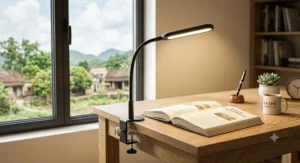
How to Choose an Eye Care Reading Lamp
- Check for adjustable colour temperature. A lamp offering both a cooler daytime setting and a warmer evening one is more versatile than a single fixed tone.
- Prioritise dimmability over raw brightness. A lamp you can turn down matters more than one that’s simply bright, since most eye strain comes from mismatched contrast, not insufficient light.
- Consider where you actually read. Desk lamps like the TaoTronics TT-DL13 suit fixed reading spots; clip lights like the Gritin 16 LED Reading Light suit bed, sofa, or travel.
- Look for a stated flicker-free specification. This is rarely mentioned on cheap unbranded listings, which is itself a signal worth noting.
- Factor in charging method. Rechargeable clip lights are more convenient for travel; mains-powered desk lamps suit a fixed spot but never run flat mid-chapter.
- Weigh up smart features against your actual habits. Auto-sensing tech like the BenQ e-Reading Desk Lamp offers is genuinely useful for people switching between paper and screens daily — less so for someone who only reads a physical book before bed.
- Set a realistic budget band first. As the comparison table above shows, most of the core eye-comfort benefit is available well under £40; premium pricing buys convenience and automation, not a fundamentally different technology.
Eye Care Reading Lamp vs Traditional Bulbs
| Factor | Eye Care Reading Lamp | Traditional Bulb/Lamp |
|---|---|---|
| Flicker | Typically flicker-free LED driver | Can flicker, especially with cheap dimmers |
| Colour temperature | Adjustable, often 3-5 settings | Usually fixed |
| Glare control | Diffused shades, directional design | Often a bare or lightly shaded bulb |
| Running cost | Low, LED-based | Higher with incandescent bulbs |
| Typical price | £11-£220 depending on features | £5-£25 for a basic lamp and bulb |
The core distinction here isn’t really “LED vs traditional” — plenty of standard lamps now use LED bulbs too. What genuinely separates a dedicated eye care reading lamp from a traditional bedside lamp with a bulb swapped in is the engineering around diffusion, adjustable colour temperature, and documented flicker-free performance. A traditional lamp fitted with a decent warm white LED bulb can get you partway there for very little money, but it won’t offer the mode-switching or directional control that make lamps like the TaoTronics TT-DL13 genuinely more comfortable across a full evening of varied reading.
🔍 Take Your Evening Reading to the Next Level
Click through on any of the lamps above to check current pricing and availability — stock and promotional pricing shift often, so it’s worth a quick look before you settle on one. These picks are designed to help you build a genuinely comfortable, eye-friendly reading routine your future self will thank you for.
Common Mistakes When Buying a Reading Lamp
The single most common mistake is buying on lumens alone. A lamp advertising huge brightness figures but no stated colour temperature range or flicker specification can still be genuinely tiring to read under, because brightness says nothing about glare or contrast. The second mistake is assuming a “warm white” label guarantees comfort — some budget listings use the term loosely for anything below daylight white, without a specific Kelvin figure, so it’s worth checking the listing states an actual number like 3000K.
A third mistake, especially common with clip-on lights, is ignoring battery runtime at your actual preferred brightness rather than the marketing headline figure, which is often measured at the dimmest setting. Finally, plenty of buyers skip checking whether a lamp is genuinely dimmable versus offering only a couple of fixed brightness steps — stepless dimming, as offered on the Gritin 16 LED Reading Light and Glocusent Clip-On Book Light, gives you far more control to match the light to the room and the hour.
Flicker-Free Reading Light for the Bedroom
Bedroom lighting carries a slightly different brief to desk lighting: it needs to be gentle enough not to fully wake you up if you’re reading right before sleep, yet consistent enough not to flicker and undermine that comfort. A flicker-free reading light for the bedroom generally means an LED driver engineered to run at a steady output rather than the rapid pulsing some cheaper drivers use to control dimming — pulsing that’s often invisible but can still contribute to fatigue over a long reading session.
Of the seven lamps covered here, the Suright Touch Control Bedside Lamp and Glocusent Clip-On Book Light are the most purpose-built for this exact brief, combining stated flicker-free operation with genuinely warm colour output and quiet, non-disruptive controls. If you’re furnishing a bedroom specifically for reading — rather than repurposing a desk lamp — these two are worth prioritising over the brighter, cooler desk-oriented options earlier in this guide.
Warm White Reading Lamp vs Anti-Glare Reading Light: Which Matters More
These two terms get used almost interchangeably in product listings, but they’re solving slightly different problems. A warm white reading lamp is about colour temperature — typically 2700-3000K — chosen because warmer light is generally perceived as gentler and less stimulating in the evening. An anti-glare reading light is about beam control and diffusion — how the light is physically shaped and softened before it reaches your eyes, regardless of its colour.
In practice, the best evening reading experience needs both. A warm white bulb in a lamp with no diffuser can still produce harsh, glary hotspots; a beautifully diffused cool white lamp can still feel too stimulating right before bed. Of the lamps above, the Lepro LED Desk Lamp demonstrates this well — its frosted diffuser tackles glare directly, while its adjustable colour temperature lets you dial in warmth separately, rather than forcing a single fixed compromise between the two.
Blue Light Free Reading Lamps Explained
“Blue light free” is a stronger, more specific claim than “warm white,” and it’s worth understanding the difference before you pay a premium for it. A warm white LED still emits some blue wavelength — it’s simply weighted more heavily toward the red-orange end of the spectrum. A genuinely blue light free lamp, like the hooga Red Book Light, avoids the blue band almost entirely by using a red-only LED rather than a white LED dialled warm.
Why would this matter for a reading lamp specifically, rather than just your phone screen? A systematic review published in Sleep Advances has demonstrated that evening exposure to LED-backlit screens can suppress and delay melatonin secretion, decrease sleepiness, and worsen sleep quality — and while most studies here focus on screens rather than reading lamps specifically, the underlying mechanism (blue wavelengths suppressing melatonin) applies to any light source rich in that part of the spectrum, reading lamp included. Reading under a standard cool white lamp right before bed is, in principle, working against your body’s natural wind-down signals in the same way a phone screen does, just less intensely.
That said, it’s worth a dose of honest perspective: for most casual readers, a warm white or amber-toned lamp — rather than a specialist red-only one — delivers the bulk of the practical benefit. A dedicated blue-light-free lamp is most worth the extra cost for genuine night owls, shift workers, or anyone who’s specifically struggling with sleep onset after evening reading.
Long-Term Cost & Value Analysis
| Lamp | Price Range | Bulb/LED Lifespan | Running Cost |
|---|---|---|---|
| BenQ e-Reading Desk Lamp | £150-£220 | Long-life LED, sealed unit | Low, LED efficiency |
| TaoTronics TT-DL13 | £25-£40 | Long-life LED | Low |
| Lepro LED Desk Lamp | £18-£30 | 10,000+ hours | Low |
| Suright Bedside Lamp | £22-£35 | Replaceable E27 LED bulb | Low, bulb replaceable |
| Glocusent Clip-On Book Light | £14-£22 | Rechargeable, no bulb | Negligible |
| hooga Red Book Light | £24-£36 | Rechargeable, no bulb | Negligible |
| Gritin 16 LED Reading Light | £11-£19 | Rechargeable, no bulb | Negligible |
Looking at total cost of ownership rather than sticker price alone, the clip-on lamps actually represent excellent long-term value: no replaceable bulbs, negligible running cost from small rechargeable batteries, and a purchase price that’s easy to justify even if you eventually upgrade. The Suright Touch Control Bedside Lamp stands out for a different reason — because its LED bulb is user-replaceable rather than sealed into the unit, you’re not forced to bin the whole lamp if the bulb eventually fails, which genuinely extends its practical lifespan versus sealed-unit alternatives.
Safety, Regulations & Compliance Guide
Any electric lamp sold in Great Britain needs to meet product safety requirements before it can legally reach the market. Since Brexit, this is generally handled through UKCA marking rather than the old CE system, and UKCA marking is the conformity mark that indicates a product meets applicable requirements for goods sold within Great Britain, having been intended to replace CE marking for that market — though a transitional period has allowed CE-marked goods to remain acceptable in many cases while the switch-over completes. You can check the current rules directly via the UK government’s UKCA marking guidance.
For a reading lamp specifically, the practical safety checklist is fairly simple: look for a UK three-pin plug rated for the UK market (or a genuine UK adapter for imported items), a stated wattage and voltage that match a standard UK socket, and — for rechargeable clip lights — a lithium battery from a listed, reputable brand rather than an unbranded generic. Overheating and fire risk in cheap electronics almost always trace back to poor-quality battery cells or uncertified charging circuitry, not the LED itself, so this is genuinely worth checking before you buy the cheapest listing you can find.

FAQ
❓ What is the best type of light for reading in bed?
❓ Are eye care reading lamps actually good for your eyes?
❓ Is a blue light free reading lamp worth buying?
❓ How many lumens do I need for a reading lamp?
❓ Do rechargeable clip-on book lights last long enough for nightly use?
Conclusion
There’s no single “best” eye care reading lamp — there’s a best one for how and where you actually read. Desk-based, screen-and-paper readers get genuine value from something like the BenQ e-Reading Desk Lamp‘s sensor-driven approach; bedtime readers sharing a room are far better served by a directional clip light like the Glocusent Clip-On Book Light or a genuinely blue-light-free option like the hooga Red Book Light; and anyone simply testing whether a dedicated reading lamp makes a difference at all can start cheaply with the Gritin 16 LED Reading Light or Lepro LED Desk Lamp without much financial risk.
What matters more than any single spec is matching the lamp’s strengths — colour temperature range, glare control, portability — to your actual evening habits, rather than chasing the highest brightness figure on the listing. Get that match right, and the gritty, tired-eyed feeling that used to end your reading sessions early becomes far less of a nightly occurrence.
✨ Ready to read in comfort tonight? Check current prices on your favourite pick above and see which one fits your bedside table.
Recommended for You
- Book Light Rechargeable: 7 Best Picks for UK Readers 2026
- Reading Light for Bed: 7 Genius Picks That Won’t Wake Anyone (2026)
- Bedside Lamp Under £20: 7 Brilliant Buys for 2026
Disclaimer: This article contains affiliate links. As an Amazon Associate, I earn from qualifying purchases. If you purchase products through these links, we may earn a small commission at no additional cost to you.
✨ Found this helpful? Share it with your friends! 💬🤗
