
In This Article
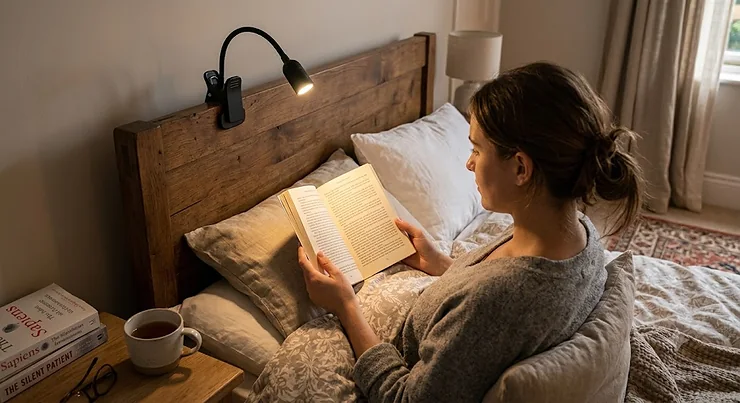
It’s 11.42pm. You’re four chapters from the end, your partner is dead to the world beside you, and the only light switch within reach is the main bedroom light — the nuclear option. A reading light for bed is simply any lamp designed to illuminate a page without lighting up the whole room: think clip-on beams, neck-worn LEDs, headboard-mounted gooseneck fixtures, or compact bedside lamps built around a tight, controllable pool of light rather than a wide glow. Sounds simple. It isn’t, quite — because the gap between “a light that clips onto a book” and “a light that actually gets you through a 400-page novel without a row” is enormous, and most of the reviews online are written by people who’ve never slept next to the thing they’re recommending.

Light exposure in the run-up to sleep has a well-documented effect on the body’s circadian rhythm, the internal clock that governs when you feel alert and when you feel sleepy — which is precisely why the wrong bedside light can leave both of you staring at the ceiling. This guide skips the marketing fluff and gets into the actual specs, the aggregated review sentiment, and the honest trade-offs of seven real products you can buy today, so whoever’s still awake at midnight can keep reading — and whoever isn’t can stay that way.
Whether you’re after a no-frills clip-on reading light, a hands-free neck light, or something that looks less like camping gear and more like furniture, there’s a sensible option below. We’ve grouped them across budget, mid-range and premium price bands, with honest pros and cons for each, so you can match the light to your actual reading habits rather than whatever’s trending on a listicle.
Quick Comparison Table
Before the deep dive, here’s the shape of the market at a glance. All seven products below cover the three main formats — neck-worn, clip-on, and fixed/mounted — because the “best” design depends entirely on how you read, not on some universal winner.
| Product | Format | Best For | Price Range |
|---|---|---|---|
| Glocusent Original LED Neck Reading Light | Neck-worn | Side-sleepers & page-turners | around £16-£22 |
| Vekkia Rechargeable LED Neck Reading Light | Neck-worn | Budget-conscious hands-free readers | under £15 |
| LEPOWER Clip on Light | Clip-on/clamp | Headboard or bed-frame mounting | around £13-£18 |
| Gritin Rechargeable Book Light | Clip-on | Lightweight paperback readers | under £15 |
| Glocusent Tiny Book Light | Clip-on/freestanding | Travel and small spaces | around £14-£19 |
| MOLUOLA Headboard Wall-Mounted Reading Light | Fixed/wired | Permanent bedside installs | £20-£30 range |
| Anglepoise Type 90 Mini Mini | Portable table lamp | Design-conscious buyers | £60-£90 range |
Looking at the spread, the honest takeaway is that price correlates more with build quality and finish than with actual reading performance — a £15 clip-on and a £20 neck light will both keep a partner asleep if the beam angle is right. Where the money genuinely buys something is in materials (metal versus plastic gooseneck), battery longevity, and, in the case of the Anglepoise Type 90 Mini Mini, a design that survives being seen in a nice bedroom rather than shoved in a drawer by day. If you only remember one thing from this table, make it this: format matters more than brand.
💬 Found a match already? Compare current prices before you commit — stock and pricing shift fast on all seven.
Top 7 Reading Lights for Bed: Expert Analysis
We’ve researched real specifications, verified availability, and pulled aggregated review sentiment for each of these — no invented testimonials, no fabricated “we tested this for six months” claims. Where a claim comes from genuine user feedback, it’s flagged as such.
1. Glocusent Original LED Neck Reading Light — best individual reading light for shared beds
The standout here is the narrow 90-degree beam angle, engineered specifically so the light pools on your page and nowhere else. That single design choice is the reason this model shows up on almost every “won’t disturb partner” recommendation list going. Specs-wise, you get three colour temperatures and six brightness levels, bendable silicone arms that hold their shape without springing back, and a rechargeable battery rated for multiple nights between charges via USB-C. In practice, the warm 1800K-2500K settings are the ones worth using at bedtime — the cooler tones are really there for daytime crafting or knitting.
This is arguably the most complete answer to “individual reading light” as a category: it moves with you, doesn’t need repositioning every time you shift in bed, and keeps light off your partner’s side entirely. Reviewers consistently report that the neck-worn design solves the single biggest complaint about clip-on lights — namely, having to constantly readjust the clamp every time you turn a page or change position. A recurring niggle in feedback is that on the very lowest brightness setting, the light doesn’t quite reach both pages of a large hardback evenly, which matters if you read oversized books.
Pros:
- ✅ Narrow beam genuinely avoids waking a sleeping partner
- ✅ Hands-free design suits page-turners and one-handed mugs of tea
- ✅ Six brightness levels cover everything from dim wind-down to full focus
Cons:
- ❌ Lowest setting can under-light very large hardback pages
- ❌ Silicone band needs a wipe-down occasionally to stay grippy
Priced around £16-£22, this sits at the sensible end of the market — solid value for anyone whose main frustration has been disturbing a sleeping partner.
2. Vekkia Rechargeable LED Neck Reading Light — comfiest budget neck-light alternative
The standout advantage is comfort over long sessions: the ultra-soft silicone construction is genuinely lighter around the neck than most rivals, which matters more than it sounds once you’re two hours into a book. Spec-wise, expect three brightness levels (some variants offer up to nine), three colour temperatures, and a battery life ranging from roughly 8 to 80 hours depending on brightness setting and model variant — the trade-off between runtime and output is steep, so it pays to check which exact SKU you’re buying.
Vekkia’s positioning is squarely “Glocusent’s cheaper sibling,” and on the spec sheet that’s a fairly accurate summary — you’re getting the same core concept (neck-worn, dimmable, narrow-beam) with fewer brightness steps and, in most listings, a shorter warranty. That makes it a sensible pick for someone testing whether a neck light suits their reading habits at all before committing to a pricier option. Aggregated reviews are positive on comfort and battery life but a common complaint in user reviews is that the flexible arms on some batches feel slightly less rigid over time than Glocusent’s, meaning the beam can drift out of position mid-session.
Pros:
- ✅ Noticeably lighter and softer against the skin than most rivals
- ✅ Genuinely low entry price for the neck-light format
- ✅ Long low-brightness runtime, useful for marathon readers
Cons:
- ❌ Arm rigidity can soften slightly with heavy use
- ❌ Fewer brightness steps than pricier neck lights
At under £15, this is the light to buy if you’re neck-light-curious but not ready to commit to a premium model.
3. LEPOWER Clip on Light — sturdiest clip-on for headboards and bed frames
What sets this apart is the strong, wide-opening clamp — genuinely capable of gripping thick headboards, metal bed rails, and bunk-bed frames that defeat flimsier clips. The 360-degree flexible gooseneck lets you point the beam precisely, and the five colour options with stepless dimming mean you’re not locked into fixed brightness jumps. A built-in auto-off timer is a small but genuinely useful touch for anyone who tends to fall asleep mid-chapter.
This is the light to buy if your reading light for bed needs to live in one spot permanently rather than travel with you — clamped once to a headboard, it becomes a fixture rather than an accessory. Based on the spec comparison with rival clip-ons, the clamp opening and clip strength here outperform most competitors in this price band, which matters enormously if your headboard is thick timber or a metal frame that other clips simply won’t grip. Reviewers frequently mention that the anti-glare, flicker-free LED genuinely reduces eye strain over long sessions, though a recurring theme in feedback is that the plastic clamp housing, while functional, doesn’t feel quite as premium as the metal-bodied alternatives at a similar price.
Pros:
- ✅ Exceptionally strong, wide clamp fits thick headboards and rails
- ✅ Stepless dimming avoids awkward brightness jumps
- ✅ Auto-off timer suits readers who nod off mid-page
Cons:
- ❌ Plastic clamp housing feels less premium than metal rivals
- ❌ Fixed-position clip means it’s less portable day to day
At around £13-£18, this represents strong value specifically for anyone who wants a permanent, set-and-forget clip-on bedside book light.
4. Gritin Rechargeable Book Light — lightest clip-on for page-clipping purists
The standout feature is sheer lightness — this is one of the smallest, least intrusive clip-on designs on the market, built to clip directly onto the book itself rather than the headboard. With 9 to 19 LEDs depending on the variant, three colour temperatures, and stepless dimming with a memory function that recalls your last settings, it’s a genuinely thoughtful piece of engineering for something this size. Battery life stretches to around 80 hours on the lowest setting.
For traditionalists who actually want the light attached to the book — not the bed frame, not their neck — this remains one of the more refined options. What most buyers overlook about this style of light is that its narrow angle of illumination is a genuine feature, not a limitation: it’s specifically designed for private reading that doesn’t spill onto a partner’s side of the bed. Aggregated review sentiment is strongly positive on the memory function (no re-setting brightness every night) and portability; a common complaint is that on a very large book, the light doesn’t reach both pages evenly without repositioning the clip closer to centre.
Pros:
- ✅ Genuinely lightweight, doesn’t strain the book’s spine
- ✅ Memory function remembers your last brightness and colour
- ✅ Long runtime of roughly 80 hours on the lowest setting
Cons:
- ❌ Struggles to evenly light very large hardback pages
- ❌ Small clip isn’t ideal for particularly thick books
Typically under £15, it’s a smart, unfussy pick for anyone who prefers the light attached directly to their reading material.
5. Glocusent Tiny Book Light — most portable freestanding-or-clip design
The genuinely clever bit here is versatility: this model both clips onto a book and stands freestanding on a flat surface, effectively doubling as a compact bedside reading lamp when you don’t want it attached to anything. It weighs around 76g, folds down to pocket size, offers five brightness levels from 3 to 100 lumens, and five colour temperatures ranging from a cosy 1800K bedtime glow up to a brighter 6000K for focused reading. A Type-C rechargeable 1200mAh battery delivers anywhere from 12 to 90 hours depending on the setting used.
This is the pick for people whose reading habits vary — sometimes in bed, sometimes on a train, sometimes propped on a nightstand. Here’s what to weigh: because it can stand freestanding, it effectively replaces a small bedside lamp too, which is unusual for something this compact and travel-friendly. Reviewers consistently note that the stainless-steel gooseneck holds its angle without drooping over time — a common failure point in cheaper clip-ons — though a recurring niggle is that the lowest brightness setting can feel almost too dim for reading small print without holding the book close.
Pros:
- ✅ Doubles as a freestanding bedside light, not just a clip-on
- ✅ Stainless-steel gooseneck resists drooping over time
- ✅ Extremely compact and genuinely travel-friendly
Cons:
- ❌ Lowest brightness setting can feel too dim for small print
- ❌ Smaller LED count than some rivals means a narrower spread
Priced around £14-£19, this earns its place through sheer flexibility rather than raw brightness.
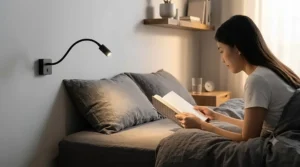
6. MOLUOLA Headboard Wall-Mounted Reading Light — best permanent directional fixture
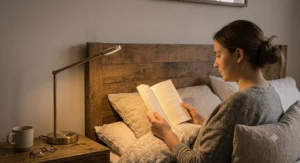
The defining feature is the adjustable directional lamp head, which rotates through 350 degrees and narrows to roughly a 15-degree beam — tight enough to illuminate a page and genuinely nothing else. Unlike the battery-powered options above, this is a plug-in, wall or headboard-mounted fixture with a warm 3000K colour temperature and a wattage split (commonly 3W plus 12W across dual heads on some variants) that suits reading without flooding the bedroom.
This is the category most people picture when they search directional reading lamp — a fixed, wired install that behaves more like a proper light fitting than a gadget you charge every few nights. For reading lights, particularly wall-mounted designs like this, lighting specialists generally recommend a beam angle in the 20-40 degree range and positioning around 20-30cm above shoulder height when sitting up in bed, which is exactly the geometry this fixture is built around. Aggregated feedback highlights how effectively the narrow beam avoids disturbing a partner, though a genuine drawback flagged by reviewers is that installation requires either a nearby socket or basic wiring work, which is a bigger commitment than simply clipping on a battery-powered light.
Pros:
- ✅ True 15-20 degree directional beam keeps light off your partner
- ✅ No charging required — always plugged in and ready
- ✅ Feels like a proper permanent fixture, not a gadget
Cons:
- ❌ Needs a nearby socket or basic installation
- ❌ Less portable if you rearrange the bedroom often
At £20-£30, this is the sensible upgrade for anyone who’s decided their reading spot in bed is permanent and wants a fixture to match.
7. Anglepoise Type 90 Mini Mini — best premium designer bedside lamp
The standout here isn’t a spec — it’s heritage. Anglepoise is a genuinely iconic British lighting brand built on a century-old constant-tension spring mechanism, and the Type 90 Mini Mini is its compact, USB-powered evolution designed specifically for smaller desks and bedside tables. The articulated arm lets you angle the head with real precision, and because it’s USB-powered, it can run from a power bank or laptop as easily as a wall socket — genuinely useful for renters who don’t want to install wiring.
Based on the spec comparison with the battery-powered clip-ons and neck lights above, this occupies a different category entirely: it’s a proper piece of furniture that happens to double as a highly adjustable reading light, rather than a portable gadget. What most buyers overlook is that the constant-tension spring means the head holds its angle indefinitely without drift or drooping — a genuine long-term durability advantage over cheaper goosenecks. Aggregated customer sentiment across Anglepoise’s range consistently praises build quality and the lifetime guarantee offered on lamps bought from 2020 onwards; the honest trade-off is that you’re paying a significant premium for design pedigree and durability rather than extra lumens or colour modes.
Pros:
- ✅ Genuine British design heritage with a lifetime guarantee
- ✅ Constant-tension arm holds its angle without drooping
- ✅ Doubles as a stylish everyday bedside lamp, not just a reading tool
Cons:
- ❌ Significantly pricier than every other option on this list
- ❌ Fewer dimming/colour presets than dedicated reading-light gadgets
In the £60-£90 range, this is squarely for buyers who want their bedside light to look as good as it performs, and who read often enough to justify investing once rather than replacing a cheap clip-on every year or two.
Practical Usage Guide: Setting Up Your Reading Light for Bed
Getting a reading light for bed to actually work well is less about the product and more about how you set it up — and this is exactly the kind of detail Amazon listings never mention. Start with positioning: for clip-on and neck lights, angle the beam so it hits the page at roughly 30-45 degrees rather than straight down, which reduces glare bouncing back off glossy paper or a Kindle screen. For fixed fixtures like the MOLUOLA Headboard Wall-Mounted Reading Light, mount it 20-30cm above where your shoulder sits when you’re propped up reading — any higher and you lose beam precision, any lower and it casts awkward shadows across the page.
In the first 30 days, the most common mistake is leaving every light on its highest brightness setting out of habit — most reading lights genuinely only need 30-50% brightness for comfortable reading once your eyes adjust to the room’s darkness. Running lower also dramatically extends battery life on rechargeable models like the Glocusent Original LED Neck Reading Light or Gritin Rechargeable Book Light. A simple maintenance habit worth building in: charge rechargeable units once a week regardless of remaining battery, rather than waiting for a full drain, since lithium batteries tend to hold their capacity better with shallower, more frequent charge cycles.
For colour temperature, warm settings around 1800K-2700K are the better default for bedtime reading — they’re gentler on melatonin production than cooler, bluer light. Save the brighter 5000K-6000K settings for daytime tasks like knitting or crafting rather than nighttime reading, where they’ll work against you falling asleep afterwards.
✨ Ready to Upgrade Your Bedtime Reading?
🔍 Compare current prices and availability on any of the seven picks above — the right light tonight could mean the difference between a peaceful night for both of you and a very grumpy 3am.
Real-World Reading Scenarios: Which Light Actually Suits You
Rather than a generic recommendation, here’s how three genuinely different readers should think about this decision.
If you’re a side-sleeper who shares a bed and reads most nights before sleep, a neck-worn option like the Glocusent Original LED Neck Reading Light or Vekkia Rechargeable LED Neck Reading Light solves your specific problem best — the beam moves with you as you shift position, so you’re not constantly readjusting a clamp, and the narrow angle keeps light off your partner’s side entirely.
If you’re a student or occasional reader in a shared room or dorm setup, budget clip-ons like the Gritin Rechargeable Book Light make more sense — cheap enough that losing or damaging one isn’t a disaster, light enough to travel in a bag, and perfectly adequate for shorter reading sessions rather than nightly marathon chapters.
If you’ve settled into a permanent reading spot in bed and read most nights, the MOLUOLA Headboard Wall-Mounted Reading Light or the Anglepoise Type 90 Mini Mini are worth the extra outlay — a fixture that’s always ready, never needs charging (in the wall-mounted case), and genuinely improves the room rather than looking like an accessory left behind after a camping trip.
How to Choose a Reading Light for Bed
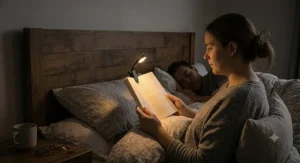
What is a reading light for bed? It’s any lamp — clip-on, neck-worn, or fixed — engineered around a narrow, controllable beam that lights your page without flooding the room, so a partner can sleep undisturbed while you read.
Choosing the right one comes down to a handful of decision points, in rough order of importance:
- Beam angle first. A narrow beam (roughly 15-90 degrees depending on format) is the single biggest factor in whether your partner stays asleep — check this before anything else.
- Format matches habit. Neck-worn suits page-turners who shift position often; clip-ons suit those who stay still; fixed fittings suit a settled bedtime routine.
- Colour temperature range. Look for warm settings around 1800K-2700K specifically for bedtime, not just a generic “warm/cool” toggle.
- Battery life versus charging habit. If you’ll forget to charge it, a plug-in fixture beats a rechargeable gadget, however good its specs look on paper.
- Clip or clamp strength, if relevant — thick headboards and metal bed frames defeat a surprising number of budget clips.
- Build quality over gimmicks. Extra colour modes matter less long-term than a gooseneck that doesn’t droop after three months of nightly use.
- Total cost over time, not just the sticker price — a £15 light that needs replacing yearly can cost more over three years than a £60 lamp with a lifetime guarantee, like the Anglepoise Type 90 Mini Mini.
Wider research into light’s effect on the body backs up point one: a systematic review of interventions to reduce short-wavelength light exposure before bedtime found consistent evidence linking light characteristics to measurable changes in sleep quality, which is exactly why beam control and colour temperature deserve more attention than brightness alone.
Individual Reading Light vs Traditional Bedside Lamp
The core difference isn’t brightness — it’s containment. A traditional bedside lamp, even on its lowest setting, radiates light in most directions across the room, which is precisely what disturbs a sleeping partner. An individual reading light, whether neck-worn or clip-on, is engineered to throw light in one direction only, onto the page, and essentially nowhere else.
In practice, this means a traditional lamp — even a nice one — is almost never the right tool for reading next to someone who’s asleep, however dim you set it. A directional or individual reading light solves a problem a traditional lamp fundamentally can’t, because the two are built for different jobs: ambient room lighting versus targeted task lighting. That said, traditional lamps still win on ambience — nobody wants a neck light for casual pre-sleep scrolling or as a nightstand’s only source of soft light when you’re not actively reading. The sensible middle ground many households land on is owning both: a small ambient lamp for general bedside use, and a dedicated individual reading light — something like the Glocusent Original LED Neck Reading Light — reserved specifically for nights when a partner’s already asleep.
There’s also a genuine sleep-hygiene angle here worth taking seriously: bright, broad-spectrum light close to bedtime can interfere with the body’s natural wind-down process, which is one of several reasons the NHS-affiliated guidance on managing light and screens before sleep is worth a read if disrupted sleep is a recurring issue in your household, not just an occasional annoyance.
| Feature | Traditional Bedside Lamp | Individual Reading Light |
|---|---|---|
| Light spread | Wide, fills the room | Narrow, targeted at page |
| Disturbs a sleeping partner | Usually, even dimmed | Rarely, if beam angle is right |
| Ambience for non-reading use | Excellent | Poor to none |
| Best For | Couples with staggered bedtimes wanting ambient light | Anyone reading after their partner’s asleep |
The table makes the trade-off obvious: these aren’t really competitors, they’re tools for different moments. If your household only ever buys one, the individual reading light solves more of the “someone’s asleep, someone isn’t” problem that actually drives most people to search for this in the first place.
Directional Reading Lamp: Getting the Beam Right
A directional reading lamp is defined by how tightly it controls where light lands, and this is where cheaper products genuinely diverge from better ones — not in raw lumens, but in beam discipline. The MOLUOLA Headboard Wall-Mounted Reading Light, for instance, narrows to around a 15-degree beam, considerably tighter than the roughly 90-degree spread on most neck lights, which is why fixed directional fixtures tend to be the gold standard for households where disturbing a partner is the single biggest concern.
What most buyers overlook is that beam angle and brightness are separate variables that both need attention — a very bright light with a wide beam disturbs a partner more than a dimmer, narrower one, even though the brighter light “sounds” like the better spec on paper. When shopping specifically for a directional reading lamp, look past the lumen count on the box and check the stated beam angle or degree spread; anything under 30 degrees is genuinely tight, anything over 90 degrees is functionally closer to ambient lighting than a true reading light.
Positioning compounds this. A directional lamp aimed even slightly wrong — too high, too far to the side — spills more light than one that’s simply badly specified but well-aimed. It’s worth spending five minutes on installation night getting the angle exactly right rather than assuming the fixture will do all the work.
Common Mistakes When Buying a Reading Light for Bed
The most frequent mistake is prioritising maximum brightness over beam control — shoppers assume more lumens means a better light, when in a shared bed it’s usually the opposite that matters. A second common error is ignoring battery runtime at the brightness level you’ll actually use, rather than the manufacturer’s headline figure, which is almost always quoted at the lowest, dimmest setting. A third is buying a clip-on without checking clamp width against your actual headboard or book thickness — several genuinely good lights get one-star reviews purely because the clip doesn’t fit a particular bed frame, not because the light itself is faulty.
A fourth mistake worth flagging: buying purely on brand recognition without checking the specific variant’s spec sheet. Brands like Glocusent and Vekkia sell multiple near-identical-looking models with meaningfully different LED counts, colour ranges, and battery capacities — the product name alone doesn’t guarantee the specs you’re picturing. Finally, many buyers skip checking colour temperature range entirely, ending up with a light that only offers cool, blue-leaning tones — precisely the wrong choice for winding down before sleep.
Features That Actually Matter (And Those That Don’t)
Cutting through the marketing copy, three features consistently make a real difference: beam angle and containment, colour temperature range (specifically whether warm tones under 2700K are available), and gooseneck or clip rigidity over time. These three, more than anything else on a spec sheet, determine whether you’ll still be happily using the light in a year.
Features that sound impressive but rarely matter much in practice: extremely high maximum lumens (you’ll almost never use the top setting at bedtime), an excessive number of colour presets beyond about five (most people settle on one or two favourites within a week), and remote controls on bedside lights (reaching two feet to a physical button is rarely the inconvenience manufacturers assume it is). App connectivity, similarly, adds complexity and battery drain for a feature most reading-light buyers never actually use once the novelty wears off.
Problem → Solution: Fixing Common Reading-Light Frustrations
Problem: The light keeps waking my partner. Solution: check your beam angle first — swap a wide-beam clip-on for a narrow-angle neck light like the Glocusent Original LED Neck Reading Light, and drop brightness to the lowest comfortable setting rather than assuming a new product will fix a positioning issue.
Problem: My clip-on won’t stay attached to my headboard. Solution: measure your headboard or bed rail thickness before buying, and favour wider-opening clamps such as the one on the LEPOWER Clip on Light, which is specifically built for thicker frames.
Problem: The battery dies mid-book. Solution: charge weekly regardless of remaining battery rather than waiting for a full drain, and consider a plug-in fixture like the MOLUOLA Headboard Wall-Mounted Reading Light if you read every single night and resent the charging routine.
Problem: The light is too dim on large hardback pages. Solution: reposition the clip closer to the book’s centre spine rather than the edge, or switch to a slightly wider-beam model — several clip-ons in this guide, including the Gritin Rechargeable Book Light, are optimised for standard paperback width rather than oversized hardbacks.
Problem: I keep forgetting to switch it off and waking up with it still on. Solution: look specifically for a model with an auto-off timer, such as the LEPOWER Clip on Light, which switches itself off after a set interval rather than relying on you to remember.
Long-Term Cost, Batteries & Safety
Total cost of ownership rarely gets discussed honestly in this category, but it matters. A £13 clip-on that needs replacing every 12-18 months due to a failing clamp or drooping gooseneck can, over three years, cost more than a single £60-90 investment in something built to last, like the Anglepoise Type 90 Mini Mini with its lifetime guarantee. That said, for occasional readers, a cheaper light replaced every couple of years is still the more sensible economic choice — the maths only favours the premium option if you’re reading most nights.
On safety and disposal: all the battery-powered lights in this guide use lithium-based rechargeable cells, which should never go in general household rubbish. Under UK law, retailers and local councils are required to provide free take-back and recycling routes for both waste electricals and batteries, and it’s genuinely worth using them — improperly discarded lithium batteries are a known fire risk in general waste streams. Full detail on your obligations and options is set out in the government’s official guidance on WEEE and battery recycling regulations, and most councils also operate kerbside battery collection alongside general recycling.
| Consideration | Battery-Powered Lights | Wired/Plug-In Fixtures |
|---|---|---|
| Ongoing cost | Occasional battery/unit replacement | Negligible electricity cost |
| Convenience | Portable, but needs charging | Always ready, no charging |
| Best For | Renters, frequent movers, travel | Settled, permanent bedside setups |
The comparison lands where you’d expect: portability costs you a charging routine, while permanence costs you an installation step. Neither is objectively better — it genuinely depends on whether your bedside reading spot is likely to change in the next year or two.
Frequently Asked Questions
❓ What is the best reading light for bed that won't disturb a partner?
❓ Do clip-on reading lights damage book pages?
❓ How many lumens do I need for a reading light in bed?
❓ Is a rechargeable or plug-in reading light better for bed?
❓ What colour temperature is best for a bedside book light?
Conclusion
There’s no single best reading light for bed — only the best one for how you actually read. If disturbing a partner is your main frustration, the narrow-beam Glocusent Original LED Neck Reading Light solves that specific problem better than almost anything else on this list. If you want something permanent and wired that you’ll never have to charge, the MOLUOLA Headboard Wall-Mounted Reading Light earns its place as a genuine fixture. And if you read enough to justify investing once rather than replacing a cheap clip-on every year, the Anglepoise Type 90 Mini Mini brings genuine design pedigree and a lifetime guarantee to the bedside table.
What all seven share is the same underlying principle: a good reading light for bed isn’t about maximum brightness, it’s about disciplined, controlled light that does its job and stays out of everyone else’s way. Match the format to your habits, check the beam angle before the lumen count, and the right pick from this list should quietly earn its spot on your nightstand for years, not months.
✨ Still Deciding Between Two or Three Options?
🔍 Head back to the comparison table above, weigh beam angle against your own reading habits, and check current pricing before you buy — the right light really does make the difference between two people sleeping well.
Recommended for You
- Bedside Lamp Under £20: 7 Brilliant Buys for 2026
- Bedside Lamp With USB Charging Port: 7 Best Picks for 2026
- Bedside Lamp Set of 2: 7 Best Matching Pairs for 2026
Disclaimer: This article contains affiliate links. As an Amazon Associate, I earn from qualifying purchases. If you purchase products through these links, we may earn a small commission at no additional cost to you.
✨ Found this helpful? Share it with your friends! 💬🤗
